On Shashi Tharoor, the West, and the Indian Complex about Foreign Validation
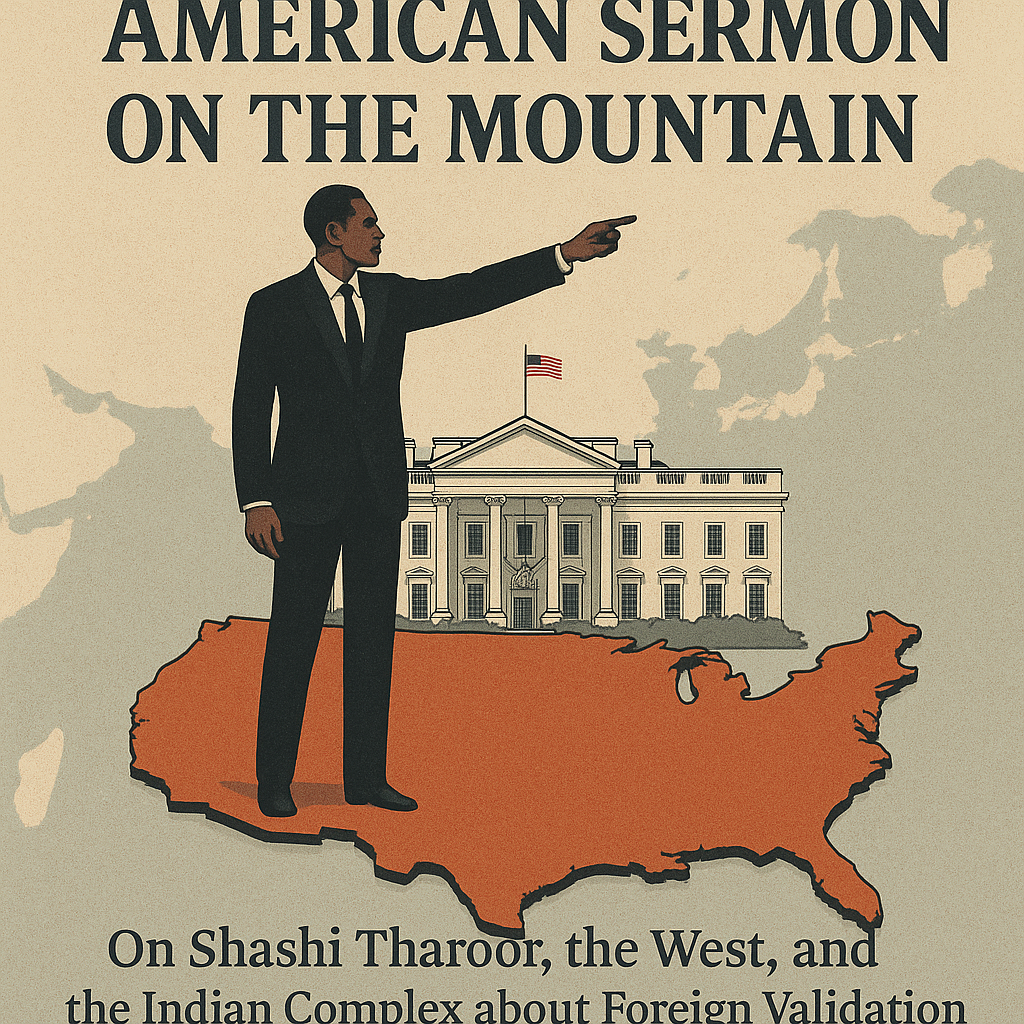
Introduction:
Why does critique feel more credible when it comes from the West? In this piece, I explore Shashi Tharoor’s reflections on Obama’s moral messaging to India—and what it reveals about our enduring colonial hangover, our craving for foreign validation, and the double standards we quietly tolerate.
Among contemporary Indian politicians, Dr. Shashi Tharoor stands out as a rare leader who possesses deep insight into both national and international policy and diplomacy. While there may be a few others like him, there’s no need to compare him with anyone else—he is distinguished in his own right. Having served as Under-Secretary-General at the UN and even contested for the post of UN Secretary-General, Tharoor understands better than most how the West, particularly the United States, excels in preaching human rights to others while often failing to uphold the same within their own borders.
The West has become notorious for crafting various indices—be it on democracy, human rights, or development—using criteria that are self-serving and ensure their dominance at the top. These indices are often projected as neutral and universal, but in truth, they reflect Western priorities and perspectives.
Many voices, especially from the Global South, have already exposed the West’s double standards and hypocrisy in areas such as democracy, human rights, and environmental policies. Today, we are no longer convinced by Western moral lectures. They rarely come across as genuine criticism or concern, and often feel patronizing. Thankfully, even Tharoor himself seems to acknowledge this paradox when he writes:
“Of course Indians don’t need an American visitor to tell them to uphold the ideal of freedom of religion, when our history is one of coexistence, the acceptance of religious diversity is deeply embedded in our culture and our Constitution reflects our pluralism. It’s a great pity that a foreign leader is obliged to recognize that some Indians do not share the values on which India is built and which are refined in our Constitution…”
— Tharoor, commenting on Barack Obama’s indirect critique of Modi during his December 2017 visit to India (p. 267–268)
This is the irony. On one hand, Shashi Tharoor rightly asserts that Indians do not need foreigners to remind them of the values enshrined in their Constitution. On the other, he expresses regret that a foreign leader had to highlight how some Indian leaders—particularly from the BJP—fail to uphold those very values. For instance, Tharoor writes:
0″But for the first time, India has elected a prime minister who was himself named for ‘severe violations of religious freedom’ in reports by the US State Department from 2002 onwards, refused an American visa and was banned from entering the United States before he became prime minister. Mr. Modi wasn’t elected PM for condoning violence against minorities, but to fulfil an aspirational development vision he effectively articulated. Mr. Obama’s speech was a way of telling him he can’t do that without abandoning his old religious intolerance that earned him those American strictures.” – Shashi Tharoor, Why I am a Hindu, New Delhi, Alph Book Company, 2019, p. 268 [See Appendix for the full excerpt.]
So what options does the U.S. have in such a scenario? Should it refuse to engage with a democratically elected leader who was once denied a visa? Can the U.S. dictate that unless Indians elect someone who meets their standards of human rights, they will sever all ties and refuse diplomatic engagement? If America were truly serious about being the world’s moral police, it would have taken such a stand. But Washington knows full well that this isn’t feasible—especially given India’s demographics and its strategic importance in counterbalancing China.
What else can an American President do when faced with the awkward and unavoidable reality of not only allowing entry to someone once banned from U.S. soil, but also being compelled to engage with him on equal diplomatic footing? To preserve America’s moral posture—and perhaps to offer consolation to secular voices like Tharoor—President Obama had to deliver yet another Sermon on the Mount, this time from Indian soil.
Tharoor is well aware of this—and yet he still insists that Modi should abandon what he characterizes as “religious intolerance” and heed Obama’s advice to avoid future American censure. But what about Obama himself—the first African American president? Was he able to end racial violence or uphold human rights according to America’s own high standards? How many human rights violations occurred under his leadership?
And yet, Tharoor tells us that when Obama comes and lectures Modi, the Indian PM should comply to escape American disapproval. This isn’t just a case of the devil quoting scripture—it’s more like the devil rebuking God for not living up to his standards and expecting God to change. Of course, I’m not claiming Modi is God—but at least in other cases, the devil merely quoted the Bible. When it comes to India—and especially those with ideological views different from the West—it seems even God must follow the devil’s standards to avoid his judgment.
As an Indian, Tharoor absolutely has the right to critique his fellow citizens and leaders. But why rely on the words of a foreign dignitary—especially one from a country still grappling with racial injustice, religious intolerance, and imperial baggage? Would any U.S. president tolerate such a lecture from a Third World leader pointing out America’s own moral failings?
This reflects a deeper problem—a colonial mindset still haunting many Indians. If a value, product, or person is validated by someone from the West, especially a white Westerner, then it gains unquestionable prestige. Whether it’s foreign jobs, clothes, money, or even spouses, anything “foreign”—and particularly “American”—is seen as inherently superior. It becomes a mark of status and pride.
Our national poet Bharathiyar rightly said:
“Thousands of divisions exist among us,
But how is it justified for outsiders to divide us further?
Brothers may quarrel,
But they are still children of the same mother.”
Brilliant as he is in English and international affairs, Dr. Tharoor—and many like him—could benefit from revisiting such native wisdom. In today’s globalized world, mutual critique is unavoidable, and even helpful when offered sincerely. No country is perfect, and constructive criticism should not be discouraged. But when Indians choose to amplify the West’s critiques over our own scholars, leaders, and saints, it reflects a lack of self-respect and confidence in our own moral compass.
This tendency isn’t limited to Tharoor. Many self-proclaimed secularists and public intellectuals are similarly inclined. I have pointed this out elsewhere, and the same applies here. [See: https://dayanandbharati.in/half-full-or-half-empty-assessing-nehrus-legacy/]
Conclusion
The integrity of any democracy rests not only on its capacity for introspection but also on the honesty of those who critique it. When thinkers like Shashi Tharoor or Mukherjee selectively apply frameworks—drawing from liberal values in one breath and Western indexes in the next—they risk reinforcing a narrative that treats India’s civilizational ethos as either irrelevant or inherently suspect. This is not to deny the presence of real challenges—rising majoritarianism, erosion of institutions, and concerns around civil liberties—but to insist that these cannot be addressed through borrowed lenses or colonial yardsticks.
We must ask: is it truly introspection when critique is filtered through agencies that display their own geopolitical and moral biases? Is it intellectual honesty to applaud Western models of democracy while ignoring their hypocrisies, as seen in the selective applications of international law? To improve as a nation, India must be held accountable—but by standards that are fair, rooted in its own constitutional promises, and free of inherited inferiority.
Criticism must never be silenced—but it must also never be sanctified merely because it comes wrapped in Western packaging. We need a discourse that holds power accountable without becoming a proxy for cultural self-doubt. Only then can we move toward a truly Indian model of pluralism and democracy—one that neither imitates the West uncritically nor excuses its own flaws blindly.
Ashram, May 4, 2025
Appendix
Chapter seventeen: Taking Back Hinduism. Pp. 266-268
If Hindutva is resisted by the vast majority of liberal Hindus, it is hardly paradoxical to suggest that Hinduism, India’s ancient homegrown faith, can help strengthen Indianness in ways that the proponents of Hindutva have not understood. In one sense Hinduism is almost the ideal faith for the twenty-first century: a faith without apostasy, where there are no heretics to cast out because there has never been any such thing as a Hindu heresy. A faith that is eclectic and non-doctrinaire, responds ideally to the incertitudes of a post-modern world.
So it was hard for a Hindu, proud of his faith’s and his country’s liberal traditions, not to be mortified, in 2015, when the visiting US President, Barack Obama, felt obliged to deliver a speech in New Delhi urging the government to live up to India’s own values and did it again in a post-Presidential visit in 2017.
‘India will succeed so long as it is not split along the lines of religious faith, Mr Obama said in 2015 in an implicit rebuke to the Hindutva brigades. The president was, of course, polite, couching his praise of religious diversity as a mutual strength of both India and the US, and speaking of his own challenges as a politician with the middle name of Hussein in a country increasingly hostile to Muslims. Many Obama critics in the US had alleged that he is a Muslims, not a Christian, the President acknowledged. ‘There have been times when my faith has been questioned by people who don’t know me…they said that I adhered to a different religion, as if that were somehow a bad thing,’ he said. {Suhasini Haider, ‘India will succeed if it is not splintered along religious lines: Barack Obama’, The Hindu, 28 January 2015.} (p.266)
The president could hardly have been unaware, of course, that India’s Hindutva-leaning prime minister had had a long track record of implying that belonging to a different religion than his own is indeed a bad thing—and that he depends for his political success on the support of people who have variously wanted all non-Hindus to convert ‘back to the mother faith or be driven out of the country. And he did it again on a visit to New Delhi in December 2017: ‘A country shouldn’t be divided into sectarian lines and that is something I have told Prime Minister Modi in person as well as to people in America, Obama declared. ‘For a country like India where there is a Muslim population that is successful, integrated and considers itself as Indian, which is not the case in some other countries, this should be nourished and cultivated.’
Obama’s message on both occasions was pointed: if India did not resolve the problems of bigotry that were dividing the country, Mr Modi’s proclaimed ambitious development plans would be thwarted. It was a message many of us in the political Opposition had also been giving Mr Modi and his colleagues. But coming from a US president, whose visit was being hailed by the government as a diplomatic triumph and whose ‘bromance’ with the Indian PM had seen first names being used and much friendly banter, it was a pointed reminder of the fundamental contradiction at the heart of Mr Modi’s regime.
As I had spelt out in my 2014 book India Shastra, Mr Modi’s speeches and rhetoric appeared to recognize, and harness, a vital shift in our national politics from a politics of identity to a politics of performance; yet he had risen to power at the helm of a party, the BJP, which is ill-suited to the challenge of delinking India’s polity from the incendiary issue of religious identity on which it had built its base.
Of course Indians don’t need an American visitor to tell them to uphold the ideal of freedom of religion, when our history is one of coexistence, the acceptance of religious diversity is deeply embedded in our culture and our Constitution reflects (p. 267) our pluralism. It’s a great pity that a foreign leader is obliged to recognize that some Indians do not share the values on which India is built and which are refined in our Constitution. As I have long argued, Indian democracy is all about the management of diversity, and if we don’t respect our diversity we will no longer be the India that Mahatma Gandhi fought to free.
But for the first time, India has elected a prime minister who was himself named for ‘severe violations of religious freedom’ in reports by the US State Department from 2002 onwards, refused an American visa and was banned from entering the United States before he became prime minister. Mr Modi wasn’t elected PM for condoning violence against minorities, but to fulfil an aspirational development vision he effectively articulated. Mr Obama’s speech was a way of telling him he can’t do that without abandoning his old religious intolerance that earned him those American strictures.
The problem is that the dominant strand in the ruling party cares much more about asserting Hindu chauvinism than it does about the economic reforms and investments that Mr Modi trumpeted-and which won him the support of voters who did not share his ‘Hindutva’ agenda. A party dependent on people who urge Hindu women to have four children-‘no, ten!’, as the Shankaracharya of Badrikashram said-not only shows profound disrespect to Hindu women. { Sandeep Joshi, ‘Hindu women should have 10 children: Shankaracharya’, The Hindu, 19 January 2015.} (who have to endure the labour to fulfil the Hindutva brigade’s political fantasies) but proves itself out of touch with the real values and priorities of the Hindu masses in whose name it claims to speak.
The fact remains that the Modi regime has given free rein to the most retrograde elements in Indian society, who are busy rewriting textbooks to glorify Hindu leaders, extolling the virtues of ancient science over modern technology, beating the drums over ‘love jihad’, extolling ghar wapsi, and asserting that India’s identity must be purely Hindu. Majoritarian communalism, as (p. 268) Nehru had long recognized, is a fundamental threat to our pluralist democracy. But throughout his life as an RSS Pracharak, Modi has devoted himself to the very worldview that is undermining India’s harmony.—pp. 266-268
Leave a Reply