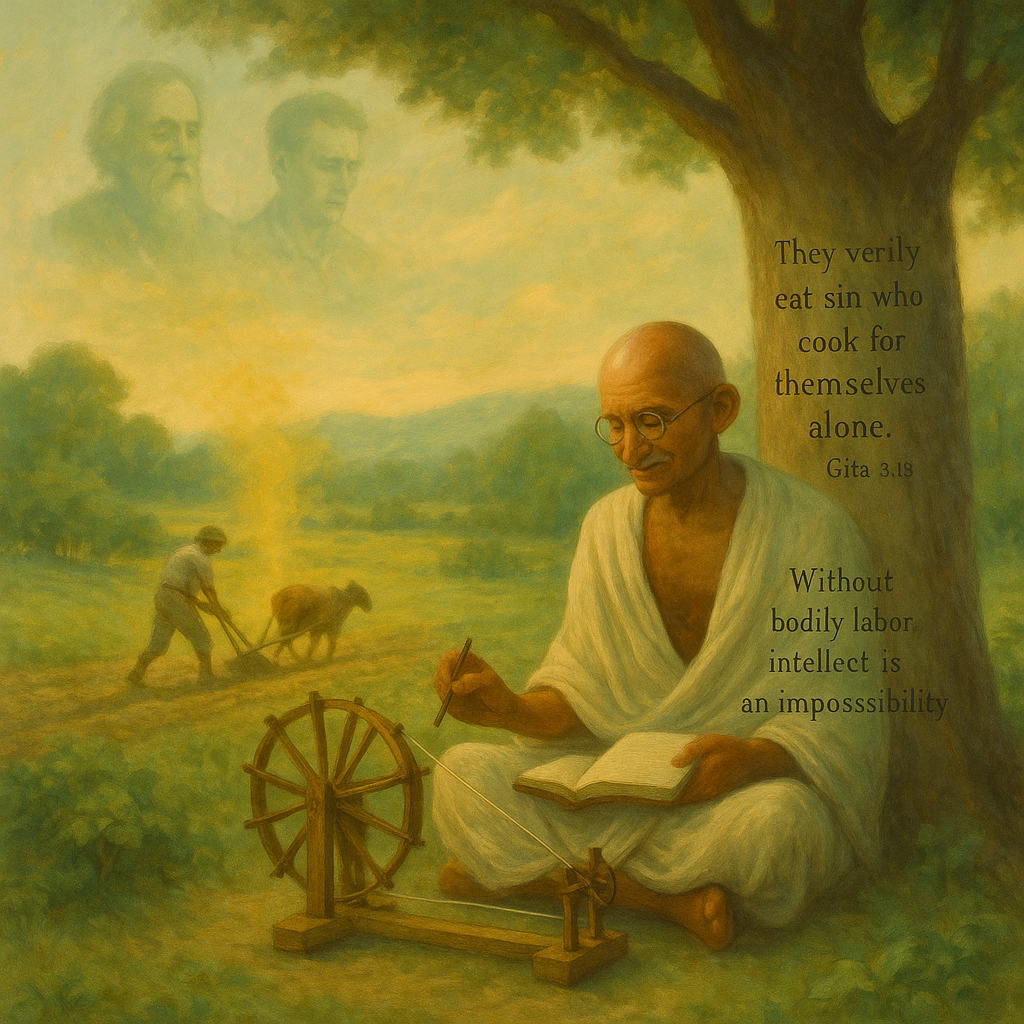
The only word that came to my mind after reading Mahatmaji’s exegesis on Gita 3:11–12 was: Wow. What a great and practical exegete he was! Although I myself have quoted these verses to stress the principle of not cooking food solely for oneself [Others, who cook food for their own enjoyment, verily eat only sin. [भुञ्जते ते त्वघं पापा ये पचन्त्यात्मकारणात्, 3:13b. see notes for 3:11 to 14], I had never considered the broader context of this passage, as highlighted by the vigilant friend who corresponded with Mahatmaji.
Interestingly, I had never come across either the friend’s two critiques or Mahatmaji’s response in any other source. This exchange reveals something profound: that many Hindus, like Mahatmaji, read their scriptures not merely for spiritual or ritual use, but also with a desire for deep understanding—employing proper exegetical methods. This is a valuable lesson for anyone wanting to learn how to interpret scripture meaningfully. And it also offers a glimpse into what kind of person Mahatmaji truly was. What an Acharya indeed!
I also appreciate how Mahatmaji maintains a thoughtful balance between the value of intellectual labour and physical work. While he does give a slight edge to intellectual effort, he clearly affirms that “without physical labour, intellect would be an impossibility.”
This reminds me of several debates about whether intellectual or physical labour is greater. Personally, I feel that even attempting to compare the two may be misguided—each belongs to its own domain. Yet, since life doesn’t operate in neat, watertight compartments, I would still cast my vote in favour of physical labour. After all, buddhi (intellect) itself depends on a healthy body to function. We often say that the ātman has a body to dwell in, not that the body possesses an ātman—and while our philosophy asserts that the ātman exists independent of the body, we cannot say the same of buddhi. In fact, much of philosophy arises from questions rooted in the physical world—first reaching outward, then turning inward to inquire into the very reason for its existence.
It is interesting to read what Amartya Sen has written about the disagreement between Tagore and Mahatmaji on this matter. Initially sceptical of Gandhiji’s emphasis on physical labour—especially his advocacy of the charkha—Sen later came to appreciate that there might be more behind Gandhiji’s views than mere sentiment. He came to see the Gandhian practice of manual labour as a meaningful expression of solidarity with the underprivileged—a way of acknowledging togetherness with the underdogs of society. Sen even draws a surprising parallel with Wittgenstein’s desire to live like a manual labourer. Though he remains somewhat sceptical, Sen admits that his earlier dismissal of Gandhiji’s position was naïve and that there may have been deeper ethical or philosophical reasoning at play. (See Appendix for the full excerpts from Sen.)
Now, though Mahatmaji did mention developing forests as part of our physical labour to bring rain, he also cautioned: “Laws of nature are still unexplored. We have but scratched the surface. Who knows all the ill effects, moral and physical, of the cessation of bodily labour?” (p. 339). This observation, read today, feels prophetic. The moral of manual labour, once viewed perhaps only as ethical discipline, now finds scientific support: rapid deforestation has indeed led to erratic and extreme climate events—droughts on one side and devastating floods on the other. This makes agricultural labour today a Himalayan task. If we cannot contribute to nature by actively planting trees or preserving forests, we can still contribute by not cutting more and more trees out of greed. In that sense, even abstaining from certain physical acts—such as unnecessary deforestation—can become a meaningful ethical contribution. This too aligns with Mahatmaji’s vision: that manual labour, in whatever form, should serve the common good, and that even individual intellect can find creative and moral ways to participate in that shared purpose.
Ashram, May 8, 2025
185. NOTES
Necessity of Bodily Labour
A vigilant friend writes:
In your address to the Jamshedpur gathering published in Young
India of the 20th August, 1 in the first paragraph, after stressing the
(p.338) importance of bodily labour above intellectual, you are reported to have said: “The same thought runs throughout Hindu religion. ‘He who eats without labour eats sin, is verily a thief.’ This is the literal meaning
of a verse in the Bhagavad Gita.” Now, the question apart whether the Gita makes any such distinction between (so-called) manual and (so-called) intellectual labour, I can say that the only passage in the Gita which could conceivably be taken to mean what (according to the report) you have said a verse in the Gita literally means is the passage, Ch. Ill, verses 12 & 13; so that in the first place it is not a verse but two, which
have been requisitioned in support of your view of “labour”, and secondly
there is no mention of “labour”, manual or other, in either of those verses; but in the first verse there is mentioned, by way of explanation of the duty of yajna, man’s partaking with or dedicating to the higher powers what they have bestowed upon him — failing in which “he is verily a thief”, — and in the second verse we are told that “they eat sin who cook for themselves alone.” So that is pretty far removed from “the literal sense of a verse” in the Gita as you are reported to have given it in your own paper by M.D. {Mahadev Desai, personal secretary to Mahatmaji} I hope you will make a note of it at your convenience.
{Mahatmaji’s response:}
Technically speaking the writer is correct in saying that the translation given by M. D. is not of one verse but a combination of parts of two verses, and I am thankful to the writer for the accuracy of his correction. But the substance of his argument seems to me to be that there is no warrant for the translation given in the report of my speech of the famous word yajna in the Gita.
But I propose to stand by that translation and venture to suggest that in the verses 12 & 13 of Chapter III quoted by the writer the word is capable of only one meaning. The fourteenth verse makes it absolutely clear which means:
By food the living live; food comes of rain,
And rain comes by the pious sacrifice,
And sacrifice is paid with tithes of toil.
— Arnold
Here therefore there is not only the theory, in my opinion, of bodily labour propounded, but there is also the theory established of labour not only for oneself but for others, when and when only it becomes yajna or sacrifice. The rains come not through intellectual feats, but through sheer bodily labour. It is a well-established scientific fact that where forests are denuded of trees rains cease, where trees are planted rains are attracted and the volume of water received increases with the increase of vegetation. Laws of nature are still unexplored. We have but (p.339) scratched the surface. Who knows all the ill effects, moral and physical, of the cessation of bodily labour? Let me not be misunderstood. I do not discount the value of intellectual labour, but no amount of it is any compensation for bodily labour which every one of us is born to give for the common good of all. It may be, often is, infinitely superior to bodily labour, but it never is or can be a substitute for it, even as intellectual food, though far superior to the grains we eat, never can be a substitute for them. Indeed without the products of the earth those of the intellect would be an impossibility.—p. 340
— Young India, 15-10-1925, CWMG, Vol. 28
Notes
देवान्भावयतानेन ते देवा भावयन्तु व: |
परस्परं भावयन्त: श्रेय: परमवाप्स्यथ || 11||
devān bhāvayatānena te devā bhāvayantu vaḥ
parasparaṁ bhāvayantaḥ śhreyaḥ param avāpsyatha
BG 3.11: By your sacrifices, the celestial gods will be pleased, and by cooperation between humans and the celestial gods, great prosperity will reign for all.
इष्टान्भोगान्हि वो देवा दास्यन्ते यज्ञभाविता: |
तैर्दत्तानप्रदायैभ्यो यो भुङ्क्ते स्तेन एव स: || 12||
iṣhṭān bhogān hi vo devā dāsyante yajña-bhāvitāḥ
tair dattān apradāyaibhyo yo bhuṅkte stena eva saḥ
Translation
BG 3.12: The celestial gods, being satisfied by the performance of sacrifice, will grant you all the desired necessities of life. But those who enjoy what is given to them, without making offerings in return, are verily thieves.
यज्ञशिष्टाशिन: सन्तो मुच्यन्ते सर्वकिल्बिषै: |
भुञ्जते ते त्वघं पापा ये पचन्त्यात्मकारणात् || 13||
yajña-śhiṣhṭāśhinaḥ santo muchyante sarva-kilbiṣhaiḥ
bhuñjate te tvaghaṁ pāpā ye pachantyātma-kāraṇāt
Translation
BG 3.13: The spiritually-minded, who eat food that is first offered in sacrifice, are released from all kinds of sin. Others, who cook food for their own enjoyment, verily eat only sin.
अन्नाद्भवन्ति भूतानि पर्जन्यादन्नसम्भव: |
यज्ञाद्भवति पर्जन्यो यज्ञ: कर्मसमुद्भव: || 14||
annād bhavanti bhūtāni parjanyād anna-sambhavaḥ
yajñād bhavati parjanyo yajñaḥ karma-samudbhavaḥ
Translation
BG 3.14: All living beings subsist on food, and food is produced by rains. Rains come from the performance of sacrifice, and sacrifice is produced by the performance of prescribed duties.
Appendix
Amartya Sen, Home in the Word: A memoir, UK, Penguin Random House, 2021
It is indeed possible that we were, in our youthful way, being unfair to Gandhiji – and Rabindranath might have been too. Performing the same tasks that manual labourers constantly do may have had, for Gandhiji, the virtue of acknowledging a togetherness with the underdogs of society, which could be important. The thought of togetherness— the sentiment of being ‘with’ others less fortunate than us – can certainly have a wide resonance. I was surprised – but also very interested – when I found later (after I arrived at Trinity College, Cambridge) how deeply preoccupied Ludwig Wittgenstein had been in wanting to follow the lifestyle of manual labourers. He talked about this a lot, in particular with his friend (and, later, my teacher) Piero Sraffa
Later, too, I realized that my initial thought—that Gandhiji was just confusing the demands of reasoned choice with some kind of unreasoned romance of hypothetical closeness to the underdogs of society – was much too naïve. As I grew older, I began to think that there was much more to the difference between the two [Tagore and Gandhi] leaders of thought in India (p. 83) and I was frustrated that I could not really pin down exactly what gave the Gandhian position the force it evidently had. Even though I continued to remain deeply sceptical of the sentimental priority that Gandhiji and Wittgenstein apparently shared, I began to allow serious doubts about my earlier belief that there was no argument on Gandhi’s side at all.—pp. 83-84
Was Rabindranath too highly focused on the priority he gave to reasoning and freedom? Certainly, his unwillingness to give serious consideration to Gandhiji in the world of rational arguments was based on his presumption that Gandhiji was simply ignoring critical reasoning (the acknowledgement of Gandhiji’s ‘greatness’ could not rub away that strong indictment). But if he was advocating the complete precedence of reason, it is hard to understand how and why he appeared to many discerning observers in Europe and America as being the exact opposite: an advocate of blind faith with a penchant for mystification, rather than clarity. How can we understand this odd reversal in understanding Tagore?
…Tagore’s alleged mysticism and rejection of reasoning were among the most common grounds of criticism, combined with a perceived lack of literary merit in his writings….. (p.86)
…Rusell was even sharper in his denunciation of what he took to be Tagore’s aversion to reason….:
His talk about the infinite is vague nonsense. The sort of language admired by many Indians unfortunately does not, in fact, mean anything at all.—pp. 86-87
Leave a Reply