“Pope Was a Communist”?
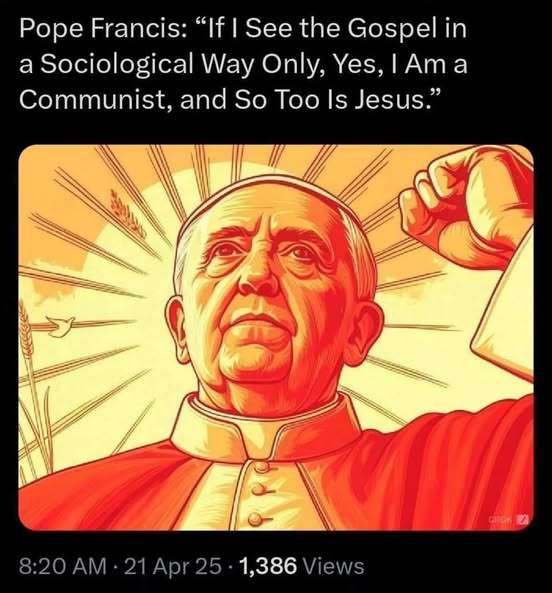
After the passing of Pope Francis, I came across a message from a well-known Communist thinker. He didn’t offer any commentary or personal opinion. Instead, he simply quoted the Pope’s own words:
“If one sees the Gospel in a sociological way only, yes—I am a Communist, and so too is Jesus.” —
On the surface, it seems like a harmless quote. But timing and selectivity matter. The quote was shared after the Pope’s death, and it was presented without any context. That silence speaks volumes. When someone lifts a powerful statement out of its original setting—especially one made by a widely respected spiritual figure—and shares it in isolation, it subtly nudges readers to draw a specific conclusion. In this case, the conclusion is political: the suggestion that Pope Francis (and even Jesus) align with Communist ideology.
This is a classic example of ideological framing through selective quoting. It is far too easy—especially after someone is gone and cannot speak for themselves—to extract a single statement from its broader theological, spiritual, or pastoral context and repackage it to serve one’s own narrative. Such moves may look clever, but they are neither respectful to the speaker nor honest to the ideology they supposedly support.
Scriptures and spiritual teachings are often open to diverse interpretations. The famous Tamil poet Kannadasan once said that the many readings of the Bhagavad Gita—by Acharyas, Gandhi, Vinoba Bhave, and others—reflect its greatness, not confusion. A text that inspires only one kind of interpretation may be limited; a truly great one speaks across generations and disciplines.
Pope Francis was deeply concerned about poverty, injustice, and the suffering of the marginalized. But his vision was grounded in the Gospel, Catholic tradition, and theological reflection—not in materialist or Marxist ideology. Quoting his sociological observation to indirectly assign him a political label is a disservice to the spiritual and moral complexity of his message.
Let us read leaders and scriptures in full—textually, historically, theologically, and yes, sociologically. But let us resist the temptation to reduce them to fit our ideologies. Let them speak on their own terms. They deserve at least that much honesty.
Poor Pope—may his soul rest in peace, at least after his death.
Ashram, 25-4-2025
“क्या पोप एक कम्युनिस्ट थे?”
पोप फ्राँसिस के निधन के बाद, मैंने एक प्रसिद्ध कम्युनिस्ट विचारक का एक संदेश देखा। उन्होंने कोई व्यक्तिगत टिप्पणी नहीं की, कोई विचार नहीं जोड़ा। बस पोप के ही शब्दों को उद्धृत किया:
“यदि कोई सुसमाचार को केवल समाजशास्त्रीय दृष्टिकोण से देखे, तो हाँ—मैं कम्युनिस्ट हूँ, और यीशु भी।“ — पोप फ्राँसिस
ऊपरी तौर पर यह एक साधारण सा उद्धरण लगता है। लेकिन समय और चयन का महत्व होता है। यह उद्धरण पोप की मृत्यु के बाद साझा किया गया, और वह भी बिना किसी संदर्भ के। यह चुप्पी ही बहुत कुछ कह जाती है। जब कोई प्रभावशाली वक्तव्य को उसके मूल संदर्भ से अलग कर देता है—खासकर जब वह वक्तव्य किसी सम्मानित आध्यात्मिक व्यक्ति का हो—और उसे अकेले प्रस्तुत करता है, तो वह पाठकों को एक विशेष निष्कर्ष की ओर चुपचाप ढकेलता है। इस मामले में वह निष्कर्ष राजनीतिक है: यह संकेत देना कि पोप फ्राँसिस (यहाँ तक कि यीशु भी) कम्युनिस्ट विचारधारा से जुड़े हैं।
यह चयनित उद्धरणों के माध्यम से वैचारिक फ्रेमिंग का एक स्पष्ट उदाहरण है। किसी के जाने के बाद, जब वह स्वयं अपनी बात स्पष्ट नहीं कर सकता, तब उसके एक वाक्य को उसके व्यापक धार्मिक, आध्यात्मिक या सामाजिक संदर्भ से अलग करके अपनी विचारधारा के समर्थन में प्रस्तुत करना बहुत आसान हो जाता है। ऐसे प्रयास भले ही चालाक दिखें, पर न तो वे वक्ता के प्रति ईमानदार होते हैं, न उस विचारधारा के प्रति जिसे वे समर्थन देना चाहते हैं।
शास्त्रों और आध्यात्मिक शिक्षाओं में अक्सर अनेक प्रकार की व्याख्याएँ संभव होती हैं। प्रसिद्ध तमिल कवि कन्नदासन ने एक बार कहा था कि भगवद्गीता की अनेक व्याख्याएँ—आचार्यों, गांधीजी, विनोभा भावे आदि द्वारा—उसकी महानता को दर्शाती हैं, न कि भ्रम को। कोई ग्रंथ यदि केवल एक ही प्रकार की व्याख्या की अनुमति देता है, तो वह सीमित हो सकता है; लेकिन एक महान ग्रंथ कई पीढ़ियों और दृष्टिकोणों से संवाद करता है।
पोप फ्राँसिस ग़रीबी, अन्याय और वंचितों के दुःख को लेकर गहराई से चिंतित थे। पर उनका दृष्टिकोण सुसमाचार, कैथोलिक परंपरा और धर्मशास्त्रीय चिंतन में आधारित था—न कि भौतिकवादी या मार्क्सवादी विचारधारा में। उनके समाजशास्त्रीय अवलोकन को उद्धृत करके उन्हें एक राजनीतिक लेबल देना, उनके संदेश की आध्यात्मिक और नैतिक गहराई के साथ अन्याय है।
आइए हम नेताओं और धर्मग्रंथों को पूरे संदर्भ में पढ़ें—पाठ्य, ऐतिहासिक, धार्मिक, और हाँ, समाजशास्त्रीय भी। लेकिन उन्हें अपनी विचारधारा में समेटने का प्रलोभन न पालें। उन्हें उनके अपने शब्दों में बोलने दें। कम से कम इतनी ईमानदारी तो उन्हें मिलनी ही चाहिए।
बेचारे पोप—कम से कम अब, उनकी मृत्यु के बाद, उनकी आत्मा को शांति मिले।
आश्रम, 25-4-2025
Leave a Reply