Introduction
Spirituality is often a deeply personal journey—an inward quest for meaning, truth, and connection that is shrouded in mysticism. When it remains this intimate and individual pursuit, spirituality rarely causes conflict within families, communities, or societies. However, as this quest moves beyond personal experience to become organized religion—with defined dogmas, sects, and missions to convert others—it frequently leads to division, rivalry, and fanaticism. This article explores this transformation, its implications, and a hopeful call to return to the essence of personal spiritual search.
From Personal Mysticism to Organized Doctrine
As long as the spiritual journey remains a quiet, personal quest, others have no reason to compare, compete, or oppose. But once mysticism solidifies into dogma or theology, it inevitably creates ‘the other’—an opposing worldview against which it must define itself. This dynamic is particularly visible in Indian philosophical traditions, where before establishing a siddhānta (doctrine), schools feel compelled to quote and refute opposing views—real or hypothetical—thus automatically creating an adversary. This comparative framework is essential to systematized philosophy but is absent in personal spiritual journeys.
In such doctrinal spaces, the emphasis subtly shifts: instead of expressing what one is or believes, the discourse increasingly focuses on what one is not—or who one is not. Identity begins to form in opposition to “the other,” often suggesting, “I am not like them.” And this contrast, though sometimes implicit, can shape entire religious or ideological postures.
The Emergence of Organized Religion and Para-Religious Wings
Organized religion has existed for millennia, but after pivotal events like the Reformation and the Enlightenment, religions became even more institutionalized. This period saw the rise of para-religious groups or “parachurch” organizations—separate wings within or alongside main religious bodies. These entities often have clear agendas aimed at propagating their doctrines and converting others, sometimes even within their own religious community. While the initial formation of dogma and organized religion may remain harmless, problems arise when these parachurch groups actively compete for converts, often leading to division, conflict, and fanaticism.
Fanaticism, Competition, and the Role of the Individual
Of course, the journey of a single individual can sometimes lead to the formation of a sect or motivate others to adopt similar spiritual convictions. Yet, there remains a crucial distinction between the community life that supports an individual’s spiritual growth and the impulse to dominate or convert others. Community life can serve as a vital anchor—helping individuals remain grounded within their chosen path, providing support and clarity, and preventing spiritual confusion or delusion.
However, some individuals, driven by overzealousness, may reject the identity of “the other” and attempt to absorb everyone into their fold. In doing so, they cross the line into fanaticism. This rejection often becomes the seedbed of fundamentalism, and in extreme cases, even violence and terrorism.
The tragic irony is that the same individuality which gives rise to mysticism can also give rise to extremism. In the early stages of forming a sect or ideology, charismatic or passionate individuals often play a leading role. When the community fails to correct or balance these individuals—and instead succumbs to their influence—the result can be dangerous. One need only recall how Hitler, a single individual, managed to stir and lead a mass movement into catastrophic consequences. What begins as personal conviction can become communal disaster.
A Personal Witness and the Minority Voices
Having witnessed these dynamics personally, particularly within any particular religion, one can recognize that not all adherents or groups share this ideological rigidity. There are always minority voices who resist the use of religious institutions as tools of conversion or control and who uphold a more inclusive and compassionate vision of faith. Unfortunately, these voices are often overshadowed by louder, more organized campaigns that promote exclusivity and dominance.
Afterthought: The Community as Angel or Devil
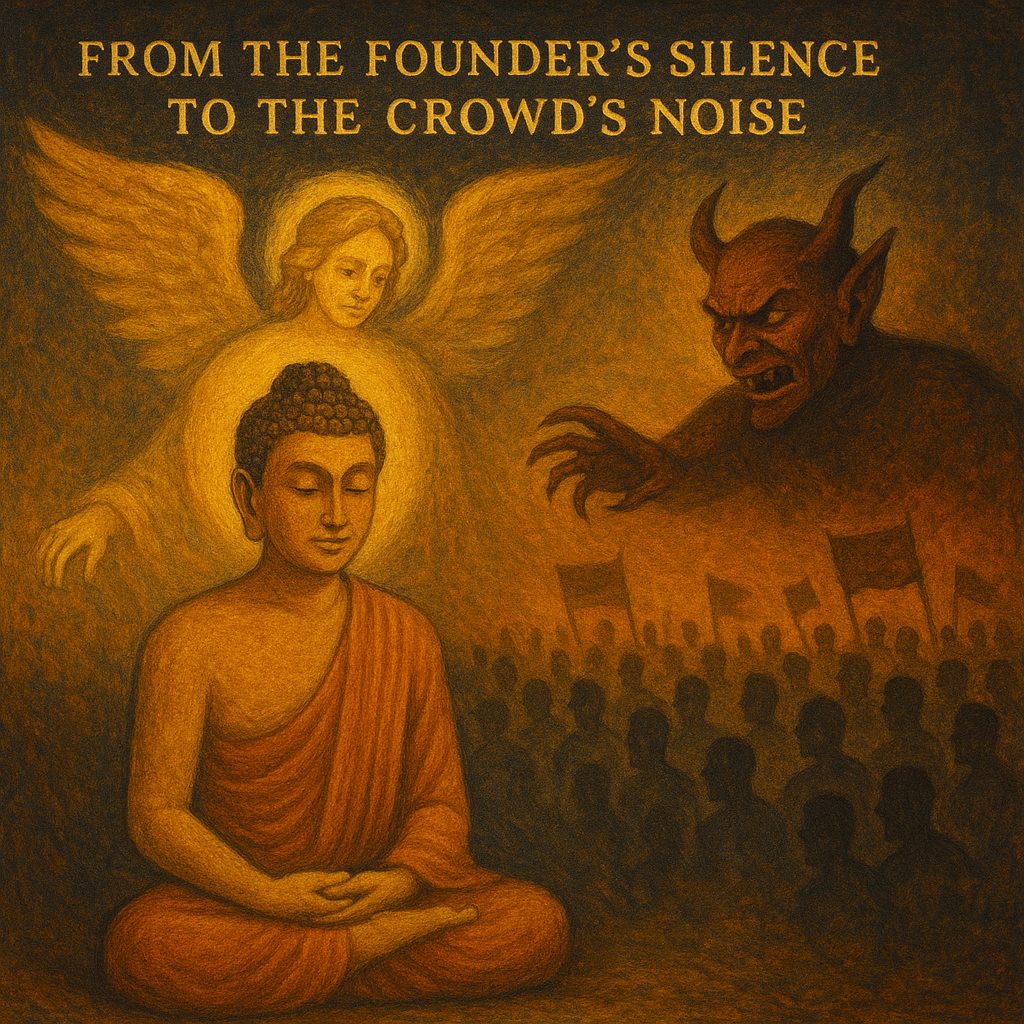
While the community gives stability to the individual in her spiritual journey, as already noted, it could also create a problem by producing ‘the other’ in its attempt to propagate its theology or ideology. However, when someone within that group wishes to break away to create their own separate identity—again, typically initiated by an individual around whom a few others gather—the same community often not only opposes but also tries to suppress the new movement.
An example that may or may not be relevant:
Jinnah, as an individual, created Pakistan based on theology by dividing the Indian subcontinent. But when East Pakistan wanted to separate—again initiated by an individual, Mujibur Rahman—the same Pakistan tried to crush them. This time, the reason was not theology but culture and economy.
The same dynamic plays out within religion. When Martin Luther voiced dissent, it later resulted in the splitting of the Church—and similar trends continued among Protestant groups, again initiated by individuals. Yet the very community that once provided security began to resist such dissent. This pattern is not limited to Christianity.
It recurs across world religions and ideologies. In Islam, sectarian divisions have often followed similar patterns of individual dissent being institutionalized and resisted. Hinduism, while not organized in the same way, has its own history of sects and reform movements that faced institutional backlash. Even in political ideologies, we see parallels: Mahatma Gandhi’s spiritualized fight for justice became a national movement, yet his ideals were later sidelined by rising right-wing political groups in India. Comparable dynamics appear in the West as well, where individual or fringe movements can evolve into rigid ideologies, sometimes manifesting as white supremacist or ultranationalist factions.
Thus, whether the community remains a guardian angel or turns into a dividing devil, the role of the individual must be studied and addressed with care and honesty.
Conclusion: Returning to the Spirit of the Journey
The journey of spirituality begins in silence, solitude, and sincere seeking. It finds its power in compassion, humility, and mystery. Institutions and communities need not be discarded, but they must remain servants of the original spirit—not its masters. The task of our time is not to abandon religion, but to return to the heart of what made it meaningful in the first place: the honest, inward search for truth. We must learn to preserve this spirit, especially when systems grow powerful and individuals get lost in collective fervor. The answer lies not in rejecting community but in nurturing it to remain faithful to the purity of the seeker’s path.
Ashram, June 9, 2025
Appendix: Scholarly Context and References
During the revision of this article, out of curiosity, I explored whether established scholars have addressed themes similar to those presented here—especially the tension between personal mysticism and institutional authority. While I have not encountered such works in my previous readings, I consulted ChatGPT, which provided the following scholarly references and summaries. These are shared here with due credit to AI assistance and to offer readers further avenues for exploration.
Max Weber: Routinization of Charisma
Max Weber’s sociological theory on authority is particularly relevant. In Economy and Society (published posthumously in 1922), Weber discusses how charismatic authority—based on the direct personal influence of a mystic or founding figure—is inherently unstable. To survive beyond the initial impulse, such authority undergoes a process Weber terms the “routinization of charisma,” transforming into traditional or bureaucratic forms of power.
“Charismatic authority is inherently unstable… if these relationships are not to remain… transitory, they… will become either traditionalized or rational-legal authority.”
— Max Weber, Economy and Society (1922)
This mirrors the article’s central theme: how a spiritual community’s original inspiration can become institutionalized, losing spontaneity and sometimes causing division.
Walter T. Stace: Mysticism versus Interpretation
Philosopher Walter T. Stace, in Mysticism and Philosophy (1960), draws a crucial distinction between pure mystical experience and the subsequent interpretive frameworks imposed by communities and doctrines. He emphasizes the personal and ineffable nature of mystical experience, which resists reduction to language or formal systems. As the founder’s original “silence” becomes a crowd’s “noise,” the immediacy of the mystical often becomes diluted.
“Mysticism is profoundly personal, direct, and resistant to being pinned down by doctrine.”
— Walter T. Stace, Mysticism and Philosophy (1960)
This observation resonates with the article’s reflection on the loss that often accompanies the institutionalization of spiritual insight.
Bibliography
- Weber, Max. Economy and Society: An Outline of Interpretive Sociology. Edited by Guenther Roth and Claus Wittich. University of California Press, Berkeley, 1978 (original essays published 1922).
- Stace, Walter T. Mysticism and Philosophy. Macmillan, New York, 1960.
Leave a Reply