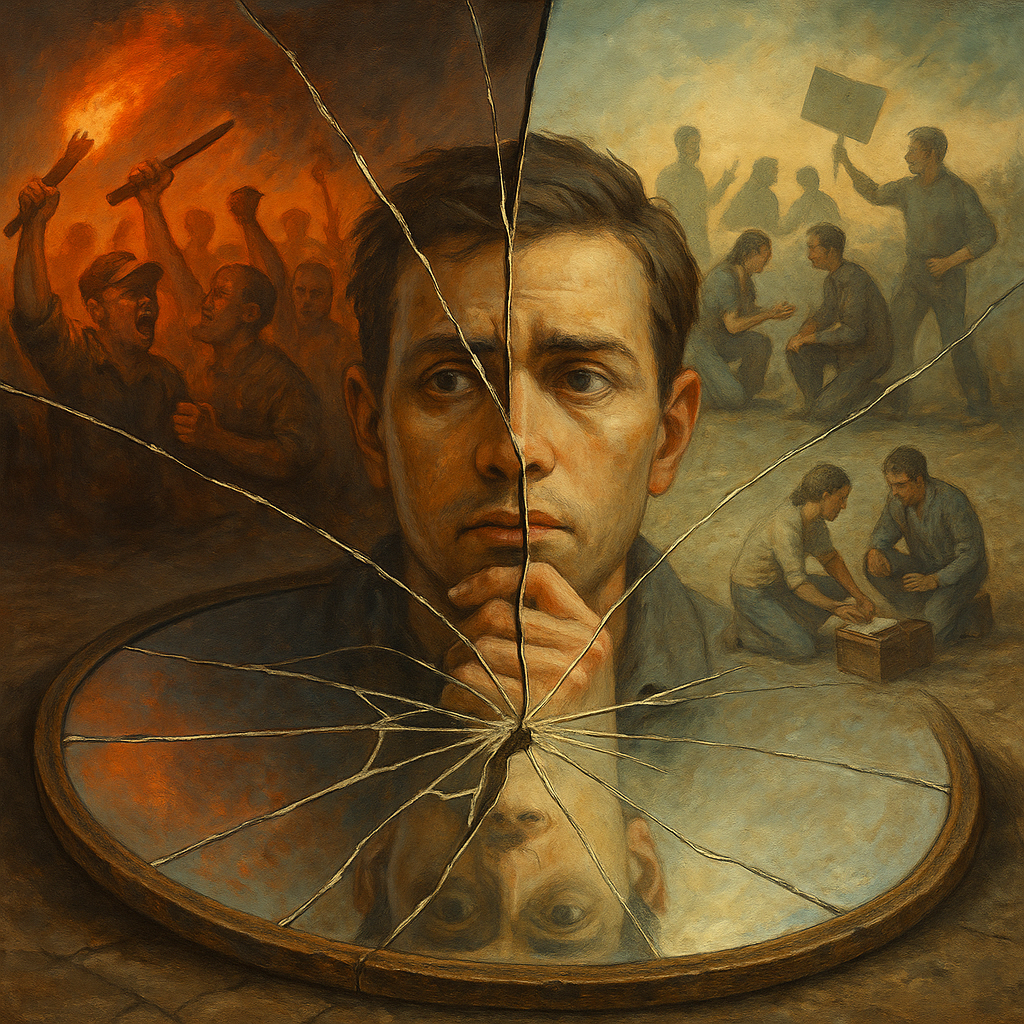
Why Self-examination and Social Responsibility must go together
Introduction
When I shared my poem and article Reform, which was inspired by a Hindi composition calling for people to raise their voice against violence—especially against the vulnerable—I received a detailed response from the person who had originally shared that poem. Below is a short summary of that response, leaving aside any reference to his religious identity:
Summary of the Response (with identity omitted):
The person strongly disagreed with the idea that one must first examine themselves before acting against wrong. He felt that in real-life situations—like when someone is being harassed—people must immediately take a stand. Waiting to become morally pure before helping others, he said, is impractical and leads to silence. He shared a personal incident where he helped a woman in public, saying that if he had followed my approach of self-examination first, he might have done nothing. According to him, true responsibility means being aware of oneself and speaking against injustice—introspection should not become an excuse to avoid action. [See Appendix for the entire original]
My Response
I broadly agree with the core argument in that response: we should not run away from our moral and social responsibilities in the name of self-examination—like a sannyasi, as he himself mentioned.
But here comes the twist.
Many who loudly raise their voice in the name of justice and morality—what I would call activism—often do so without doing any real self-examination. It is much easier to take a public stand or play the role of “moral guardian” than to follow the same standard inside one’s own home, family, or workplace.
In the example he gave, he helped a woman being harassed—a truly commendable act. But the real test of moral courage is not only in public but also in private life. Can we show the same courage in our families, offices, or social circles, where the consequences may affect us personally? In such places, many who shout in public often choose to remain silent.
This contradiction becomes even sharper when we look at the larger level of government and political groups. Many activists, especially from left-leaning or progressive circles, raise their voices loudly when their opponents are in power. But when similar injustices happen under their own rule, or within their ideology, they go silent—or suddenly start talking about “complexity” and “self-reflection.” This is not genuine self-examination—it is convenient silence.
The same applies to Western countries. They preach human rights to others, but fail to practice the same at home. Even worse, when their trade interests are involved—like with China, where serious human rights violations are taking place against Uyghur Muslims and Tibetan Buddhists—they stay quiet. In such cases, they suddenly return to “self-examination mode” as a cover-up.
Even in India, we criticize the Taliban regime for its treatment of women, yet some countries—including ours—are forced to keep diplomatic ties with them because of geopolitical needs. We may understand these pressures, but we should not pretend that such compromises are morally consistent.
In short, this selective use of activism and self-examination—based on convenience rather than truth—is what I am questioning.
This is why I insist that genuine self-examination is not an escape. It is a necessary balance. It forces us to ask whether the fire we are trying to fight outside has already been put out within.
Even Mahatma Gandhi faced this struggle. While he boldly spoke against violence and injustice in society, he was sometimes seen as strict and controlling in his personal life. His grandson, Varun Gandhi, writes about this in Daughter of Midnight, showing how Gandhi’s high ideals created tensions even in his family.1 This reminds us that no one, however great, is above the challenge of maintaining the same moral standard both publicly and privately.
So I do not say we should be silent in the face of injustice. But I do question the kind of activism that becomes a cover for personal or religious ideology—and that fails to look inward with honesty.
So tell me, is it wrong to draw a line between vigilantism (where people take law into their own hands) and mobocracy (where angry groups push their agenda without responsibility)? And where does real activism stand, if it is not built on a strong inner foundation?
In the end, I would rather be a man who examines himself first—even if I am weak—than one who is loud in public but blind to my own flaws. It is better to search for truth than to use religion, politics, or social slogans as weapons in the name of justice.
Conclusion: Afterthought
Recent events in India show that vigilantism and mobocracy are rising fast, especially against one particular community. This is dangerous. But we must also be careful of activism that is built on religious identity or group loyalty. That too can divide society.
In the example I mentioned, the person who stood up to defend a woman did a good thing. But when he later shared that story in a blog post and openly connected his action to his religious belief, it turned a human act into a religious statement. That doesn’t bring people together—it creates division. In such moments, a bit of self-examination could have brought some humility. Instead of showing himself as a hero from a particular faith, he could have become a voice for truth, peace, and justice that speaks to everyone, beyond identity.
To put it simply: don’t become a theologian when you act as a saviour. Just be a true human being who stands against violence—whether it targets a minority or a majority.
Thiruvalluvar put this beautifully in just one Kural:
செல்லா இடத்துச் சினந்தீது செல்லிடத்தும்
இல்அதனின் தீய பிற. – Kural 302
“Where power is none, to vent your wrath is wrong;
But to wield wrath when power is yours—that is even worse.”
This is not only about personal anger. It applies to any kind of power—social, political, religious. How we use our voice, and when we choose to be silent, both matter.
The West also shows the same double game. They talk of human rights when it suits them, but remain quiet when money or trade is involved. Left-wing governments also behave the same. They speak against injustice loudly when others are ruling, but do the same or worse when they themselves are in power—and then hide behind silence.
One more important point needs to be considered in this incident. Though the person took a bold stand and managed to drive away the young man who was harassing the woman for her dress and identity, what if that situation had turned into mob violence? What if the young man had returned with a group and attacked both the woman and the one who helped her?
Yes, the saviour took timely moral action. But he also had a responsibility to ensure the woman’s safety beyond that moment. As an outsider to that place, instead of just chasing the culprit away, he could have tried to get local help or inform others nearby to prevent any backlash. Without this, both the woman and the culprit are again left in the same place, and she may have to face more trouble.
So even good activism must be careful, wise, and supported by the community—not just personal bravery.
So the point is not to reject activism or self-examination. It is to reject dishonesty. Both must go together. Real moral strength comes when we act outwardly and reflect inwardly—with courage, with humility, and with consistency.
Ashram, June 16, 2025
Notes
- This incident from Gandhi’s life reveals the tension between public ideals and private behavior. While he preached dignity and equality, he could be harsh and controlling at home. In one such moment, when a Harijan guest had defecated in a bucket under his bed [in South Africa], Kasturba Gandhi, with great hesitation, tried to clean it. Gandhi, upset that she didn’t do it joyfully, attempted to throw her out of the house. But Kasturba fiercely rebuked him, reminding him of her isolation in a foreign land and her dignity as his wife. This moment exposed not only the inner conflict of a moral leader but also the quiet power of his wife, who did not hesitate to speak the truth to him.
…The wife, with her matchless powers of endurance, has always been the victor.— Arun Gandhi, Daughter of Midnight: The Child Bride of Gandhi, London, Blake Pub. Ltd. 1998, p.85
Appendix
I like the idea of one of my favourite YouTuber,
There is no negative, positive or neutral when a village is burning, there are only two types of people there, type one are those who are killing the fire and type two are those who are burning the village and those who are silent are the part of those who are burning the village.
I am happy that I don’t follow your philosophy of “Self examination only”. When I was in Punjab, a Bihari guy was eve teasing a lady in burqa. I realized that the guy was very confident in what he was doing because he thought no one would stand for the lady since she was a Muslim.
Following your philosophy, I would have thought “I must examine myself first, if there is no evil in me, only then I should stand against evil.”
I see it as a typical Indian Christian response, Indian Christians use such techniques to hide their cowardice and allow wrong things to happen around them in the name of “self examination”.
I stood for the lady and threatened the guy and he ran away because he saw someone standing for the lady who was alone, uncomfortable and disturbed. Being a supporter of Non-violence I could not hit him but I at least raised my voice. I would have even fought back if it was required at that very moment. So, the idea you have shared through your poem sounds very good but has no practical utility in one’s earthly journey since it won’t do any good to any society. Self examination and moral responsibilities go together. One is critical about society because he is aware of himself and aware of the good and bad happening in his society.
I personally know some people who want to be a sanyāsin because they want to run away from their moral, social and national responsibilities in the pretext of “self examination”. This is why I reject your idea of moral inaction (नैतिक निष्क्रियता) in the disguise of “self examination”.
Leave a Reply