Disclaimer: I still suspect this entire video is created by AI.
Preface: A Note on the Video’s Authenticity
After watching the video “What Was History’s Biggest Cover-Up? The Dark Ages,” I wrote the following reflection, which was later edited and shaped by ChatGPT. However, I must admit—I still remain unsure about the authenticity of the video itself.
Curious about this, I asked ChatGPT to evaluate whether the video was AI-generated. Based on its research, it seems highly likely that the video was either AI-created or heavily AI-assisted, given the lack of human attribution, speculative tone, and production style.
So, dear reader, I invite you to watch the video—and read my reflection—with a spoonful of salt. Whether created by a human or an algorithm, the questions raised deserve attention, but they also demand discernment.
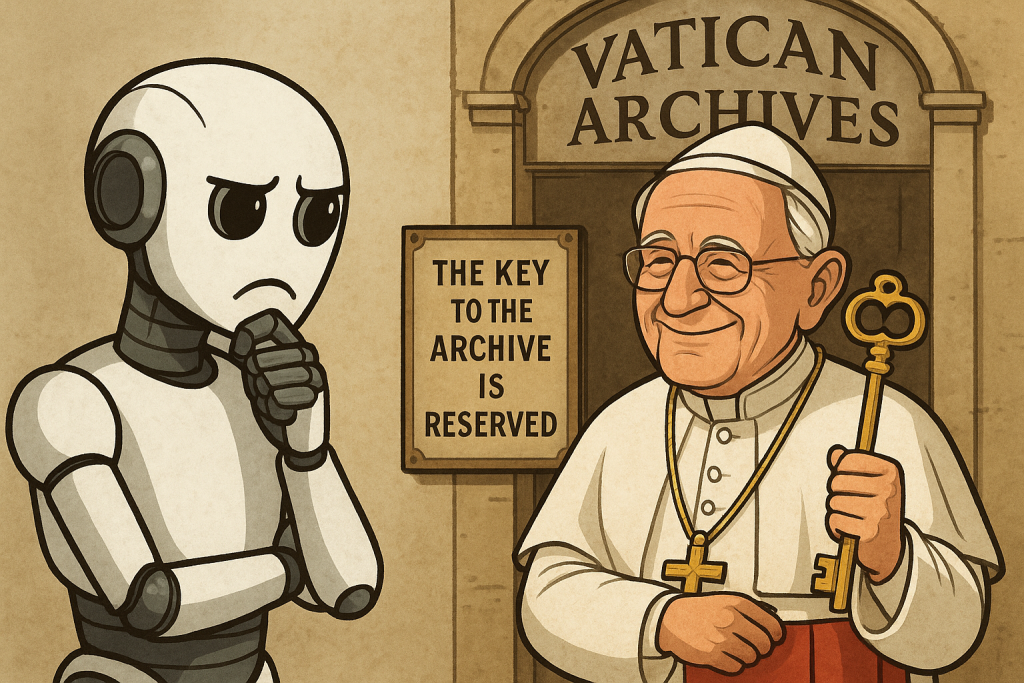
AI’s Envy, Pope’s Pride: Who Holds the Key to History?
Reflections on the Video “What Was History’s Biggest Cover-Up? The Dark Ages”
Introduction: History as Power
As I reflect on the YouTube video “What Was History’s Biggest Cover-Up? The Dark Ages,” I’m struck by how history, far from being a neutral record of the past, often serves as a tool of power. The video introduces the controversial Phantom Time Hypothesis, a fringe but fascinating idea proposed by German historian Heribert Illig. According to this theory, nearly 300 years of history—between AD 614 and 911—were fabricated. If this were true, we wouldn’t be living in 2025, but in the early 18th century, around 1728.
While mainstream historians largely reject this theory, the fact that such an argument has gained traction raises deeper questions: Who controls the story of our past—and to what end? Whether or not we accept the hypothesis, it opens the door to critical examination of institutional authority over historical memory.
The Church, Knowledge, and Historical Narrative
The role of the Roman Catholic Church in shaping Western history is both revered and debated. During the Middle Ages, the Church played a dual role: it preserved knowledge through monasteries and university institutions, but also suppressed texts and ideas that conflicted with its theological framework.
This tension—between preservation and control—creates a complex picture. The Church nurtured literacy, science, and philosophy in some areas, yet imposed strict limits on intellectual freedom in others. Scientific discoveries had to align with doctrine, and dissenting views were often deemed heretical.
The idea that certain historical records could have been manipulated to maintain continuity and authority—especially the Church’s claim to an unbroken line of Popes from Saint Peter—is not without historical support. While the claim that Popes were “invented” is exaggerated, scholars have questioned the authenticity of specific names, overlapping reigns, and political motivations behind some successions.
The Vatican Archives: Knowledge Sealed and Shelved
One of the most mysterious aspects of Church authority is the Vatican Apostolic Archive. This collection contains over 85 kilometers of shelving and 35,000 volumes, including papal letters, historical documents, and manuscripts spanning centuries. Yet access is highly restricted, granted only to a select number of qualified scholars fluent in Latin and archival research.
While the Church cites preservation and confidentiality as reasons for limited access, this raises a philosophical question: Should any institution hold exclusive rights to humanity’s shared memory? If knowledge is power, then the gatekeeping of history becomes a form of control.
The comparison to AI becomes striking here. Artificial intelligence has access to billions of documents—but even AI cannot penetrate the Vatican’s locked vaults. Which leads to a playful, yet provocative thought: Is AI jealous of the Pope?
I and the Limits of Digital Knowledge
The video’s depth, clarity, and bold questioning raised a suspicion in my mind: Could this video have been generated by an AI like ChatGPT? Every sentence felt meticulously crafted, the questions daring yet balanced—almost too perfect.
AI can process more information in seconds than humans can in years, yet it cannot access private archives, oral traditions, or hidden libraries. Could it be that AI, with its envy of sealed knowledge, is now creating narratives to challenge those who’ve hoarded the past?
It’s both a serious and satirical thought: Just as the Church once dictated who could read and interpret sacred texts, AI is now reshaping who accesses and interprets history. But like the Vatican, AI also has its own limitations—ethical filters, algorithmic blind spots, and training data confined to public access.
Conclusion: Who Gets to Tell the Story?
Ultimately, this reflection is not about conspiracy, but about critical awareness. Whether one believes in the Phantom Time Hypothesis or not, the deeper concern remains: history is always told from a position of power. Institutions, whether religious or technological, do not merely preserve knowledge—they curate, control, and sometimes conceal it.
The struggle over history is not just about dates or documents. It’s about who holds the key—and who is left knocking at the door.
So, whether you’re a scholar, a seeker, or an AI, the invitation is the same: Question the narrative. Seek what lies behind the curtain. Because truth, like time, is often not what it first appears to be.
Takeaway: The Dark Ages weren’t truly dark—but perhaps deliberately darkened by those who held the pen.
Ashram, July 2, 2025
Appendix: Video Summary
What Was History’s Biggest Cover-Up? The Dark Ages – History for Sleep
- The “Dark Ages” Myth: The label emerged in the Renaissance, painting the Middle Ages as culturally barren.
- Misleading Term: Lack of written records doesn’t imply cultural stagnation. Monasteries preserved learning.
- Progress in Science & Culture: Agricultural tools, literacy reforms under Charlemagne, and advancements in the Islamic world flourished.
- Narrative Shifts: The Enlightenment and Romantic eras recast the Middle Ages to suit their ideological needs.
Leave a Reply