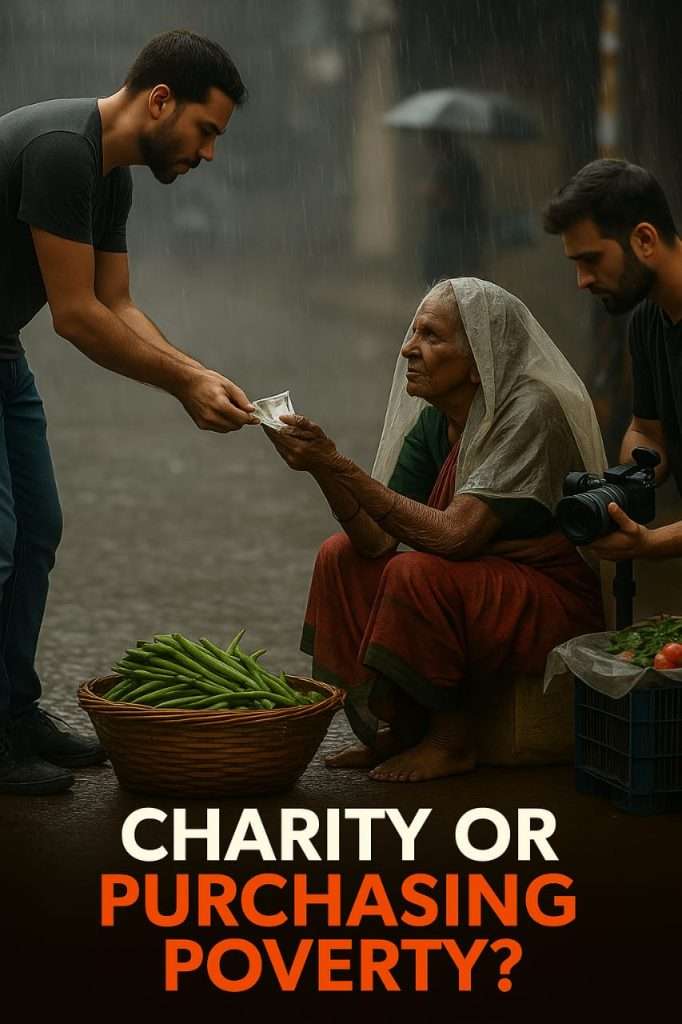
When compassion becomes content
📹 A Moment That Bothered Me
The other day, I came across a video on my feed. A man was buying vegetables from an old woman sitting in the pouring rain — soaked to the skin, barely covered by a torn plastic sheet. In another clip, he purchased artificial flowers from a roadside vendor whose small stall was drenched, her sari clinging to her, her hands trembling in the cold.
He didn’t stop there. He spoke with them gently. He sat down and ate with them. In one video, he even replaced the leaking plastic sheet covering a vendor’s wares. In another, he gave a toy to a terminally ill child.
But what struck me most was not just what he did — it was how it was shown:
No music. No words. No captions. No narration. Just silent footage, capturing every movement, every emotion, every reaction — with the camera quietly, almost reverently, following him through each act of giving.
And yet, in that silence, something felt too loud. Too staged. Too intentional.
I couldn’t help but wonder:
Was this really about the people in need — or was it about the one giving?
🤲🏽 The Quiet Virtue of Giving
Traditionally, charity is meant to be hidden. As the saying goes:
“Let not your left hand know what your right hand is doing.”
When giving is done quietly, it honors the dignity of the receiver and preserves the humility of the giver. But today, with cameras in every hand, giving often becomes a performance — carefully curated, silently edited, and visually powerful.
Of course, sharing a good act can inspire others. Sometimes, seeing kindness does encourage us to be kinder. But there is a line. And that line blurs dangerously when charity turns into content, and poverty becomes a prop.
🐟 Teach to Fish — or Give Food?
We’ve heard it often: “Don’t give a man a fish — teach him to fish.” The idea is to empower, not create dependence.
But Mother Teresa once offered a gentle challenge to this wisdom. She said:
“The poor may need food just to have the strength to hold the fishing rod. So let me give food, and you give the rod.”
Both kinds of help are important — immediate relief and long-term empowerment. But neither of them were ever meant to be turned into a slow-motion video to rack up views.
🎥 When Help Becomes a Stage
There is something unsettling about watching the same person appear in video after video — helping different people in similar ways, always on camera, always silent, always emotionally charged. No words. Just the same visual story, over and over.
That repetition raises a serious question:
Is this charity, or is this branding?
Is this compassion — or content strategy?
Some may even treat it as a form of investment: a few acts of kindness in front of the camera — and in return, thousands of likes, followers, maybe even financial rewards.
🔁 Poverty on Repeat
Even when intentions are good, repeating the same public acts of charity — especially to the same kinds of people — risks turning their lives into performance.
The old woman in the rain may be grateful for a warm meal today. But tomorrow, she’ll be back in the same spot. Her suffering might draw more silent cameras, more online attention. Some parents, seeing this pattern, might begin using their children’s hardships to evoke sympathy — not because they want to, but because it works.
It becomes a cycle. One side showcasing compassion. The other side adapting to it.
🤔 A Gentle Pause
I’m not against charity. And I’m not even against sharing it when it truly encourages others to act with compassion.
But when the giving becomes a quiet spectacle — repeated, polished, and circulated — it risks stripping people of their dignity. It turns them into visual subjects, not human beings. And it sends a troubling message:
That even suffering, in the age of social media, can be bought, captured, and sold.
💬 What Do You Think?
Have you seen such videos?
Do you find them inspiring — or uncomfortable?
Is this modern charity — or is it purchased poverty?
Let’s think about how we give. And why we give.
Because real giving lifts others up — not just our own image.
Ashram, August 5, 2025
ख़रीदी हुई ग़रीबी
जब करुणा, कंटेंट बन जाती है
📹 एक दृश्य जो मुझे परेशान कर गया
कुछ दिन पहले, मैंने एक वीडियो देखा। एक आदमी बारिश में भीगती एक बूढ़ी महिला से सब्ज़ियाँ ख़रीद रहा था — उसके सिर पर बस एक पुरानी पॉलीथिन की चादर थी, और उसका पूरा शरीर पानी में भीग चुका था। एक और वीडियो में वह एक महिला से कृत्रिम फूल ख़रीद रहा था, जिसकी छोटी-सी दुकान आधी भीग चुकी थी, और जिसके कपड़े पानी में लथपथ थे।
वह केवल सामान ही नहीं ख़रीदता — वह उनसे बात करता है, उनके साथ बैठकर खाना खाता है, कभी-कभी उनकी फटी हुई पॉलीथिन को भी बदल देता है। एक वीडियो में, वह एक लाइलाज बीमारी से पीड़ित बच्चे को खिलौना देता है।
लेकिन जो बात सबसे ज़्यादा चुभी, वो ये थी कि यह सब बिलकुल चुपचाप दिखाया गया था।
कोई म्यूज़िक नहीं। कोई कैप्शन नहीं। कोई वॉयसओवर नहीं। बस एक शांत कैमरा, जो हर हरकत, हर भाव, हर पल को दर्ज कर रहा था।
और उस ख़ामोशी में भी एक अजीब-सी शोर था — जैसे मदद नहीं, कोई प्रदर्शन हो रहा हो।
मैं सोचने लगा:
क्या यह वाकई ज़रूरतमंदों के लिए था — या मदद करने वाले के लिए?
🤲🏽 दान का मौन सौंदर्य
परंपरागत रूप से दान को गुप्त रखने की सीख दी जाती है।
“तुम्हारा बायाँ हाथ न जाने कि दायाँ क्या दे रहा है।”
ऐसा दान न केवल लेने वाले की गरिमा को बनाए रखता है, बल्कि देने वाले की विनम्रता को भी।
लेकिन आज, जब हर हाथ में कैमरा है, दान एक प्रदर्शन बनता जा रहा है — संपादित, सजाया हुआ, और सोशल मीडिया के लिए तैयार।
ज़रूर, कभी-कभी किसी अच्छे कार्य को साझा करने से दूसरों को प्रेरणा मिलती है। लेकिन जब करुणा कंटेंट बन जाए, और ग़रीबी एक दृश्य, तब कहीं कुछ गड़बड़ है।
🐟 मछली देना या मछली पकड़ना सिखाना?
अक्सर कहा जाता है:
“किसी भूखे को मछली मत दो, उसे मछली पकड़ना सिखाओ।”
मतलब, उसे आत्मनिर्भर बनाओ।
मदर टेरेसा ने इस पर एक भावुक टिप्पणी दी थी:
“उस भूखे को पहले खाना चाहिए, ताकि उसमें मछली पकड़ने की ताक़त आए। तो मैं खाना दूँ, तुम जाल दो।”
दोनों दृष्टिकोण ज़रूरी हैं — तात्कालिक राहत और दीर्घकालिक समाधान।
लेकिन इनमें से कोई भी वीडियो कंटेंट बनने के लिए नहीं है।
🎥 जब मदद एक मंच बन जाती है
आजकल कई वीडियो में वही व्यक्ति बार-बार अलग-अलग लोगों की मदद करता दिखता है — हर बार कैमरे के साथ, हर बार ख़ामोशी से, हर बार भावनात्मक दृश्य के रूप में।
वही पैटर्न, वही कैमरा ऐंगल, वही दृश्य — बस अलग चेहरे।
ऐसे में सवाल उठता है:
क्या ये दान है — या एक ब्रांडिंग?
क्या ये संवेदना है — या सोशल मीडिया रणनीति?
कभी-कभी तो ऐसा लगता है जैसे यह एक निवेश है: थोड़ी सी मदद करो — और बदले में मिलते हैं हज़ारों लाइक्स, फ़ॉलोअर्स, और शायद भविष्य में आर्थिक लाभ भी।
🔁 बार-बार दोहराई जाती ग़रीबी
चाहे इरादा नेक हो, लेकिन बार-बार एक ही तरह की सहायता को इस तरह दिखाना, ग़रीबों के जीवन को प्रदर्शन बना देता है।
वह बूढ़ी महिला, जिसे आज खाना मिला, कल फिर उसी जगह भीगी हुई बैठेगी। शायद कुछ माता-पिता यह भी सोचने लगेंगे कि अपने बच्चों की हालत दिखाकर लोगों की संवेदना पाना ज़्यादा आसान है — और वही एक कमाई का ज़रिया बन जाए।
एक तरफ़ मदद दिख रही है, दूसरी तरफ़ उसकी आदत बनती जा रही है।
🤔 एक छोटा-सा ठहराव
मैं दान के ख़िलाफ़ नहीं हूँ। न ही उसे साझा करने के ख़िलाफ़, अगर उसका उद्देश्य प्रेरणा देना हो।
लेकिन जब देने की क्रिया एक चुप्पी में लिपटा प्रदर्शन बन जाए, जब वही दृश्य बार-बार दोहराया जाए — तो इंसान की गरिमा कहीं खो जाती है।
तब दया नहीं दिखती, दृश्य दिखता है।
और ऐसा लगता है कि सोशल मीडिया के इस दौर में —
ग़रीबी भी बिकने के लिए उपलब्ध है।
💬 आप क्या सोचते हैं?
क्या आपने ऐसे वीडियो देखे हैं?
क्या वे आपको प्रेरित करते हैं — या असहज कर देते हैं?
क्या यह आज की उदारता है — या ख़रीदी हुई ग़रीबी?
आइए सोचें, हम क्यों देते हैं — और कैसे देते हैं।
क्योंकि सच्चा दान किसी और को ऊँचा उठाता है — सिर्फ़ हमारी छवि को नहीं।
Ashram, August 5, 2025
Leave a Reply