When I first read the incident involving Gandhiji and the schoolboys who proudly announced that they were spinning yarn “because it is Mahatmaji’s order,” I found myself imagining how a modern psychologist might interpret such a moment. Today, a developmental or educational psychologist would likely say something like this:
“While it is correct to discourage hero-worship, Gandhi could still have written a brief note appreciating the boys’ effort. Such validation strengthens intrinsic motivation without encouraging blind obedience.”
This sounds perfectly reasonable from a contemporary standpoint. It differentiates between acknowledging effort and validating dependency.
But what struck me is that Gandhiji did not even take that step. Even a small handwritten message, in his eyes, could blur the line between affirming the cause and affirming the leader. His lifelong struggle was not merely political—it was deeply moral. He believed that for the spinning-wheel to survive, it must be rooted in understanding, not in devotion to him.
And throughout his life, he stood firmly against being made the object of reverence.
Near the end of his life, he said something so revealing, so disarmingly humble, that it defines the man more than any biography:
“For men like me, you have to measure them not by the rare moments of greatness in their lives, but by the amount of dust they collect on their feet in the course of life’s journey.”
—Gandhi to Nirmal Kumar Bose (1947), cited in Lelyveld, Great Soul
This is the Gandhi who answered that schoolteacher.
“It is Mahatmaji’s order.” — A Sentence Gandhi Found Dangerous
In the teacher’s report, the boys proudly declared:
“It is Mahatmaji’s order. It has got to be obeyed.”
Most leaders would have smiled at such devotion. Many today would melt with satisfaction. Some would use it to build a personality cult, to reinforce their indispensability, to feed the myth of the great figure who must be followed unquestioningly.
But Gandhi reacts with worry.
He writes bluntly:
“The worst thing that can happen to boys in a school is to have to render blind obedience to everything that the teacher says.”
He sees danger in their reason for spinning, not the spinning itself. He understood that obedience without understanding is not virtue; it is conditioning.
And then he adds a line that captures the heart of his political philosophy:
“It is therefore infinitely better that the pupils should reason out for themselves all the things that are capable of being so treated.”
In other words:
Children must learn to think, not to bow.
The Cause Must Outlive the Leader
Gandhi confesses something deeply human. Many people, he says, had already begun to reject him; some had withdrawn their affection. But he is not disturbed by this.
What troubles him is something else:
“When I am dislodged… I am afraid the spinning-wheel will be destroyed. Surely, a cause is often greater than the man.”
This is almost prophetic.
He fears that when he is gone, the cause he lived for may collapse because too much had been attached to his personality. He wanted students to spin not for the “love of Gandhi,” but for the love of India, for the understanding of its poverty, its labour, its suffering.
A just cause must never rest on the shoulders of one charismatic man.
The Teacher’s Duty: Not Obedience, but Awakening
Gandhi tells the teacher what modern psychologists stress today:
“Teachers are to stimulate the reasoning faculty… and make them think for themselves.”
The spinning-wheel was to be a window into India’s reality, not a ritual of devotion.
He wanted children to see:
- the crushing poverty of the masses
- the decline of village industries
- the moral value of self-denial
- the dignity of labour
- the sheer need of India’s millions
Only then, he argued, would spinning become meaningful—and survive beyond him.
A Warning for Our Democracies
Toward the end of the message, Gandhi leaves a line that feels like a warning written for our times, not his:
“…prevent their pupils from lazily basing their actions upon statements… of men reputed to be great.”
Is this not exactly the disease of modern politics?
People today follow loud leaders, flamboyant leaders, leaders who shout slogans, leaders who trade in emotions. Democracies collapse when citizens forget how to think, how to question, how to distinguish charisma from truth.
Across the world, we see leaders delighting in being praised, decorated, adored. They reward flattery, elevate sycophants, and validate even the most absurd forms of hero-worship by giving followers posts, positions, and proximity.
Contrast this with Gandhi, who refused even a simple note that might encourage the faintest scent of personal adoration.
His voice cuts through our age of personality cults like a beam of moral light:
Reason before reverence.
Truth before personality.
Cause before leader.
Conclusion
Gandhiji’s message to that schoolteacher is not an anecdote from the 1920s.
It is a mirror held up to our age.
He teaches us that a society that cannot think cannot remain free. A people who worship leaders without understanding justice or compassion will ultimately destroy the very causes they claim to support. In a world intoxicated with power, where leaders demand loyalty more than truth, Gandhi stands apart as a reminder of what leadership was meant to be:
Humility over ego.
Principle over pride.
Understanding over obedience.
And unless we reclaim these values, no democracy, no nation, and no civilization can endure.
If you want, I can also format this for publishing, add subheadings, footnotes, or prepare a shortened newspaper version.
$$$
Now in modern time, what kind of psychologist would have responded to this Gandhiji’s message? Most probably he might say, ‘though we agree with Gandhiji that such hero worship should not be encouraged, still after making that clear to the students considering their age and also to appreciate the time they gave to spin that much yard, he should have written a short handwritten to them so that it would validate their work and not their worship and encourage the cause accepting Gandhiji’s moral teaching of not doing hero-worship.
But the greatness of Gandhiji lies that, even sending a message would go against his personal idealism and commitment to a cause, as several times in his life he clearly denounced such hero-worship him, though he cannot completly stop it. That’s why before his death he even said: For men like me, you have to measure them not by the rare moments of greatness in their lives, but by the amount of dust they collect on their feet in the course of life’s journey.—Gandhi (1947) {Gandhi to Nirmal Kumar Bose, cited in Parekh, Bhikhu. Colonialism, Tradition, and Reform: An Analysis of Gandhi’s Political Discourse, Rev. Ed. New Delhi, 1999, p. 272.}— Josephy Lelyveld, GREAT SOUL: Mahatma Gandhi and His struggle with India, New Delhi, HarperCollins Publishers India, 2011, p. vii
But compare this with any contemporary leaders in India and other countries. How they would have responded to such hero worship, which is openly going on in our land—for every achievement of a leader. Though they might give credit to others, still they would pleased and even validate their hero-worship in a subtle way by rewarding them in his own way—elevating to higher position in the party or cabinet etc.
Beyond Hero-Worship: Gandhiji’s Warning for Our Times
When I read Mahatmaji’s response to the teacher who proudly reported that young students were spinning yarn simply because “it is Mahatmaji’s order,” my thoughts went far beyond that school in 1926. I could not help thinking of today’s leaders across the world. The craving for flattery, the delight in blind followers, the celebration of obedience without question—none of this is new. Every age has its Trumps, its demagogues, its self-styled messiahs. Some leaders appear almost intoxicated when someone praises them, even when they are utterly undeserving of such praise. Many of them believe they can bring “peace among warring nations” only to win a Nobel Prize or maintain power, for winning has become a civilizational obsession—particularly in the modern West, where winning through any means has long been glorified, even though little true civilization remains to justify such pride.
In this atmosphere, Gandhiji’s honesty feels refreshing—even shocking. For here is a man revered by millions, yet he criticizes not only blind hero-worship but also the ways in which such worship erodes truth and corrupts moral action. His words ring with unusual humility and deep moral clarity.
Gandhi’s Objection to Blind Hero-Worship
In the teacher’s letter, the boys proudly claim:
*“It is Mahatmaji’s order. It has got to be obeyed.”*¹
Instead of feeling honoured, Gandhi responds with discomfort. He warns that such obedience, especially among children, is unhealthy and harmful. He writes:
*“The worst thing that can happen to boys in a school is to have to render blind obedience to everything that the teacher says.”*²
This warning may well be extended to nations today. The worst thing that can happen to a democracy—or any society—is to raise citizens who obey without thinking, who follow leaders merely because they speak loudly, play to emotions, or craft a heroic image.
Gandhi’s concern is not that the boys were spinning; rather, it was the reason behind their spinning. He believed that actions taken without understanding weaken the very cause being served. He insists:
*“It is therefore infinitely better that the pupils should reason out for themselves all the things that are capable of being so treated.”*³
His honesty is disarming. He confesses that many people had already begun rejecting him, some even withdrawing their affection and support. Yet he fears not the loss of love—but the loss of the spinning-wheel, the symbol of Indian self-reliance:
*“When I am dislodged… I am afraid the spinning-wheel will be destroyed. Surely, a cause is often greater than the man.”*⁴
How many modern leaders possess such humility? How many would say, “Let people reject me, but let the truth survive”? Gandhi stands apart precisely because he understood that the cause must never be sacrificed for the ego of the leader.
What Gandhi Demanded: Reason, Awareness, and Moral Strength
Gandhiji urges teachers to train students not in obedience but in thinking:
*“Teachers are to stimulate the reasoning faculty… and make them think for themselves.”*⁵
He explains that spinning itself is not a ritual of devotion to him; it is a meaningful act tied to the suffering of India’s poor. Students must learn:
- the poverty of the masses
- the collapse of villages
- the immensity of India’s population and need
- the virtue of self-denial
- the dignity of labour
Only then, he says, will they truly understand the value of spinning—and only then will the practice survive even if admiration for him collapses.
What a profound insight:
A just cause must never depend on a charismatic leader.
A Message Too Relevant for Today
Gandhi laments that many people follow leaders without testing their words:
*“I hope… teachers… prevent their pupils from lazily basing their actions upon statements, without testing, of men reputed to be great.”*⁶
Is this not the condition of our world today?
People follow leaders because they appear strong, loud, or confident. Nations worship power. Citizens trade their intellect for slogans. Democracies crumble under the weight of unthinking obedience. Gandhi foresaw this danger nearly a century ago.
If societies today were to internalize even a fraction of this wisdom, many political illusions, personality cults, and authoritarian tendencies would evaporate.
Conclusion
Gandhiji’s message is not merely a critique of hero-worship; it is a call to reclaim our moral and intellectual independence. A society that cannot think cannot remain free. A people who worship leaders without understanding justice, truth, or compassion will ultimately destroy the causes they believe they are upholding.
In an age of global leaders who demand loyalty, obedience, and uncritical admiration, Gandhi’s voice stands like a lighthouse in a storm:
Reason before reverence.
Truth before personality.
Cause before leader.
And unless we learn this, no democracy, no nation, no civilization can endure.
Ashram, December 2025
Footnotes
- “It is Mahatmaji’s order. It has got to be obeyed.”
- “The worst thing that can happen to boys in a school is to have to render blind obedience…”
- “It is therefore infinitely better that the pupils should reason out for themselves…”
- “When I am dislodged… I am afraid the spinning-wheel will be destroyed. Surely, a cause is often greater than the man.”
- “Teachers are to stimulate the reasoning faculty… and make them think for themselves.”
- “…prevent their pupils from lazily basing their actions upon statements… of men reputed to be great.”
7.
- Summary
- Gandhi responds to a teacher who reported that schoolboys are spinning yarn simply because “it is Mahatmaji’s order.” Gandhi strongly discourages such blind obedience and hero-worship. He argues that children must be taught to reason, not to follow instructions without understanding. Blind faith, he says, is harmful and should be rare, even when directed toward revered figures.
- Gandhi explains that the spinning-wheel is valuable not because he commands it, but because it represents self-reliance, economic well-being, and identification with the poor of India. Students should understand the deeper purpose behind spinning—India’s poverty, the needs of the masses, and the value of self-denial—rather than doing it out of devotion to him.
- He warns that if people follow him blindly, then whenever their faith in him collapses, the good causes he stands for will also collapse. Therefore, he urges teachers to cultivate reasoning in pupils, not unthinking hero-worship, and to ensure that actions are based on understanding, not on statements from reputed great men.– 59. ‘MAHATMAJI’S ORDER’, Young India, 24-6-1926, pp. 46-47. CWMG, vol. 31
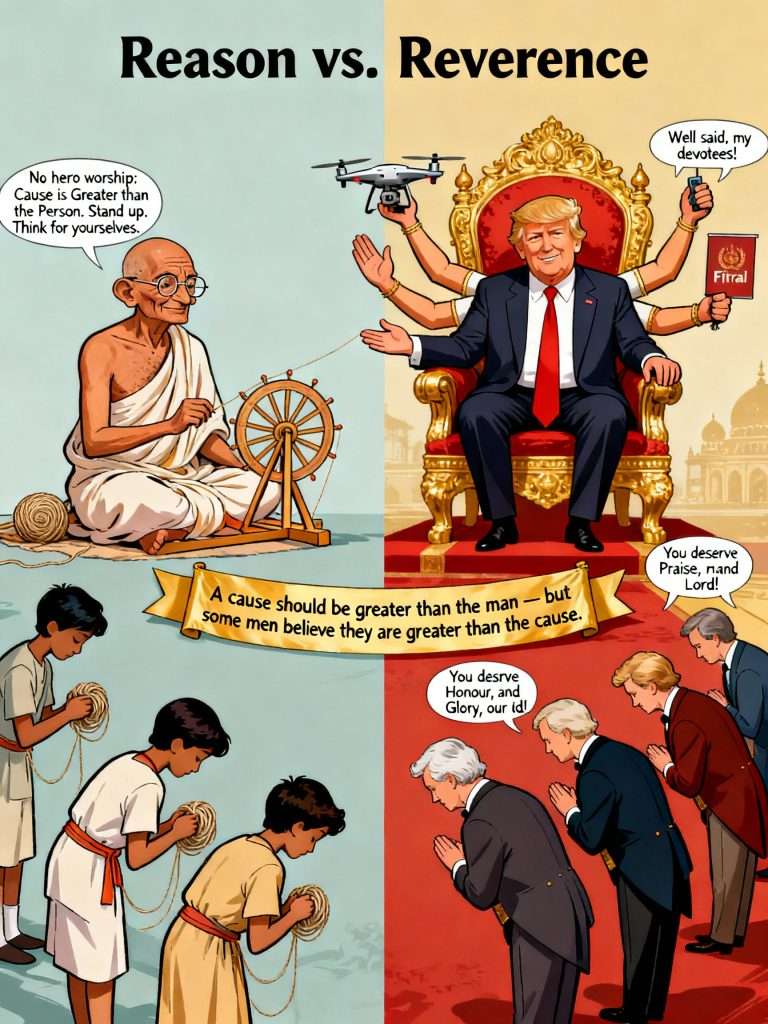
Reason versus Reverence
Mahatma Gandhiji, warning students again about their habit of hero-worshipping him, gently reminded them:
“The cause is greater than the person.
Stand up, and think for yourselves.”
Trump, meanwhile, seems to have heard only the opposite message.
“A cause should be greater than the man —
but some men sincerely believe they are greater than the cause.”
Donald’s Supporters
- “You deserve praise, honour, and glory, our Lord!”
Donald (glowing like a nuclear Christmas tree):
“Well said, my loyal devotees!
You deserve more weapons of mass destruction, which I shall generously send.
And I, of course, deserve the Nobel Prize —
for bringing peace among warring nations, to whom I alone can supply more weapons.”
“Isn’t it beautiful? Indeed, it is beautiful.
We will make America great again…
by destroying everyone else.”
तर्क बनाम श्रद्धा
महात्मा गांधीजी, छात्रों को उनकी हीरो-वर्शिप की आदत के बारे में फिर चेतावनी देते हुए बोले:
“कार्य व्यक्ति से बड़ा है।
खड़े होइए… और खुद सोचिए।”
लेकिन उधर ट्रम्प ने मानो इसका उल्टा ही संदेश सुन लिया।
“कार्य हमेशा व्यक्ति से बड़ा होना चाहिए —
लेकिन कुछ लोग सच में मानते हैं कि वे कार्य से भी बड़े हैं।”
डोनाल्ड के भक्तगण:
- “आप प्रशंसा, सम्मान और महिमा के योग्य हैं, हे प्रभु!”
डोनाल्ड (परमाणु–दीपावली की तरह चमकते हुए):
“बहुत अच्छा कहा, मेरे भक्तो!
आप अधिक विनाशकारी हथियारों के योग्य हैं, जिन्हें मैं उदारता से भेजूँगा।
और मैं, स्वाभाविक रूप से, नोबेल पुरस्कार का हकदार हूँ —
क्योंकि युद्धरत देशों में शांति मैं ही ला सकता हूँ,
उन्हें और अधिक हथियार देकर।”
“क्या यह सुंदर नहीं? वाकई सुंदर है।
हम अमेरिका को फिर महान बनाएँगे…
दूसरों को बर्बाद करके।”
इस पर और पढ़ें: भक्ति से परे: हमारे समय के लिए गांधीजी की चेतावनी
Ashram, December 1, 2025
Leave a Reply