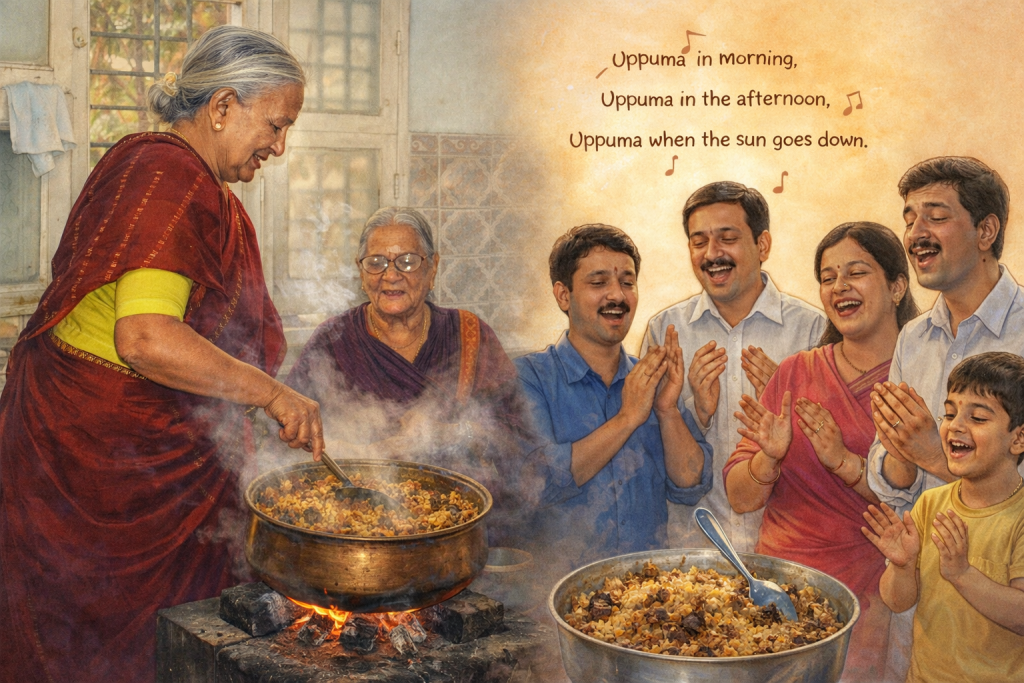
In the picture with the help of ChatGPT I used real image of my mother and mami.
The moment Dr. Hoefer said he was missing Uppuma, I didn’t need Google Translate. I knew exactly what kind of emotional crisis he was going through. Uppuma is not just food — it is therapy, companionship, financial planning, and survival strategy for single people across South India. Especially in Tamil Nadu. And most especially for the legendary species called “married-bachelors.”
For the uninitiated, a “married-bachelor” is a man whose wife has gone to her mother’s house for a few weeks. Within 48 hours, he rediscovers Uppuma. By Day 3, he respects it. By Day 5, he worships it.
Long ago I wrote about the Greatness of Uppuma, but I must repeat: this humble dish deserves a national award. It should officially be titled “Saviour of Indian Bachelors.” North India may proudly present poha (made from beaten rice), and we respect that. But let’s be honest — how many varieties can you stretch poha into? Uppuma, on the other hand, is a full democratic republic. Rava uppuma, semiya uppuma, idli uppuma, rice uppuma — each one ready to rescue a hungry soul at short notice.
And above them all stands the Emperor: Rice Uppuma — the one my mother made.
This is not ordinary cooking. This is tapasya. It must be cooked slowly in a thick bronze-bottom vessel, over charcoal, with the patience of a saint and the discipline of a yogi. The fire must be minimal. Hours must pass. Family members must circle the kitchen like devotees waiting for darshan. And then — at the bottom — appears the sacred, crispy brown layer we Tamilians call Kandal.
There is even a proverb:
“Karuppē azhagu; Kandalē rusi.”
Literally: Dark is beauty; the browned crust is taste.
And mind you — this is not just about cooking. In a land where “fairness” creams sell like sacred ash, this proverb boldly declares: dark alone is beautiful. It is often quoted to defend dark-skinned women against society’s foolish colour obsession. In the kitchen too, the same philosophy applies — the darker the crust, the deeper the flavour.
In simple English:
Burn it slightly… and it becomes divine.
And then begins the real family drama.
All devotees will sing the eternal bhajan:
Uppuma in the morning,
Uppuma in the afternoon,
Uppuma when the sun goes down.
But when the vessel is finally opened and the sacred kandal revealed, spirituality vanishes. Siblings transform into courtroom lawyers. Diplomacy collapses. Negotiations fail. Everyone wants the lion’s share — especially the crispiest, darkest, most “philosophically beautiful” portion from the bottom.
Because Uppuma is not just food.
It is loyalty.
It is emergency support.
It is economic stability.
It is emotional insurance.
It is the eternal companion of the single human race.
Ashram, February, 6, 2026
Secular Song 639
My Deity
The delicious Uppuma,
my revered deity,
cared for me
three times a day.
Will this happen
if my mother were here?
Will things change
if I marry?
Can anyone else
make Uppuma
like my mother does?
What if a wife
comes into my life,
could she cook
like my Amma?
So, other than
my Amma,
what others make
is just a trial.
Even after
understanding this well,
is it right for her
to witness this drama?
Is it fair
if she says
once married,
I’ll stay silent?
But having seen
my father’s state,
can I agree
to marry?
So, if my Amma
returns and prepares
Uppuma thrice a day,
Considering it
as nectar,
will my mind
refuse to eat?
Since that
will never happen,
now Uppuma
is my guardian deity.
Therefore, worshiping
this deity
and offering Uppuma
as a sacred offering.
Once Uppuma, the deity,
and this devotee
merge together,
will there be any separation?
7-7-2024, Gurukulam, 5:50 pm.
Secular Song 639 என் தெய்வம்
காலை மாலை
இரவு என்று
காக்குது என்னை
அருமை உப்புமா 1
அம்மா இருந்தால்
இதுவும் நடக்குமா
எனக்கென ஒருத்தி
வந்தால் மாறுமா 2
ஆனால் அம்மா
செய்வது போல
பிறருக்கு வருமா
அருமை உப்புமா 3
எனக்கென ஒருத்தி
வந்தால் என்ன
அம்மா போல
அவளுக்கு வருமா 4
ஆகவே எனது
அம்மா அன்றி
மற்றவர் செய்தால்
கொடுமை அம்மா 5
அதனை அறிந்தும்
எனது அம்மா
வேடிக்கை பார்ப்பது
இன்னும் நியாயமா 6
கால்கட்டு போட்டால்
வாய்க்கட்டிப் போகும்
என்று சொல்வது
அவளுக்கு தகுமா 7
ஆயினும் எனது
அப்பா நிலைமை
கண்டபின் என்மனம்
சம்மதம் தருமா 8
ஆகவே அம்மா
என்னிடம் வந்து
அனுதினம் உப்புமா
கிண்டித் தரினும் 9
அதையே நானும்
அமுதமாய் எண்ணி
உண்ண என்மனம்
என்றும் மறுக்குமா 10
ஆயினும் அதுவும்
நடக்கா தென்பதால்
என்னைக் காக்கும்
தெய்வம் உப்புமா 11
ஆகவே அந்த
தெய்வம் தொழுது
அநுதினம் உப்புமா
படையல் இட்டு 12
பக்தனும் தெய்வமும்
ஒன்று சேர
பிரிவினை எமிடம்
என்றும் வருமா 13
Gurukulam, 7-7-2024, மாலை 5.50
शाश्वत साथी और अविवाहितों का आधिकारिक उद्धारकर्ता
जिस क्षण डॉ. होफ़र ने कहा कि उन्हें उप्पुमा की याद आ रही है, मुझे गूगल ट्रांसलेट की ज़रूरत नहीं पड़ी। मैं तुरंत समझ गया कि वे किस प्रकार के भावनात्मक संकट से गुज़र रहे हैं। उप्पुमा केवल भोजन नहीं है — यह थेरेपी है, संगति है, आर्थिक योजना है, और दक्षिण भारत के अविवाहितों की जीवन-रक्षा रणनीति है। विशेषकर तमिलनाडु में। और सबसे बढ़कर उस महान प्रजाति के लिए जिसे “विवाहित-कुँवारा” कहा जाता है।
जो लोग इस शब्द से परिचित नहीं हैं, उनके लिए “विवाहित-कुँवारा” वह पुरुष है जिसकी पत्नी कुछ हफ्तों के लिए मायके चली गई हो। 48 घंटे के भीतर वह उप्पुमा को फिर से खोज लेता है। तीसरे दिन वह उसका सम्मान करने लगता है। पाँचवें दिन वह उसकी पूजा करने लगता है।
बहुत पहले मैंने उप्पुमा की महानता पर लिखा था, पर मुझे फिर कहना होगा — यह विनम्र व्यंजन राष्ट्रीय पुरस्कार का हकदार है। इसे आधिकारिक रूप से “भारतीय कुँवारों का उद्धारकर्ता” घोषित किया जाना चाहिए। उत्तर भारत गर्व से पोहा (चिवड़े से बना) प्रस्तुत कर सकता है — और हम उसका सम्मान करते हैं। पर सच बताइए — पोहा की कितनी विविधताएँ बनाई जा सकती हैं? उप्पुमा तो एक पूर्ण लोकतांत्रिक गणराज्य है। रवा उप्पुमा, सेवई उप्पुमा, इडली उप्पुमा, चावल उप्पुमा — हर एक भूखी आत्मा को तुरंत बचाने के लिए तैयार।
और इन सबके ऊपर सम्राट के रूप में विराजमान है — राइस उप्पुमा — वही जो मेरी माँ बनाती थीं।
यह साधारण पकवान नहीं है। यह तपस्या है। इसे मोटे कांसे के तले वाले बर्तन में, कोयले की धीमी आँच पर, संत जैसी धैर्य और योगी जैसी अनुशासन के साथ पकाया जाना चाहिए। आग न्यूनतम होनी चाहिए। घंटे बीतने चाहिए। परिवार के सदस्य रसोई के चारों ओर ऐसे मंडराएँ जैसे दर्शन की प्रतीक्षा कर रहे भक्त। और फिर — तले में प्रकट होती है वह पवित्र, कुरकुरी भूरी परत, जिसे तमिल में कंडल कहा जाता है।
एक कहावत भी है:
“करुप्पे अळगु; कंडले रुचि।”
अर्थात: काला ही सुंदर है; भूरी परत ही स्वाद है।
ध्यान रहे — यह केवल खाना बनाने की बात नहीं है। उस देश में जहाँ “फेयरनेस” क्रीम पवित्र भस्म की तरह बिकती है, यह कहावत साहसपूर्वक घोषणा करती है कि काला रंग ही असली सुंदरता है। इसे अक्सर समाज के रंग-भेद के विरुद्ध गहरी त्वचा वाली स्त्रियों के समर्थन में उद्धृत किया जाता है। रसोई में भी यही दर्शन लागू होता है — परत जितनी गहरी, स्वाद उतना गहरा।
सरल अंग्रेज़ी में कहें तो:
हल्का सा जला दो… और वह दिव्य हो जाता है।
और फिर शुरू होता है असली पारिवारिक नाटक।
सभी भक्त मिलकर यह शाश्वत भजन गाते हैं:
सुबह उप्पुमा,
दोपहर उप्पुमा,
सूरज ढले तब भी उप्पुमा।
लेकिन जैसे ही बर्तन खुलता है और पवित्र कंडल दिखाई देता है, आध्यात्मिकता गायब हो जाती है। भाई-बहन अदालत के वकील बन जाते हैं। कूटनीति विफल हो जाती है। बातचीत टूट जाती है। हर कोई शेर का हिस्सा चाहता है — खासकर तले का सबसे कुरकुरा, सबसे गहरा, सबसे “दार्शनिक रूप से सुंदर” हिस्सा।
क्योंकि उप्पुमा केवल भोजन नहीं है।
यह निष्ठा है।
यह आपातकालीन सहारा है।
यह आर्थिक स्थिरता है।
यह भावनात्मक बीमा है।
यह अविवाहित मानव जाति का शाश्वत साथी है।
सेक्युलर गीत 639 मेरा देवता
स्वादिष्ट उप्पुमा,
मेरा पूज्य देवता,
दिन में तीन बार
मेरा ध्यान रखता रहा।
क्या ऐसा होता
यदि मेरी माँ यहाँ होती?
क्या बदल जाता
यदि मैं विवाह कर लूँ?
क्या कोई और
वैसा उप्पुमा बना सकता है
जैसा मेरी माँ बनाती हैं?
यदि कोई पत्नी
मेरे जीवन में आए,
क्या वह भी
अम्मा जैसा बना पाएगी?
इसलिए, मेरी अम्मा के सिवा
जो भी बनाए —
वह तो केवल
एक प्रयोग है।
यह सब जानकर भी
क्या उचित है
कि मेरी अम्मा
यह नाटक देखती रहें?
क्या यह न्याय है
यदि वह कहें —
“शादी के बाद
मैं चुप रहूँगी”?
परंतु अपने पिता की दशा देखकर
क्या मेरा मन
विवाह के लिए
सहमति दे सकता है?
तो यदि मेरी अम्मा
लौट आएँ
और दिन में तीन बार
उप्पुमा बनाएँ,
उसे अमृत मानकर
क्या मेरा मन
उसे खाने से
इन्कार करेगा?
पर चूँकि वह समय
कभी लौटेगा नहीं,
अब उप्पुमा ही
मेरा रक्षक देवता है।
अतः इस देवता की पूजा कर
उप्पुमा को ही
नैवेद्य अर्पित करता हूँ।
जब उप्पुमा देवता
और यह भक्त
एक हो जाएँ,
तो क्या फिर
कोई वियोग रहेगा?
7-7-2024, गुरुकुलम्, सायं 5:50 बजे।
Leave a Reply