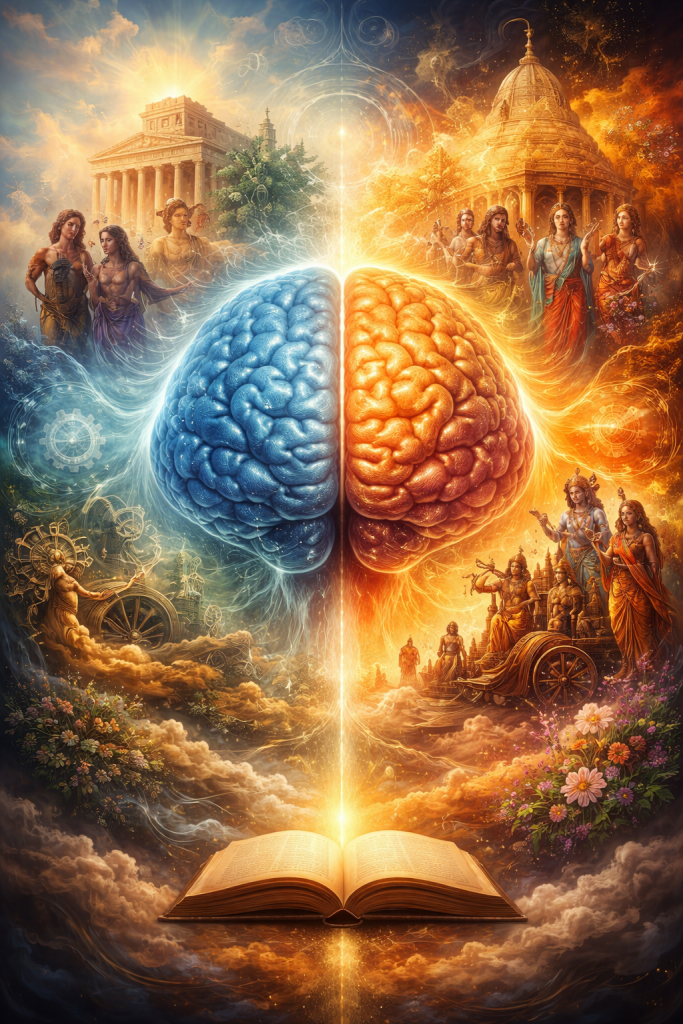
Let me start with a little background on what sparked this. Iain McGilchrist is a British psychiatrist and author who has written widely about how our divided brain shapes the way we see the world. In a fascinating YouTube interview—linked at the top of this post—he explains that the left side of the brain likes to break things into neat facts and categories, while the right side tends to see the big picture, relationships, and deeper meaning. Watching it half‑asleep in the hospital after a minor surgery, under medication that made everything fuzzy, I replayed it a couple of times. Those ideas stuck with me, blending with my own thoughts on truth, myths, and dharma from our Indian epics. It’s not some big lecture—just me pondering as an ordinary reader of these stories.
We’ve all felt that tug inside, right? One part of us wants clear answers: “Did this really happen?” The other part senses there’s more to life than checklists and certainties. McGilchrist suggests that modern life leans too hard on the “facts‑only” side, making us dismiss myths and faith as childish fairy tales. But what if they are quietly telling us something true about how we live?
Take our epics, the Ramayana and the Mahabharata. Some people treat them as straight history; others dismiss them as made‑up stories. Both approaches miss something essential. Myths are not primarily about “did it happen?” They are about what keeps happening in our hearts and choices every day.
Think of the Greek tale of Orpheus and Eurydice. Orpheus’ wife, Eurydice, dies young, and he goes all the way to the underworld to bring her back. The condition he is given is simple: he must lead her out without turning to look back at her. Trusting that she is following him, he almost reaches the upper world—but at the last moment, doubt overtakes him, and he turns to see her. In that instant, she is snatched back from him forever. The story is not about history; it is about how doubt can destroy what trust alone sustains. Not an event in the past, but as real as our own regrets and second‑guesses in relationships, work, and faith.
Faith fits right into this image—not as blind guessing, but as trusting enough to let truth show up even when it’s not yet fully visible. Like Orpheus: some realities only grow if you don’t demand proof at every step. In dharma terms, it’s that quiet steadiness in the midst of uncertainty, standing by truth even when it cannot yet be measured.
Now, picture the Ramayana. Rama does not just talk about dharma; he lives it—dharma paripālanam, the upholding of righteousness in action. But it is not neat or easy. Was sending Sītā away after her pregnancy, when her fidelity had already been “proved” in the fire ordeal in Laṅkā, really fair? Why did the Agni Parīkṣā take place at all, especially if Rāma already knew who Sītā was? And then there is the killing of Vāli from hiding—was that dharmic, or a political move? People still argue about these questions today. That, in fact, is the strength of the text. It shows that dharma is not a ready‑made rulebook, but a living, often painful negotiation between roles, responsibilities, and consequences. Rama as king, husband, and friend embodies dharma differently in each situation. Rama’s life shows that even the highest ideal, when enacted in the world, enters into complexity and tension.
The Mahabharata cranks this up even more. Its central insight—“Dharmo rakṣati rakṣitaḥ” [“Dharma protects those who protect it.”]—suggests that dharma has an intrinsic moral power: those who protect dharma are themselves protected. Sounds straightforward, but look closely. The Pandavas stand for dharma, yet they stumble. The Kauravas stand against it, clearly wrong. Even Krishna, who comes precisely to “establish dharma when adharma prevails,” acknowledges that the path to dharma is not always neat or clean.
In the Bhagavad Gītā, Krishna says:
Yadā yadā hi dharmasya glānir bhavati Bhārata,
abhyutthānam adharmasya tadātmānaṁ sṛjāmy aham.
(Whenever there is a decline of dharma, O Bhārata, and a rise of adharma, then I manifest Myself.)
Here, Krishna presents himself as the one who restores dharma when it is overwhelmed by injustice. Yet in the actual unfolding of the Mahabharata, even this very Krishna, while upholding dharma in its broader sense, allows and sometimes suggests actions that seem to bend or violate ordinary moral rules. There are moments—such as the killing of Droṇa and Jayadratha, or the strategy around Karṇa—where it appears that he is doing what he himself elsewhere warns against. His own brother Balarāma strongly criticises these methods, showing that even within the tradition, Krishna’s choices are not automatically accepted as beyond question.
The story is not black‑and‑white; dharma comes as a deep moral flow, expressed imperfectly through human hands, full of strategy, sorrow, and compromise. The epic leaves you wrestling with it, which is exactly how life feels.
It is also interesting to note that the Bhagavad Gītā begins with the line:
Dharmakṣetre kuru‑kṣetre.
This sets the scene as a “field of dharma,” yet the very ground where the Gītā is spoken—the battlefield of Kurukshetra—is filled with all kinds of adharma enacted by both sides. The juxtaposition is striking: the discourse is on dharma, but the setting is saturated with violence, hatred, deception, and moral failure. That irony itself deepens the sense that dharma is not a neat, rule‑bound system, but a living, struggling reality that must be sought even in the midst of confusion and conflict.
So where does this leave “truth”? It is not a rigid law, nor is it “whatever I feel.” Our everyday truths are partial—right for our time, role, and circumstance. In that sense, dharma is not one fixed blueprint, but a living pattern that shifts with context. Yet beneath these shifting forms there seems to be something steady and unchanging, beyond our full grasp. To avoid extremes, we must steer clear of both dogmatic certainty (“I alone possess the truth”) and careless relativism (“anything goes”). Instead, we remain seekers of truth, not owners of it—like Arjuna on the battlefield, questioning, listening, and slowly learning.
This movement from certainty to openness is echoed in the Bible as well. When Christ says, “I am the truth,” he does not give a definition; he embodies it. And when Pontius Pilate asks, “What is truth?”, there is no neat philosophical answer—only silence. This suggests that truth is not merely a concept to be pinned down, but something to be encountered, lived, and realised along the way.
These tensions—between facts and meaning, between one truth and many perspectives—are not bugs to be fixed. They are part of the journey. We are meant to hold them lightly, not to crush them under a single slogan.
Whether one reads dharma through śāstra, ācāra, or modern reflection, the core tension—between ideal and action—remains the same.
That half‑sleep hospital watch of the YouTube talk opened my eyes in a small but lasting way. Myths whisper truths through stories; faith holds space for them; reason clarifies them through analysis; life tests them through experience. We cannot live by reason alone, or by myth alone, or by faith alone. The challenge is to balance them. Truth is not something we grab and hoard; it walks with us, humble and real, through dharma’s living path.
So don’t trust your reason as if the left side of the brain alone is the “authentic” voice. At the same time, don’t accept everything the right side of the brain suggests, especially when it comes wrapped in a suit of philosophy or bhakti. Start with the right side—openness, feeling, images, stories—but let the left side analyse them. Mere experience, however vivid, is not enough. What we need is wisdom—reflective, analytical wisdom based on past experience—able to examine that experience and translate it into practical guidance for life. Walk between the extremes: neither cold, detached rationalism nor unchecked emotion, neither dismissing reason at the cost of depth nor dismissing myth and heart at the cost of meaning.
Chennai, April 18, 2026
Leave a Reply