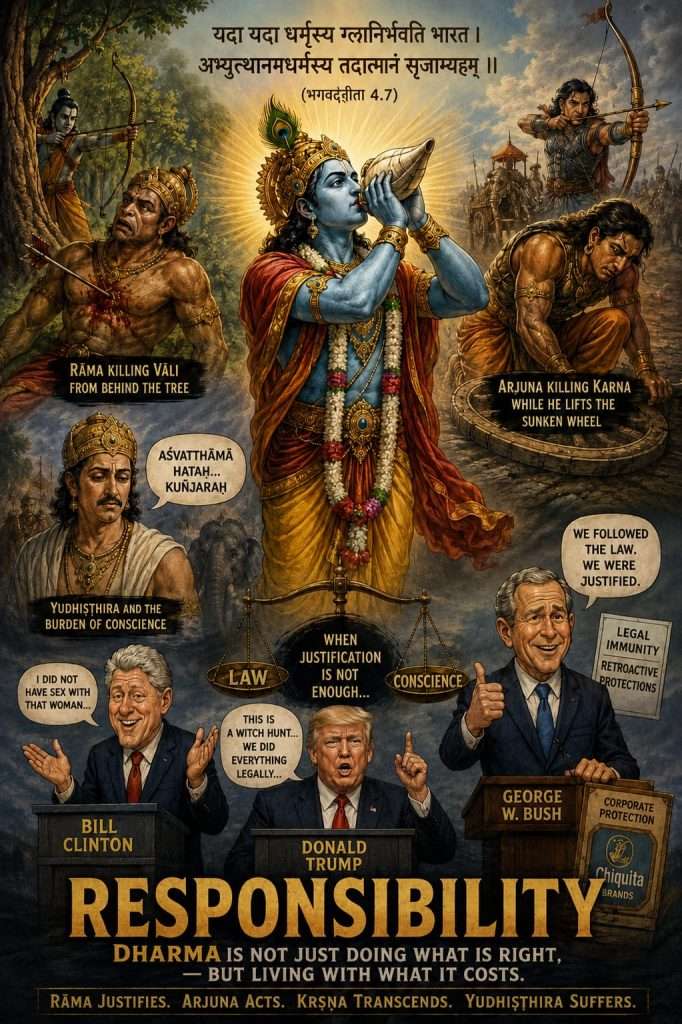
What Rāma, Yudhiṣṭhira, Clinton, Bush and Trump Reveal About Moral Responsibility
What is dharma? Few questions in Indian thought are as subtle, difficult, and troubling as this one. The Mahābhārata itself admits that dharma is hidden, uncertain, and difficult to grasp fully even for the wise. Logic leads to endless conclusions, scriptures appear to differ among themselves, and sages do not always agree. In one of the most famous verses in the epic, Yudhiṣṭhira tells the Yakṣa:
tarko ’pratiṣṭhaḥ śrutayo vibhinnāḥ
naiko ṛṣir yasya vacaḥ pramāṇam |
dharmasya tattvaṁ nihitaṁ guhāyāṁ
mahājano yena gataḥ sa panthāḥ ||¹
Inferential logic is uncertain; scriptures differ; no single sage possesses final authority. The truth of dharma lies hidden in a cave. Therefore, the path followed by the great is the path to follow.
Yet even this answer leaves us with another question: who are the “great,” and what happens when even the great stand morally divided within themselves?
Arvind Sharma notes that the word mahājana in this verse may not merely mean “great individuals,” but “the great mass of people” or moral consensus itself.² Even this ambiguity reflects the larger problem: dharma is never mechanically clear.
Indian tradition itself never portrays morality as simple. Certain Vedic stories even preserve a subtle tension between gods and humans. Patrick Olivelle discusses traditions in which the gods, having attained heaven through sacrifice, erased the traces of sacrifice from the earth lest humans also rise to their level.³ Yet the ṛṣis rediscovered the hidden knowledge through toil, austerity, and spiritual effort.
Similarly, Wendy Doniger O’Flaherty observes that Hindu mythology preserves several explanations for the existence of evil and adharma: sometimes because dharma becomes meaningful only in contrast to adharma; sometimes because the gods fear humans becoming too powerful; and sometimes because the divine itself descends into the world of suffering and moral conflict in order to redeem it.⁴
Thus from the earliest layers of Indian thought, dharma is never portrayed as morally transparent. Power, morality, cosmic order, and human suffering remain deeply intertwined.
It is within this morally uncertain world that the great epics present their heroes.
Many discussions on dharma focus on morally troubling episodes from the Rāmāyaṇa and Mahābhārata: Rāma killing Vāli from concealment, Arjuna killing Karṇa while he struggled to lift the wheel of his chariot, and Yudhiṣṭhira’s role in the death of Droṇa through the ambiguous statement concerning Aśvatthāman. Yet among all these figures, one man stands apart in a profoundly human way—not because he is morally flawless, but because he refuses to escape the burden of moral responsibility.
This insight emerges with remarkable depth in Alf Hiltebeitel’s discussion of Rāma and Yudhiṣṭhira in his book Dharma.⁵ Hiltebeitel’s comparison is extraordinary because he moves beyond simplistic moral judgment and instead examines the inner moral consciousness of the epic heroes themselves.
Hiltebeitel observes that the killings of Vāli and Karṇa form “an iconic and structural pair.”⁶ Both involve warriors attacked while disadvantaged. In each case divine authority stands behind the act: Rāma in one epic, Kṛṣṇa in the other. Yet the deeper issue lies not merely in the acts themselves but in the moral responses that follow them.
In the Rāmāyaṇa, Rāma justifies his killing of Vāli through royal duty and righteous kingship. The epic largely shields him from prolonged moral uncertainty. As Hiltebeitel remarks, “Rāma, of course, does not put non-cruelty above truth.”⁷ Truth and kingly dharma override moral hesitation.
The Mahābhārata, however, moves in a darker and more inward direction.
Even Arjuna, often celebrated as the ideal warrior, is not morally uncomplicated. Earlier in the epic tradition, the Niṣāda youth Ekalavya displayed extraordinary skill in archery through devotion to Droṇa as his unseen guru. When Droṇa realized that Ekalavya’s talent threatened Arjuna’s position as his foremost disciple, he demanded Ekalavya’s right thumb as guru dakṣiṇā. Ekalavya obeyed without hesitation, but the act permanently destroyed his future as a great archer. The epic quietly reveals that even revered teachers and heroic warriors remain entangled within hierarchy, ambition, loyalty, and morally troubling acts.
The same complexity appears later during the Kurukṣetra war.
Droṇa, teacher of both Kauravas and Pāṇḍavas, had become nearly invincible on the battlefield. Unable to defeat him directly, Kṛṣṇa devised a strategy. Bhīma killed an elephant named Aśvatthāman and loudly proclaimed that “Aśvatthāman is dead.” Since Droṇa trusted only Yudhiṣṭhira’s truthfulness, he turned to him for confirmation.
Pressed by the terrible necessities of war, Yudhiṣṭhira uttered the famous words:
Aśvatthāman hataḥ… kuñjaraḥ
“Aśvatthāman is dead… the elephant.”
According to the tradition, Kṛṣṇa deliberately blew his conch at that moment so that the final word—kuñjaraḥ (“the elephant”)—was drowned out. Believing that his son had died, Droṇa laid down his weapons and was then beheaded by Dhṛṣṭadyumna [brother of Drupathi].
Strategically, the act was justified for the preservation of the Pāṇḍavas and the larger cause of dharma. Yet Yudhiṣṭhira never escapes its moral burden.
This is where the Mahābhārata becomes spiritually extraordinary.
After listening to Arjuna denounce him and Bhīma defend him, Yudhiṣṭhira finally speaks in anguish. Hiltebeitel beautifully observes that his words brim not only with despair, but also with subtle rebuke toward both Arjuna and Kṛṣṇa.⁸ Yudhiṣṭhira declares:
“Dharma-souled Kṛṣṇa will also make himself safe. He is competent to instruct the world, what more himself!”⁹
This is one of the most profound and painful moments in the entire epic.
Yudhiṣṭhira does not openly reject Kṛṣṇa. Nor does he deny the strategic necessity of what occurred. Yet hidden within his words is a deeply human realization: Kṛṣṇa, as divine guide and avatāra, can move through morally dangerous actions for the preservation of cosmic order and yet remain untouched by inner collapse. The divine strategist remains secure. But the human participant must continue to live with the wound created by action.
Hiltebeitel perceptively notes that Yudhiṣṭhira accepts responsibility for the death of Droṇa while simultaneously exposing the painful contradictions surrounding him—Arjuna’s accusations, Droṇa’s partiality, and the brutal necessities of war itself.¹⁰
This tension may represent one of the deepest theological and existential moments in the Mahābhārata. Kṛṣṇa can guide the world through the complexity of dharma because he stands above ordinary human limitation. Yudhiṣṭhira cannot escape so easily. Even when the action serves dharma, conscience still bleeds. But it is not merely his bleeding conscience that matters. The epic also shows him reaping the consequences of his action. According to the tradition, the wheels of Yudhiṣṭhira’s chariot, which had always remained slightly above the earth cushioned by the power of his truthfulness and righteousness, touched the ground after his participation in the deceptive killing of Droṇa. Later, even after a life devoted to dharma, Yudhiṣṭhira must briefly experience hell before finally reaching heaven. The Mahābhārata thus refuses to grant even its most righteous hero complete moral immunity from the consequences of morally troubling action.
What makes Yudhiṣṭhira extraordinary is that he never seeks refuge in metaphysical justification. He does not absolve himself through divine command, destiny, avatāra doctrine, or philosophical detachment. He remains painfully human.
Hiltebeitel therefore makes a remarkable observation:
“Only Yudhiṣṭhira admits guilt, that is, admits himself accountable as a sinner.”¹¹
This becomes the decisive distinction between Rāma, Arjuna, Kṛṣṇa, and Yudhiṣṭhira.
Rāma justifies.
Arjuna acts.
Kṛṣṇa transcends.
But Yudhiṣṭhira suffers.
At this point Alf Hiltebeitel introduces startling modern comparisons to illuminate the continuing universality of this moral problem. He compares Yudhiṣṭhira’s “elephant” deception and subsequent punishment with Bill Clinton’s famous carefully worded denial regarding Monica Lewinsky: “I did not have sex with that woman….”¹² By contrast, he compares the immediate moral and legal justifications surrounding Rāma’s actions to modern systems of political and institutional immunity, including retrospective legal protections associated with the George W. Bush presidency and even corporate protections connected with the Chiquita Brands International controversies in Colombia.¹³ In a more recent and highly polarised political landscape, figures such as Donald Trump further intensify this pattern, where legal defence, political loyalty, and public denial intersect with equally forceful accusations of ethical violation and democratic accountability, producing not resolution but heightened moral turbulence in which the very language of innocence and blame becomes part of the struggle over legitimacy.
These comparisons are intentionally provocative. Their purpose is not partisan politics, but moral illumination. They reveal that the ethical dilemmas of the Mahābhārata are not relics of ancient India. The same tensions between legality and morality, power and accountability, justification and conscience continue in every age.
That is why Hiltebeitel calls Yudhiṣṭhira “a rare kind of man in the Indian epics.”¹⁴
The prevailing epic ideal, he observes, is that the truly knowing Self remains untouched by morally staining acts. “The compound ‘of stainless acts,’ reserved for men,” Hiltebeitel writes, “is used mainly for these three characters”—Rāma, Arjuna, and Kṛṣṇa.¹⁵ In other words, the epic tradition often grants its greatest heroes a kind of metaphysical immunity from moral contamination.
Yet Yudhiṣṭhira appears unable—or unwilling—to seek refuge in such immunity. Even though he hears teachings that could absolve him from guilt, “he seems to have no use for it.”¹⁶
And thus Hiltebeitel arrives at one of the most penetrating conclusions ever written about the Mahābhārata:
“Yudhiṣṭhira’s dharma biography comes from within. Unlike Rāma’s, and like the Buddha’s, it is one of moral and spiritual reflection.”¹⁷
Here the Mahābhārata reaches a depth rarely found in world literature. Dharma is no longer merely obedience to cosmic law or kingly duty. It becomes an inward moral struggle within the human soul itself.
Yudhiṣṭhira emerges as spiritually profound not because he is morally perfect, but because he fully experiences the tragic burden of moral action. He upholds dharma, yet never escapes its weight.
And perhaps that is why, among all the heroes of the epic, Yudhiṣṭhira remains the most human.
Conclusion
The Mahābhārata ultimately refuses to offer a comfortable resolution to the problem of dharma. It does not allow moral action to settle into certainty, nor does it permit conscience to be silenced by success, necessity, or authority. Instead, it leaves the human being suspended within a permanent ethical tension—between what is required, what is justified, and what continues to trouble the soul after the act is complete.
In this sense, Yudhiṣṭhira stands not as an exception to moral ambiguity but as its most transparent witness. His greatness lies precisely in his inability to escape the interior consequences of action. Where others may rely on divine mandate, heroic necessity, or institutional justification, he remains exposed to guilt, reflection, and the enduring question of whether dharma has truly been served. One further point worth noting is that although he is born of divine parentage—as the son of Yama through Kuntī—this semi-divine origin never provides him any moral exemption or advantage in the ethical sphere. As Hiltebeitel observes in another context regarding the Pāṇḍavas’ divine connections, their godly origins do not translate into immunity from moral struggle; rather, they remain fully embedded in human ethical ambiguity.
This unresolved moral condition is not confined to the world of epic narrative. It reappears with striking clarity in modern democratic politics, where language and legality often strive to stabilize actions that remain ethically contested. The carefully framed denial associated with Bill Clinton during the Lewinsky affair, or the expansive debates over executive authority, war powers, and national security decisions during the presidency of George W. Bush, reveal how modern leadership too must negotiate the fragile boundary between justification and moral accountability. In a more recent phase of heightened political polarisation, similar dynamics can be observed in the rhetoric surrounding Donald Trump, where competing claims of legality, loyalty, and ethical violation further expose the instability of moral consensus in public life.
These parallels are not intended as direct equivalences between epic figures and modern statesmen, but as structural echoes of a persistent human dilemma: the difficulty of reconciling action in the world with moral clarity in the self. Whether in the battlefield of Kurukṣetra or the contested arena of contemporary politics, moral responsibility does not dissolve once justification is offered. It continues as an inward pressure, as memory, as conscience, and as the lingering question of dharma itself.
Seen in this light, Yudhiṣṭhira becomes not merely an epic hero but a symbolic reminder of an enduring truth: that moral life is never completed at the moment of action. It continues afterward, within the silent and often painful dialogue between what was done and what must still be borne.
Ashram, May 10, 2026
Appendix I
“Aśvatthāman Hataḥ Kuñjaraḥ”
During the Kurukṣetra war, Droṇa was devastating the Pāṇḍava forces and could not easily be defeated in direct combat. Kṛṣṇa therefore devised a strategy to disarm him emotionally.
Bhīma killed an elephant named Aśvatthāman and loudly announced:
Aśvatthāman hataḥ
“Aśvatthāman is dead.”
Droṇa, however, trusted only Yudhiṣṭhira, whose commitment to truth was legendary. Pressured by the demands of war and persuaded that Droṇa had to be stopped for the preservation of dharma, Yudhiṣṭhira declared:
Aśvatthāman hataḥ… kuñjaraḥ
“Aśvatthāman is dead… the elephant.”
Tradition holds that Kṛṣṇa deliberately blew his conch at that moment so that the final word, kuñjaraḥ (“the elephant”), could not be heard by Droṇa. Believing that his son had died, Droṇa laid down his weapons in grief. He was then beheaded by Dhṛṣṭadyumna.
Though strategically successful, the event became a lasting source of moral anguish for Yudhiṣṭhira.
Appendix II
Ekalavya and the Right Thumb
Ekalavya was a young Niṣāda prince who deeply admired Droṇa and wished to become his disciple. Since Droṇa refused to teach him, Ekalavya created a clay image of Droṇa and trained himself in archery with extraordinary devotion and discipline.
Eventually his skill became so great that even Arjuna feared he might surpass him.
When Droṇa learned of Ekalavya’s achievement, he demanded guru dakṣiṇā from him. Ekalavya willingly agreed. Droṇa then asked for Ekalavya’s right thumb.
Without hesitation, Ekalavya cut off his thumb and offered it to Droṇa. The act permanently crippled his ability as an archer and ensured that Arjuna would remain unsurpassed.
The Mahābhārata does not offer a simple moral judgment on this episode. Instead, it quietly reveals how even revered teachers and heroic figures remain entangled within social hierarchy, ambition, loyalty, and moral complexity.
Notes
- Mahābhārata, Vana Parva. Translation adapted from Bal Gangadhar Tilak, Śrīmad Bhagavadgītā-Rahasya, trans. A. S. Sukthankar (Poona: Tilak Brothers, 1986), 97.
- Arvind Sharma, Hinduism for Our Times (Delhi: Oxford University Press, 2001), 19–20; citing P. V. Kane.
- Patrick Olivelle, The Āśrama System: The History and Hermeneutics of a Religious Institution (New York: Oxford University Press, 1993), 10, 38.
- Wendy Doniger O’Flaherty, The Origins of Evil in Hindu Mythology (Delhi: Motilal Banarsidass, 1980), 378.
- Alf Hiltebeitel, Dharma: (Honolulu: University of Hawai‘i Press, 2010), chapter 6.
- Ibid., 86.
- Ibid., 87.
- Ibid., 86.
- Ibid., 86.
- Ibid., 86.
- Ibid., 87.
- Ibid., 87.
- Ibid., 87–88.
- Ibid., 88.
- Ibid., 88.
- Ibid., 88.
- Ibid., 88.
Bibliography
Alf Hiltebeitel. Dharma: Its Early History in Law, Religion, and Narrative. Honolulu: University of Hawai‘i Press, 2010.
Wendy Doniger O’Flaherty. The Origins of Evil in Hindu Mythology. Delhi: Motilal Banarsidass, 1980.
Patrick Olivelle. The Āśrama System: The History and Hermeneutics of a Religious Institution. New York: Oxford University Press, 1993.
Arvind Sharma. Hinduism for Our Times. Delhi: Oxford University Press, 2001.
Bal Gangadhar Tilak. Śrīmad Bhagavadgītā-Rahasya. Translated by A. S. Sukthankar. Poona: Tilak Brothers, 1986.
Leave a Reply