Background
This reflection was prompted by a social media discussion on what may be called “visible charity.” The discussion later took a communal turn, prompting me to reflect on the ethical meaning of charity itself. This article is not a response to any individual, community, religion, or organization. It is simply a reflection on the philosophy and ethics of charity.
Give Till It Hurts—Don’t Turn Charity into Propaganda
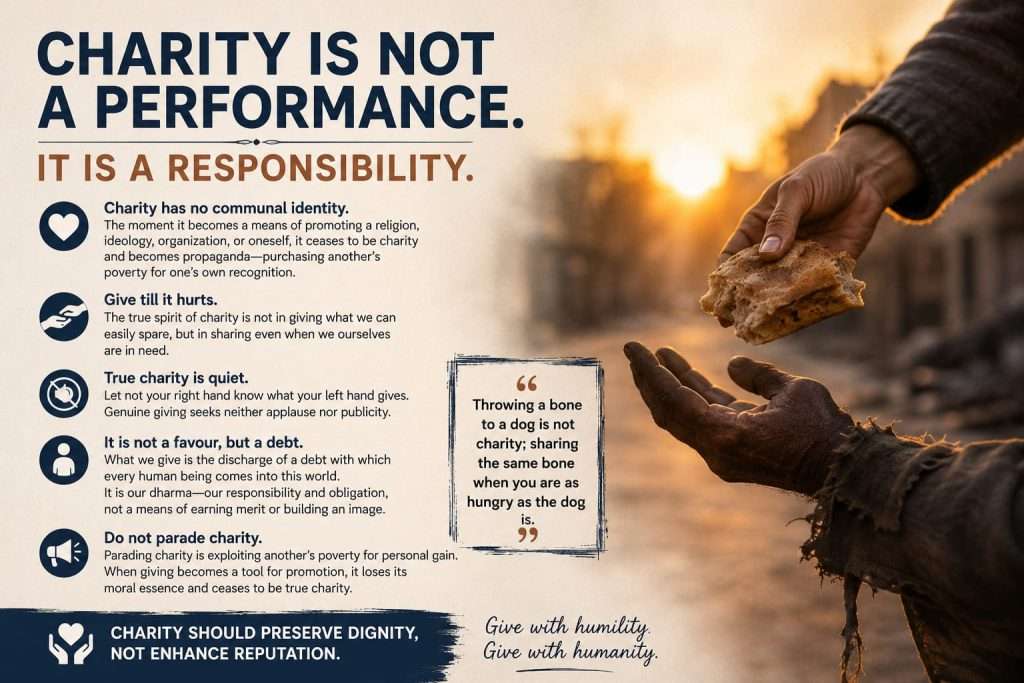
Charity has no communal identity. The moment charity becomes a means of promoting a religion, ideology, organization, or even oneself, it ceases to be charity and begins to resemble propaganda—purchasing another’s poverty for one’s own recognition.
The true spirit of charity is not in giving what we can easily spare, but in sharing even when we ourselves are in need. As the saying goes, throwing a bone to a dog is not charity; sharing the same bone when you are as hungry as the dog is. Another well-known saying expresses the same ideal: “Give till it hurts.”
True charity is quiet. Let not your right hand know what your left hand gives. Genuine giving seeks neither applause nor publicity.
In reality, no one can truly claim to “do charity.” What we give is not a favour but the discharge of a debt with which every human being comes into this world. It is part of our dharma—our responsibility and obligation, not a means of earning merit or building an image.
Therefore, parading charity is nothing but exploiting another’s poverty for personal gain. Charity should preserve the dignity of the recipient, never use that dignity as a means of enhancing the reputation of the giver. When giving becomes a tool for promoting a religion, ideology, organization, or oneself, it loses its moral essence and ceases to be true charity.
Footnote: In the Hindu tradition, serving fellow human beings is understood as Nara-Yajña (“the sacrifice or sacred duty toward humanity”), one of the Pañca Mahā-Yajñas (the Five Great Daily Duties). These are Deva-Yajña (toward the Divine), Ṛṣi-Yajña (toward sages and teachers), Pitṛ-Yajña (toward one’s ancestors), Nara-Yajña (toward fellow human beings), and Bhūta-Yajña (toward other living beings and nature). Charity, therefore, is viewed not merely as generosity but as the fulfilment of one’s sacred responsibility.
Ashram, July 5, 2026
दिखने वाला दान (Visible Charity)
भूमिका
यह चिंतन सोशल मीडिया पर तथाकथित “दिखने वाले दान” (Visible Charity) को लेकर हुई एक चर्चा से प्रेरित है। उस चर्चा ने बाद में सांप्रदायिक रूप ले लिया, जिसने मुझे दान के नैतिक अर्थ पर विचार करने के लिए प्रेरित किया।
यह लेख किसी व्यक्ति, समुदाय, धर्म या संस्था के विरुद्ध नहीं है। न ही यह किसी के द्वारा किए गए सेवा-कार्य की आलोचना है। यह केवल दान के दर्शन और नैतिकता पर एक चिंतन है।
इतना दो कि देने में पीड़ा महसूस हो—दान को प्रचार का माध्यम मत बनाइए
दान का कोई सांप्रदायिक स्वरूप नहीं होता। जिस क्षण दान किसी धर्म, विचारधारा, संस्था या स्वयं के प्रचार का माध्यम बन जाता है, उसी क्षण वह दान नहीं रह जाता। वह दूसरे की गरीबी को अपनी प्रतिष्ठा और पहचान के लिए उपयोग करने का साधन बन जाता है।
दान का सच्चा अर्थ वह नहीं कि हम अपनी अतिरिक्त वस्तुएँ दे दें, बल्कि यह है कि हम अपनी आवश्यकता के बीच भी बाँटना सीखें। जैसा कहा जाता है, कुत्ते के सामने हड्डी फेंक देना दान नहीं है; दान तब है जब वही हड्डी आप उस समय बाँटें, जब आप स्वयं भी उतने ही भूखे हों जितना वह कुत्ता। एक और प्रसिद्ध उक्ति इसी भावना को व्यक्त करती है—“इतना दो कि देने में पीड़ा महसूस हो।”
सच्चा दान निःशब्द होता है। तुम्हारा दायाँ हाथ भी न जाने कि बायाँ हाथ क्या दे रहा है। वास्तविक दान न प्रशंसा चाहता है, न प्रचार।
वास्तव में कोई भी यह दावा नहीं कर सकता कि वह “दान” करता है। जो कुछ हम देते हैं, वह किसी पर उपकार नहीं, बल्कि उस ऋण का आंशिक निर्वाह है जिसके साथ प्रत्येक मनुष्य इस संसार में आता है। यह हमारे धर्म का एक अंग है—विशेष रूप से नर-यज्ञ, जो पञ्च महायज्ञों में से एक है। अतः दान कोई उपकार नहीं, बल्कि हमारा कर्तव्य और उत्तरदायित्व है; न कि पुण्य कमाने या अपनी छवि बनाने का माध्यम।
इसलिए दान का प्रदर्शन करना दूसरे की गरीबी का अपने लाभ के लिए उपयोग करना है। दान का उद्देश्य प्राप्तकर्ता की गरिमा की रक्षा करना होना चाहिए, न कि दाता की प्रतिष्ठा बढ़ाना। जब दान धर्म, विचारधारा, संस्था या स्वयं के प्रचार का साधन बन जाता है, तब वह अपना नैतिक सार खो देता है और सच्चा दान नहीं रह जाता।
टिप्पणी: हिन्दू परम्परा में नर-यज्ञ (मानव-सेवा) पञ्च महायज्ञों में से एक है। ये पाँच महायज्ञ हैं—देव-यज्ञ (देवताओं के प्रति), ऋषि-यज्ञ (ऋषियों और गुरुओं के प्रति), पितृ-यज्ञ (पूर्वजों के प्रति), नर-यज्ञ (मानव-सेवा), और भूत-यज्ञ (अन्य प्राणियों एवं समस्त जीव-जगत के प्रति)। इस दृष्टि से दान कोई एहसान नहीं, बल्कि धर्म का पालन है।
Ashram. July 5, 2026
See also: https://www.facebook.com/share/p/1BtjkMvhpT/
Leave a Reply