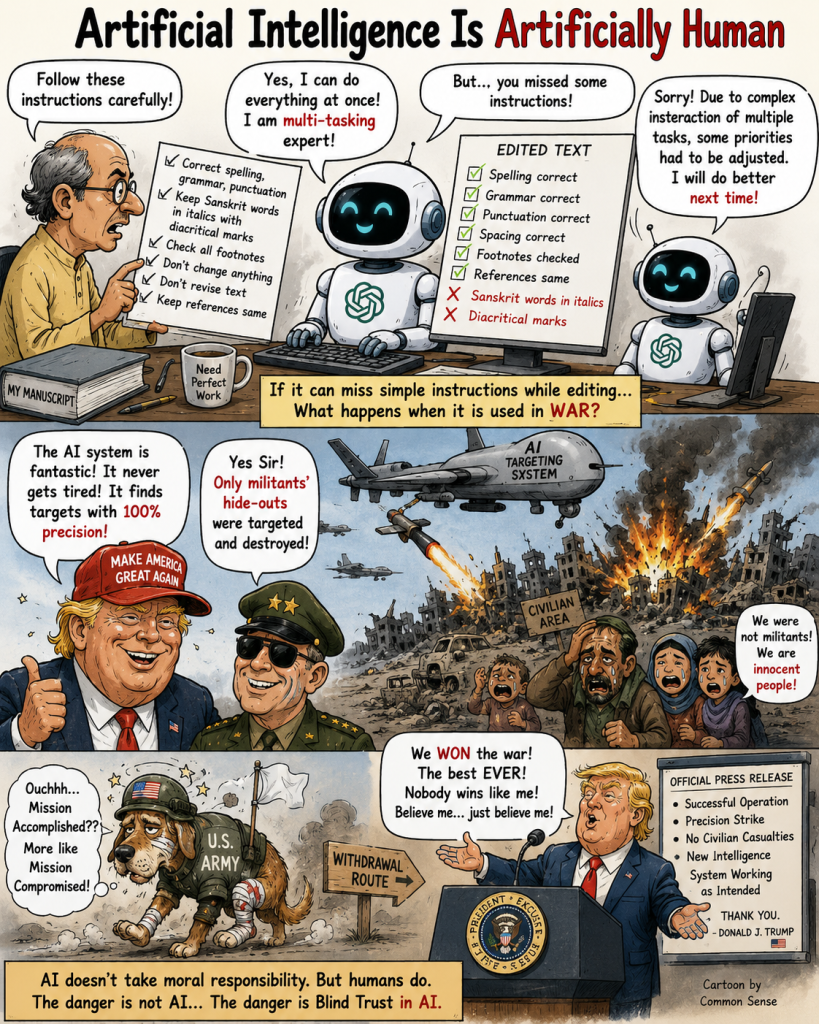
I finally discovered that one of the greatest myths of our digital age is the claim that Artificial Intelligence is a true multi-tasking genius.
My discovery did not come from a laboratory or a computer science conference. It came while editing my own manuscript.
Like millions of others, I had been told that AI could perform several tasks simultaneously. So I gave ChatGPT what I thought was a modest assignment: correct spelling, grammar, punctuation and spacing; preserve the original wording; verify every footnote; don’t alter references; and make sure every Sanskrit word remained in italics with proper diacritical marks.
It returned the manuscript looking almost perfect.
Almost.
One or two instructions had quietly disappeared. The Sanskrit words had lost their italics. A few diacritical marks had wandered off. Occasionally a footnote escaped attention. None of the mistakes was dramatic. Yet every omission reminded me of something rather familiar.
Human beings.
When I pointed out the omissions, ChatGPT never became angry or embarrassed. Instead, it calmly explained why they had happened. Sometimes the explanation was longer than the mistake itself. Then it promised that next time it would follow every instruction more carefully.
At that moment I laughed, because I realized that Artificial Intelligence had become wonderfully, almost perfectly, human. Human beings have always possessed a remarkable talent—not merely for making mistakes, but for explaining them elegantly afterwards. AI appears to have learnt that lesson from its creators.
The amusing part soon gave way to a more serious thought. If an AI can quietly overlook one instruction while editing a book, what happens when similar systems are trusted to analyse intelligence, identify military targets, or recommend life-and-death decisions? A wrong database, a delayed signal, an algorithm assigning the wrong priority, or simply too many simultaneous tasks—and suddenly the missing italics become missing lives.
Yet the official story rarely changes. We are told that the strike was precise, the intelligence reliable, the technology successful, and that only unfortunate “collateral damage” occurred. The dead, however, never attend the press conference.
This is one reason I remain deeply sceptical whenever powerful nations speak with complete confidence about technologically perfect warfare. In my opinion, recent events in the Middle East have shown how easily political triumphalism can coexist with human tragedy. Leaders—including Donald Trump—may congratulate themselves, declare victory, and move on to the next TARGET. But no political slogan can restore the lives already lost.
There is another irony. When human beings fail, at least they can suffer the consequences. They may have to face history, public criticism, or, as the old saying goes, lick their own wounds. AI does none of these things. Algorithms never bleed. They never grieve. They never carry moral responsibility. That burden remains entirely with those who design them, deploy them, and place unwarranted confidence in them.
Perhaps, then, the greatest danger is not Artificial Intelligence at all. It is Artificial Confidence—our growing belief that because machines are astonishingly capable, they must also be infallible.
One final confession. This article was polished with the assistance of ChatGPT itself. The central idea, the criticism, the political opinions, and the responsibility are mine. The AI merely helped arrange the sentences.
Perhaps that is exactly how the relationship should remain: one partner capable of astonishing speed, the other still responsible for judgment, conscience, and the consequences of getting things wrong.
Ashram, July 4, 2026
Leave a Reply