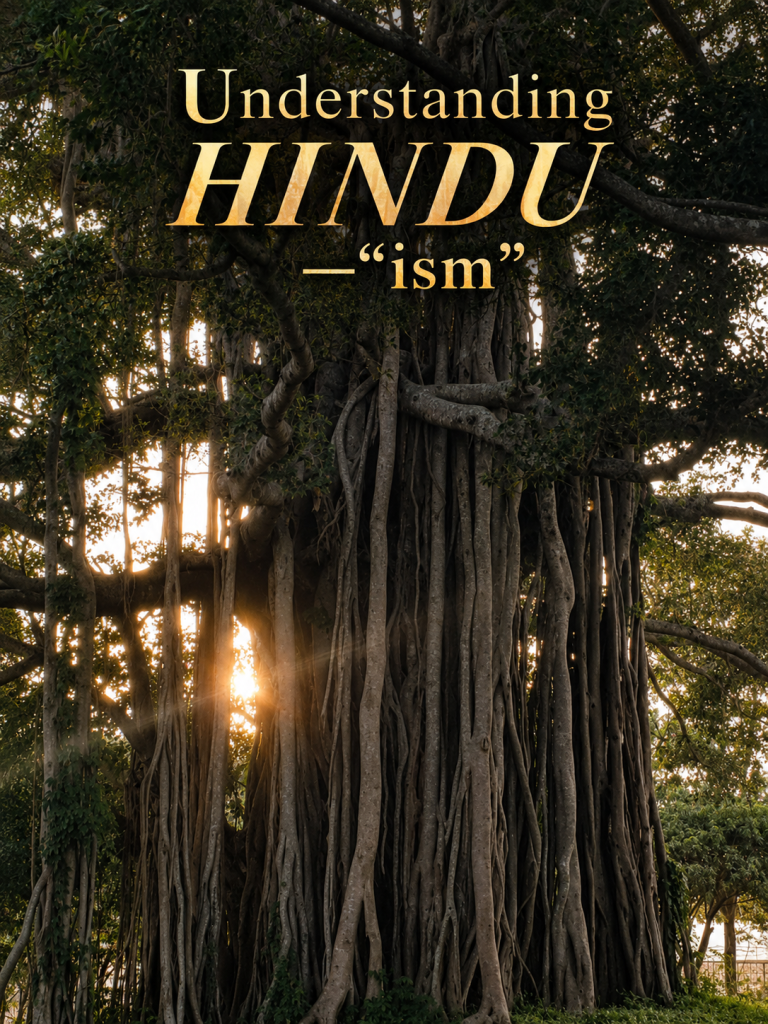
As I complete the third revised edition of Understanding HINDU—”ism”, I find myself returning to a simple question:
How do we truly understand a religion?
This question also explains why I have made two small but significant changes in this revised edition. The first is the title, now changed from Understanding Hinduism to
Understanding
HINDU
“ism.”
The second is the cover, where the banyan tree from our ashram replaces the ashram building. Neither change is merely cosmetic. Both reflect the central insight that gradually emerged while revising this book.
The banyan tree offers a fitting image for understanding Hinduism. From a single living organism, its branches spread outward and gradually send down new roots, which in time become sturdy trunks themselves. To an observer, it may appear to be many trees, yet it remains one living whole. In much the same way, Hinduism has grown through countless traditions, philosophies, communities, and practices. Diverse though they are, they remain connected to a larger civilizational and spiritual inheritance that has continually grown, adapted, and renewed itself without losing its continuity.
Most of us assume that understanding another religion merely requires reading its scriptures or observing the lives of its followers. Yet neither approach, by itself, is sufficient.
In the concluding chapter of the book, I use another simple analogy.
The scriptures and literature of a religion are like the doorway to a house. They provide the proper entrance through which outsiders may enter the inner world of a faith and discover how its members understand and live their religion. One cannot simply stand outside the house, observe its occupants from a distance, and imagine that one has understood their deepest beliefs, values, and aspirations.
At the same time, those who already live within the house look out upon the world through the windows of their own scriptures, traditions, and inherited interpretations. Every window offers a view, but every view is necessarily partial. Genuine understanding therefore requires more than looking through our own window. We must also be willing to step outside our own house and encounter others within their own living traditions.
This is true of every religion.
When some Christians speak of a “biblical” way of life, some Muslims of an “Islamic” or “Qur’ānic” way of life, or some Hindus describe certain ideas as “Vedic,” they are expressing the understanding of particular living traditions. Sacred texts do not interpret themselves. They are always understood, lived, and transmitted through communities of faith. No religious tradition can therefore be understood either by scripture alone or by the behaviour of its followers alone. Both belong together.
This insight has shaped the central argument of my book.
Hinduism cannot be understood merely through its scriptures, philosophies, or theological systems. It must also be understood through the Hindus themselves—the people who have lived, preserved, interpreted, questioned, enriched, and transmitted this vast civilizational tradition across countless generations. In this sense, the living Hindu comes before the abstract “ism.”
This conviction has led me to make a small but significant change to the title of the third revised edition—from Understanding Hinduism to Understanding HINDU—”ism.” The change reflects the central theme that gradually emerged during the revision of the book: before we attempt to understand Hinduism, we must first seek to understand the Hindu.
Perhaps this principle extends beyond Hinduism itself.
Understanding another religion is ultimately not an academic exercise but a human encounter. It begins when we have the humility to enter another’s house through its own doorway and the courage to step outside our own house to meet others as neighbours rather than strangers.
Like the banyan tree, whose branches continue to grow while remaining rooted in the same living organism, the journey of understanding has no final destination. Every ending becomes the beginning of a new understanding.
Ashram
August 1, 2026
Leave a Reply