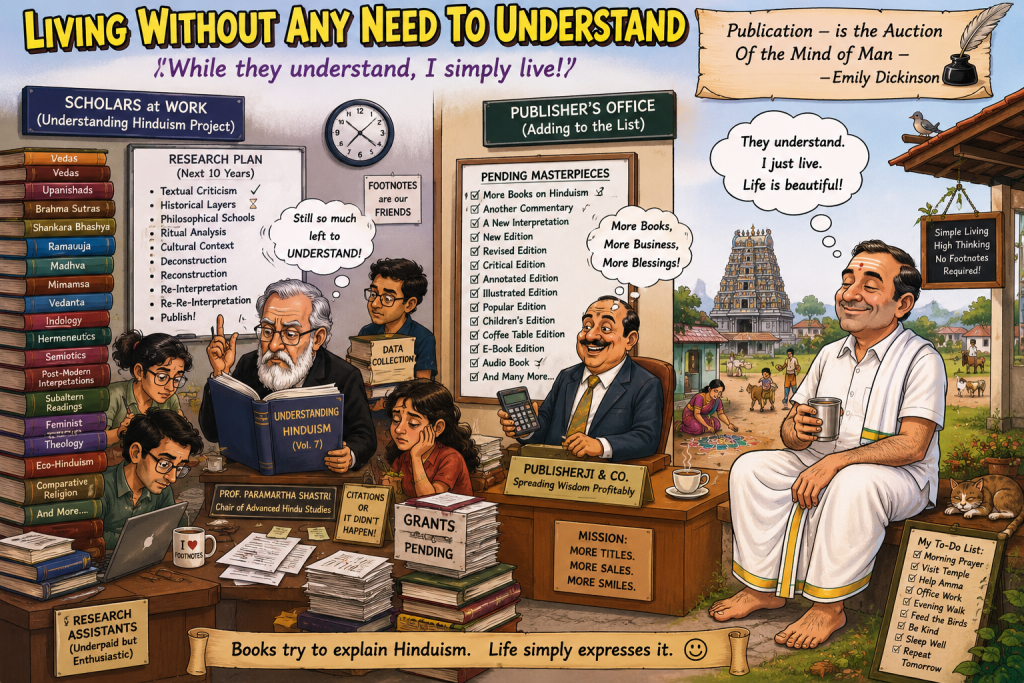
A Layman’s Friendly Rebellion Against Scholars
Whatever their limitations, however, we cannot ignore the enormous contribution made by scholars—both Indian and Western—to the study of Hindu traditions. Their painstaking research has preserved texts, uncovered forgotten histories, clarified philosophical ideas, and enriched our understanding of one of the world’s oldest living civilizations. Yet scholarship is only one way of engaging with Hinduism. Ordinary Hindus have also preserved the tradition—not through books and footnotes, but through daily worship, festivals, family customs, pilgrimages, songs, stories, and lived experience. Rather than depending entirely upon scholars, lay people too should make sincere efforts to understand their own traditions with humility, openness, and critical reflection.
That sounds perfectly reasonable.
But then one of my close relatives, a highly educated person with absolutely no interest in academic discussions on Hinduism, listened patiently to my explanation of why I was writing a book to help ordinary readers “understand Hinduism.”
He looked at me with genuine surprise.
Then came his response.
“Understand Hinduism?
We are already living as Hindus. We don’t wake up every morning wondering whether we have correctly understood our religion. We simply live it.
You scholars have divided the world into ‘philosophical Hinduism’ and ‘popular Hinduism.’ We never did. We don’t call ourselves ‘lay Hindus.’ That’s your label, not ours.
You write books because you enjoy writing. Scholars write books because they need another publication for their résumé. Publishers publish them because publishing is a business. A few people buy them, and the rest eventually decorate library shelves.
But don’t expect us to buy them just to discover whether we have been living as Hindus correctly all these years!
We don’t need a certificate in Hinduism to celebrate Deepavali, visit Tirupati, observe Ekādaśī, perform a wedding, mourn our dead, or teach our grandchildren to fold their hands before God.
We have managed for generations without reading books on Understanding Hinduism. Why should we start now?”
I must confess—I had no immediate answer.
After all, he had never attended a seminar on Hindu philosophy. He could not distinguish Advaita from Viśiṣṭādvaita. He had probably never heard the word “hermeneutics” and certainly had no interest in learning it.
Yet he had lived as a Hindu for decades.
He had celebrated every festival.
He had visited temples all over India.
He had performed family rituals.
He had raised children within the tradition.
He knew when to remove his footwear, when to ring the temple bell, when to keep silence, when to offer flowers, when to light a lamp, and when simply to bow his head.
Without reading a single academic article, he knew exactly how to live as a Hindu.
That conversation has stayed with me ever since.
Perhaps this explains why scholarly books on Hinduism are mostly read by scholars, while millions of Hindus continue to live perfectly content lives without feeling the slightest need to “understand Hinduism” academically.
The scholar says, “First understand, then live.”
The ordinary Hindu smiles and replies, “No, my friend. First live. Understanding can wait.”
And perhaps that is why, after thousands of years, Hinduism has survived not only in universities and libraries, but also in kitchens, temples, village festivals, family stories, crowded pilgrimages, and the countless homes of people who have never once asked themselves whether they have “correctly understood” the religion they quietly live every day.
Now, if you’ll excuse me, I have another chapter to revise on Understanding Hinduism.
My relative, meanwhile, has gone to the temple.
Neither of us thinks the other is entirely wrong.
Ashram, August 6, 2026
Leave a Reply