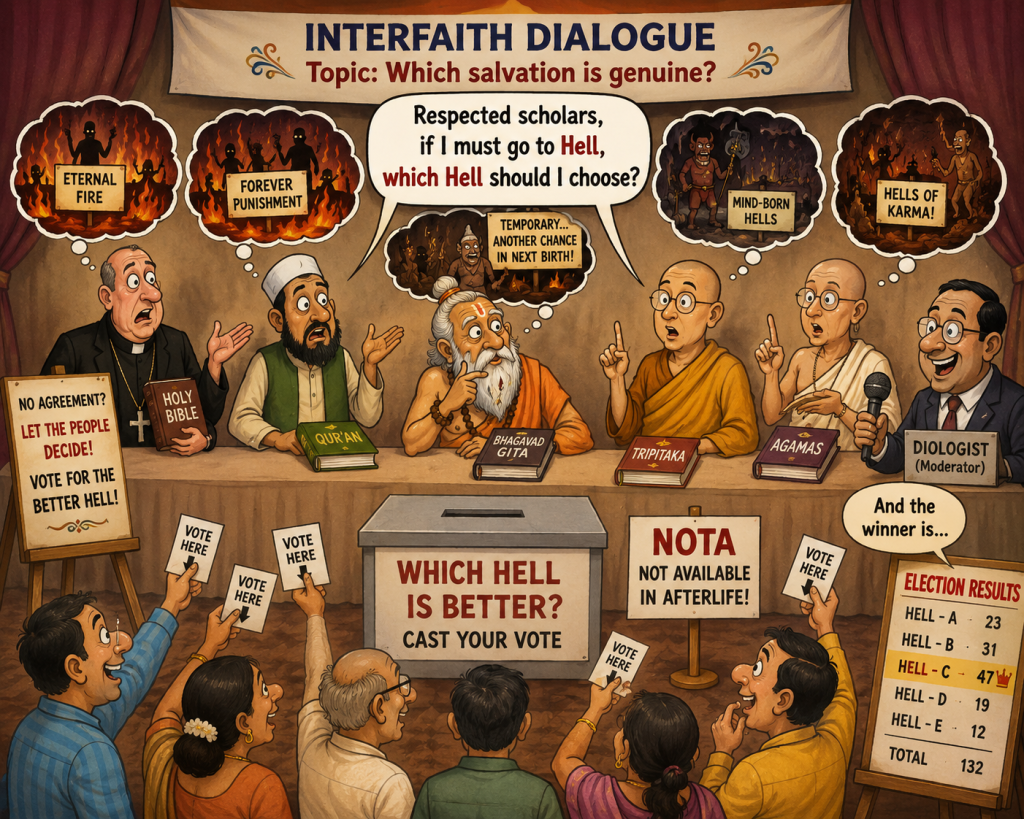
This is a completely imagined interfaith dialogue in which a few ordinary people are also allowed to participate. At the end, the audience is invited to ask questions, which the theologians agree to answer.
After listening to a long discussion about which faith is superior and which one offers authentic salvation, one member of the audience finally raised his hand.
“I have a simple question,” he said.
The theologians looked pleased. Simple questions are usually easier to answer than complicated ones.
“I understand that you do not agree about which salvation is the right one. Each of you has your own Scripture, doctrine and interpretation. But there seems to be at least one thing you have in common: all of you have something to say about Hell.”
The theologians nodded.
“Now, I am neither an agnostic nor a skeptic. I have faith in God, in my chosen Lord and in the Scripture I follow. For me, my RELATIONSHIP [Bhakti] with God is the real destiny. I am not particularly worried about which heavenly address I will finally be given.”
A few theologians smiled approvingly.
“But suppose,” he continued, “that after listening to all of you I still cannot decide which interpretation is correct. And suppose, just for the sake of argument, that I have to go to Hell.”
The smiles disappeared.
“Then I have a practical question. Which Hell should I choose?”
There was silence.
“I ask because all Hells may not be equally unpleasant. In some religious cosmologies, Hell is permanent. In others, there may eventually be another opportunity to work out one’s salvation through another birth. So, if a person is not certain which doctrine is correct, would it not be sensible to choose the Hell that at least leaves open the possibility of another chance?”
The theologians looked at one another. One of them cleared his throat. Another opened a book. A third began explaining that the matter was far too complicated to be reduced to such a simple question. The audience waited.
After several minutes of theological deliberation, the theologians finally announced:
“Unfortunately, we have once again failed to reach an agreement.”
The audience laughed.
“But,” one of them continued, “since this is an interfaith dialogue, and since we are all familiar with democratic procedures, perhaps the audience should decide.”
There was immediate enthusiasm.
Someone in the audience remarked:
“That is not such an unusual way of voting in India. Sometimes people do not vote simply to choose the party they most want. They vote to make sure the party they do not want does not come to power.”
“Excellent!” said the Diologist.
He turned to the theologians.
“Perhaps the same principle can be applied here. We do not have to choose the Hell we like. We only have to decide which Hell we dislike the least.”
There was laughter and applause.
“Then let us vote.”
The theologians voted. The ordinary people voted.
Even the Diologist voted. Just before the votes were counted, someone from the audience shouted:
“What about NOTA?”
There was another round of laughter.
The Diologist looked serious.“Unfortunately, NOTA is not available in the afterlife.” The votes were counted. There was a clear winner.
One Hell had won the election.
And now comes the only question that remains:
Which Hell won?
Ashram, August 17, 2026
Leave a Reply