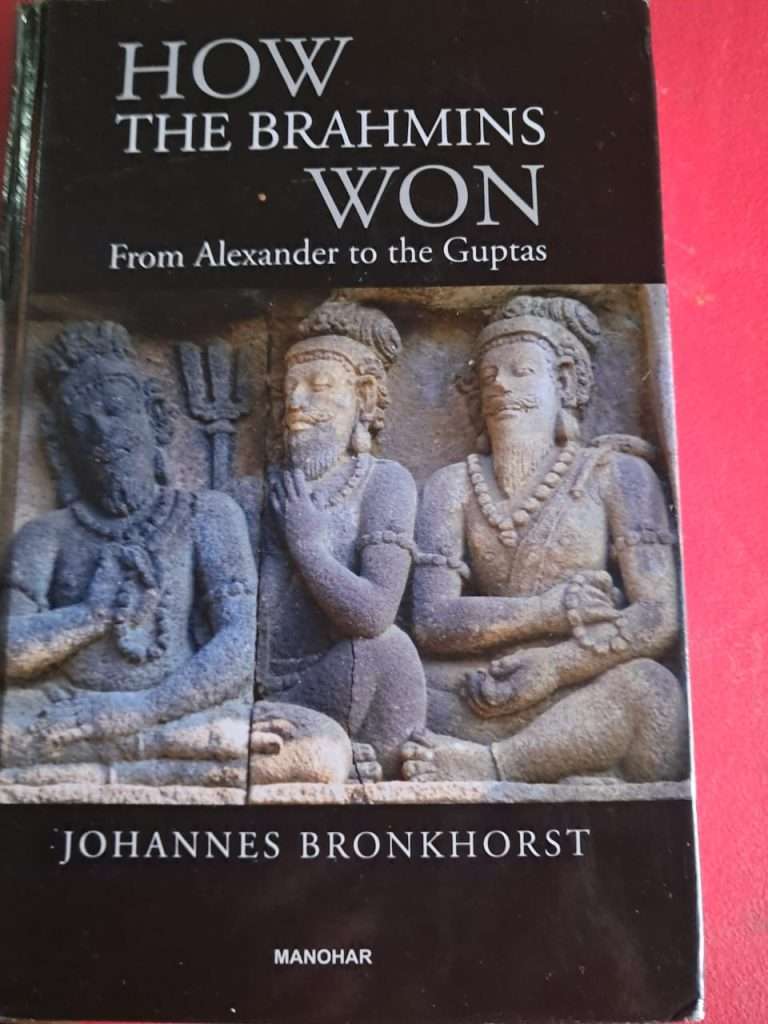
A Lay Reader’s Reflection on Johannes Bronkhorst’s
How the Brahmins Won: From Alexander to the Guptas, New Delhi, Manohar Publishers, 2025
🐘 Taming the Elephant: The Power of Story
The simplest answer to the question, “How did the Brahmins win?” is this: by telling stories. A Tamil proverb captures this well:
யானை வரும் பின்னே மணி ஓசை வரும் முன்னே
The bell rings before the elephant arrives.
Just as the sound of the bell around an elephant’s neck is heard before the elephant is seen, stories laid the groundwork for Brahmanical power long before their influence became visible in political structures. But someone must first tame the elephant and tie the bell. In this book, Bronkhorst has done just that—by carefully analyzing the historical forces and narratives that gave Brahmins their enduring influence.
After the setbacks following Alexander’s invasion in the northwest—when the Brahmins lost both land and influence—they managed to reassert themselves across much of South Asia. How? By creating and disseminating epics like the Ramayana and the Mahabharata, which didn’t merely entertain but subtly taught a lesson: “Don’t cross the Brahmins; better to have them on your side.” (p. 410)
Bronkhorst admits much of this must be assumed, because direct evidence is scarce.1 But his thesis rests on a plausible reconstruction: that these stories—initially composed by Brahmins but later told and retold by others—instilled in kings and commoners alike a belief in Brahmanical authority, ritual purity, and social hierarchy.
And here’s the twist: this didn’t require any social media. It didn’t even require the audience to read or understand Sanskrit. As Bronkhorst points out, Brahmanism presented itself as ancient and eternal—an ideology rooted in stories that felt timeless. By anchoring their tradition in a distant past (for example, through the legend of Parasurama, who humbled kings), Brahmins created a self-understanding that made them appear indispensable—even to monarchs.2
And monarchs responded. They invited Brahmins into their courts and kingdoms, often gifting them land (Agraharas and Brahmadeyas), hoping to benefit from their rituals and cosmic authority. Why? Because Brahmins didn’t want to be kings. As Bronkhorst puts it, “They are also safe in the sense that they will not try to replace the king they advise.” (p. 411) As we note in the case of Chandragupta establishing the Maurya Empire with the legendary Brahmin Canakya, who is credited with the authorship of the Arthasastra (p. 411).
Of course, Bronkhorst doesn’t claim this happened through any single, deliberate strategy. He’s careful to say, “We may conjecture that kings somehow felt they could harness Brahmanical power.” (p. 411)3 And most of what we know comes from the stories themselves—which may be propaganda, or at least emplotted in a way that hides their origin, making it hard to critique them, especially when their values are transmitted implicitly.
That’s why Bronkhorst invokes Hogan’s theory of “implicit emplotment.”4 These stories didn’t preach; they shaped moral instincts. And once shared across kingdoms and languages—particularly the Mahabharata and Ramayana—they helped Brahmanical values take root far beyond their Sanskrit-speaking origins.
“If the morality expressed in the stories is Brahmanical morality, the Brahmanical vision of society is likely to gain a foothold and spread among those who listen to them.” (p. 412)5
This, Bronkhorst argues, is how Brahmins “won” across South and Southeast Asia—not by conquest or conversion, but by narrative diffusion and elite patronage.
📺 From Ancient Epics to Modern Media?
What struck me, as a layperson, is how familiar this strategy feels. It’s not unlike today’s social media manipulations, where corporations and ideologues flood our feeds with curated stories, “expert” takes, and viral slogans—all designed to manufacture conviction. In the same way, those ancient stories sold an idea: that Brahmins were indispensable for both cosmic and political order. Just as Pepsodent marketed dental hygiene as a ritual, Brahmanism marketed itself as a timeless truth.6
Even those opposing Brahmanism were often shaped by it. We can note how Buddhism and Jainism eventually brahmanized—adopting caste structures, Sanskrit idioms, and orthodox rituals. In this sense, Brahminism not only “won”—it changed the rules of the game.
In this Brahmanical hierarchy, even non-Brahmins adopted Brahminical values to elevate themselves—using this ideology for their own political, social, and economic gains. Many studies now show that Brahminism’s dominance among non-Brahmins was not imposed but adopted for advantage, thus sustaining its power for centuries.
That’s why I find Bronkhorst’s book timely. If companies today can shape public opinion through viral narratives, why not imagine Brahmins doing something similar—long before newspapers or the internet?
Of course, these ancient epics weren’t accessible to everyone. The Vedas remained off-limits to the public and the Sanskrit language was reserved for the few. But the values contained within them were translated into performance, ritual, and storytelling—and that was enough.
📚 Do You Need to Read the Whole Book?
Frankly, no. If you’re a lay reader like me, start with:
- Introduction
- Chapter 1: Catastrophe and New Departure (pp. 7–108)
- Conclusion (pp. 404–412)
The rest of the book is a goldmine of scholarship—covering Vedic ritual, grammar, karma theory, philosophy, and more. But be warned: many quotations are in French, without English summaries. It’s dense and demanding, not for the casual reader. Thankfully, with the help of AI, one can now translate those passages with relative ease.
When I read through all the scholarly and technical details, I couldn’t help but wonder: What do all these extensive references—quoting, comparing, contrasting, agreeing, and disagreeing with other scholars—have to do with the central theme of the book? Could this be yet another Brahminical strategy of complicating their thought, cloaking it in philosophical jargon that flies over the heads of ordinary people?7
✝️ Christianity vs. Brahmanism
One of Bronkhorst’s most interesting comparisons is with Christianity. Like Brahmanism, early Christianity spread partly through elite support—notably, Constantine’s conversion in the 4th century.8 But Bronkhorst rightly notes a crucial difference:
“No king needed to convert to Brahmanism. Brahmanism is not the kind of thing you can convert to…. It makes more sense to call it a socio-political ideology with a variable religious dimension.” (p. 408)9
While Constantine’s conversion arguably compromised Christianity’s eastern future10 and while church fathers debated heresies with imperial pressure behind them, Brahmanism spread without institutionalizing itself as a conversion-based religion. Instead, it diffused through reputation, ritual, and association with power.
Rodney Stark’s theory in The Rise of Christianity places more credit on ordinary believers than emperors,11 and Andrew Walls speaks of a “barbarian phase” in Christian expansion. But Brahmanism never needed a “missionary phase”12—its pull factor was its prestige.
However, two things need to be noted here.
First, many believe Constantine’s conversion was a political strategy, much like missionary expansions later sponsored by colonial European powers such as the Portuguese monarchy. In order to win and consolidate his power, Constantine not only sought the support of the Christians who remained marginalized and persecuted before him. Later, when various heresies threatened this Christian solidarity to back up his power, he even forced the Church Leaders to address that issue and settle the matter once for all. And this is the story behind the Nicene Creed.13 Later also, kings and queens had to play a crucial role in shaping various creeds. [See: Jenkins, Jesus Wars]]14
Next, while we agree with Bronkhorst’s observation that “no king needed to convert to Brahmanism,” the reality is that many did so—often willingly—and even supported the efforts of particular sects to eliminate their rivals.
One striking example can be found in the case of the Jain Pandya king known as Koon Pandiyan, later called after his conversion as Nedumaran / Sundara Pandiyan / Ninraseer Nedumaran (நின்றசீர் நெடுமாறன்), who was converted by the Saiva saint Sambandar, at the request of the queen, Mangayarkkarasiyar, also called Seranmadevi. When Sambandar successfully cured the king’s illness, the king not only converted but also persecuted Jains—reportedly by impaling them on sharp stakes, an act referred to in Tamil as Kazhuvetrudal [Impaling].15
Similar stories exist of kings switching allegiance from one sect to another and throwing their support behind the newly adopted faith. In many such instances, this support was not purely spiritual—it was often a strategic move to consolidate political and economic power. The role of Brahminism in facilitating or legitimizing such shifts cannot be ignored.
🧬 The Afterlife of Brahmanism
This is why Bronkhorst’s central claim—that Brahmanism spread not through force or formal conversion, but through stories, association with power, and ritual prestige—feels both credible and profound. And yet, it must be stressed that these very mechanisms also allowed Brahminism to adapt itself over time. It was not a monolith, but a system that could shift, absorb, and co-opt local variations to maintain its status.
As M. N. Srinivas observed in a very different context, hierarchy is always influenced by local factors and is therefore dynamic.16 So too with Brahminism: its prestige wasn’t just imposed from above; it was tailored and negotiated in each local setting, with the help of stories, rituals, alliances—and yes, kings.
Final Thoughts
For those unfamiliar with South Asian history or Sanskrit literature, Bronkhorst’s book can feel overwhelming. But if you begin with the first chapter and conclusion, you’ll grasp the key argument: Brahmins “won” not by domination, but by persuasion—through a sophisticated use of storytelling, ritual, and association with elite power.
This wasn’t accidental. It was the result of careful self-positioning, both mythic and practical. Brahmanism’s claim to antiquity, its moral narrative embedded in epics, and its ability to serve kings without threatening their thrones—these formed the core of its success.
And this story still matters. Because in many ways, we are still living in worlds shaped by ancient stories—often without realizing who wrote them, and why.
After Thought
So, to the question “How did the Brahmins win?”—my answer is: by creating Brahminism and successfully diffusing it throughout Indian society, making it an inevitable part of our collective life.
A Brahmin can walk away from Brahminism—discard it entirely—and still retain his social prestige through other means. But most other Indians don’t have that luxury. For them, Brahminism became a tool for survival and upward mobility—a political strategy dressed up as social ideology.
It’s like a ghost—one that the Brahmins learned to name, narrate, and control, but which came to possess others far more visibly and destructively. And no exorcism seems able to cast it out. (Sociological studies suggest that spirit possession today is more common among the socially marginalized—perhaps symbolically pointing to who now carries the burden.)17
And even those who authored it are not entirely free. Some Brahmins, under the influence of liberal or Marxist ideologies, have even attempted to renounce their Brahmin identity—only to find, in the words of an unnamed South Indian writer quoted by Abbe Dubois:
“Even though I have renounced Brahmanism, the latter will not renounce me.”18
This is the Brahminical reality. If Brahmins cannot entirely shed Brahminism, what hope do others have?
The Brahmins “won” by inventing Brahminism, embedding it in others, and remaining a minority with the last laugh. They were always ready to hand over power—but never their authority.
As I often say:
“Brahmins never wanted power. They gladly gave it to others—but never gave up their authority to decide who gets to hold it.”
Of course, one can change the label—replace Brahminism with another term—but the spirit persists. As long as this Brahminical worldview remains deeply rooted in our society, any reform effort—like Gandhi’s attempt to abolish untouchability (which failed in his time and still eludes us today, as it has now become a political tool to gain power)—will face fundamental limits.
What was diffused from the top down can only be dismantled by a reform that begins from the bottom up.
Unless that deeper transformation takes place, Brahminism will persist—and those who authored it will continue to shape the terms of power.19
Notes
1 Stories of the kind we find in Sanskrit epics must be assumed to have spread. They must have been appreciated and must have left in those who heard them that ‘conviction’.”—Bronkhorst, 2025, p. 410
2 Brahmanism in its own self-understanding was no new phenomenon. Brahmanical literature is at pains to point out that it had been around for a long time… Like the Veda and the Sanskrit language, the world had always been there, with Brahmins and all.—ibid. 410
3 We may conjecture that kings somehow felt they could harness Brahmanical power in this way (even though I am not aware of any texts that explicitly put it this way). All of this information could reach rulers (and others) through the STORIES that were PRESUMABLY created by Brahmins but may subsequently have been told and retold by others.”—ibid. p. 411
4 Patrick Colm Hogan: Understanding Nationalism: On narrative, cognitive science, and identity. Columbus: Ohio State University press, 2009.
5 Stories paved the way for Brahmins who moved to other regions, either invited by the king or simply on their own initiative… Brahmanical stories—primarily the Mahabharata and the Ramayana, but not only these—spread far and wide in the Indian subcontinent and in Southeast Asia… If the morality expressed in the stories is Brahmanical morality, the Brahmanical vision of society is likely to gain a foothold and spread among those who listen to them.— Bronkhorst, 2025, p. 412
6 See more on this in: From Brahmin to Brahminism: The Invention of an Idea and Its Afterlives
8 Royal courts appear to have played a central role in the spread of Brahmanism. This justifies us to return once again to a comparison with Christianity, in whose early spread, too, a royal or rather imperial court played a central role. Christianity was imposed onto the Roman Empire as a result of the conversion of its emperor, Constantine.” – Bronkhorst, 2025 op. cit. p. 407
9. Constantine converted to Christianity, but no king needed to convert to Brahmanism. Brahmanism is not the kind of thing you can convert to… It makes more sense to call it a socio-political ideology with a variable religious dimension.”—ibid. p. 408
10 There was a price for his embrace of a new faith: it spectacularly compromised Christianity’s future in the east.”—Peter Frankopan, The Silk Roads: a new history of the world, Bloomsbury. , 2015: 44; note 3, in Bronkhorst, 202, p. 407
11 Scholars like Rodney Stark would disagree that Constantine alone was responsible. In Rodney Stark, The Rise of Christianity, Harper San Francisco An Imprint of Harper Collins Publishers, 1977, Stark gives credit to lay believers, not kings or even early Church Fathers who were busy battling heresies and forced to create creeds to maintain political unity [see Jesus Wars].
12 Andrew F. Walls identifies a “barbarian phase,” when Christianity regained momentum only after non-Roman groups embraced it: “The Missionary Movement in Christian History,” Orbis Books, 1996/2005, p. 19
13. Although not directly related to this review, a brief scholarly note on the Nicene Creed is included to provide context on how rulers have historically influenced religious faith for political and economic purposes. See Appendix for the Nicene Creed.
14 …All the great councils involved a confrontation between the great patriarchal sees, each represented by a prelate who went on to become either a great saint and father of the church, or a condemned heretic. Several of these church leaders, also, represented a particular tradition of political power, and indeed of monarchy. As the Roman Empire crumbled, older patterns reasserted themselves, so that Alexandrian patriarchs like Cyril thought of themselves and acted like—literally—ancient pharaohs or Ptolemaic god-kings. Leo and the Roman popes saw themselves as successors of the ancient Roman emperors, the patriarchs of Constantinople as leaders of a Christian theocracy. The theological rows make no sense except in terms of this clash of self-images, as the shades of monarchies past and future tried to secure their supremacy as the legitimate successors of a fading regime. Ephesus and Chalcedon were battles for the political future as much as a war for eternal truth.— Philip Jenkins, Jesus Wars: How Four Patriarchs, Three Queens, and Two Emperors Decided What Christians Would Believe for the Next 1,500 Years, New York: HarperOne, 2010p. 25
15 see: A. Manikkam, Periyapuranam with commentary, [Tamil] Vardaman publishers, 2000, p. 208 ff, songs, 2498. Also see: Kamil Zvelebil – The Smile of Murugan, pp. 192–194, – Gives a scholarly overview of the Sambandar–Pandya–Jain conflict.; David Shulman – Tamil: A Biography, – Mentions the sectarian rivalry and cultural significance of such hagiographies.
16 …hierarchy is influenced everywhere by local factors: since local factors may change over a period of time, hierarchy is also dynamic.— The Social System of A Mysore Village. Pp. 40-73, in, M. N. Srinivas, Collected Essays, New Delhi, Oxford University Press, (2002) Paperbacks 2004. p. 65
17…The evidence adduced from the Sanskrit texts testifies that possession has long been a part of unofficial (and preofficial) brahmanical religion; it was no less a part of Sanskritic culture than was officially engineered brahmanical religion.
Arguments that possession was “originally” a folk phenomenon distinguished from Sanskritic culture are, of course, correct, as far as they go. But these arguments cannot go very far, because folk culture by definition preceded Sanskritic culture and continued to flourish alongside it without operating in opposition to it. However, Sanskritic culture was never very far behind or far removed from folk culture. Indeed, one can argue that early Sanskritic, which is to say vedic, culture is nothing more than a poetic or literary redaction of folk culture. Folk culture was a part of Sanskritc culture from the outset….—Frederick M. Smith, Deity and Spirit Possession in South Asia, Delhi, MOtilal Banarsidass Pub. Pvt. Ltd. (2006) First Indian edition, 2009, p. 147
18 Abbe Dubois, Hindu Manners, Customs and Ceremonies, OUP, 1906/1985, p. 219
19 Although I am not a scholar and have never received formal academic training, my interest in various topics has led me to read widely. While reading this book, I was prompted to reflect on the subject of Brahminism. At the same time, I was also reading another scholarly work by historian Manu S. Pillai titled Gods, Guns and Missionaries: The Making of the Modern Hindu Identity (Gurugram: Penguin Random House India, 2024). Although the title does not explicitly mention Brahmins, the book contains several references to Brahminism in different contexts. Together, these books deepened my understanding of how Brahmins played a role in creating what is now known as Brahminism—a pan-Indian phenomenon that has grown beyond the control or even the authority of its original creators. Based on these reflections, I wrote a few articles on the subject of Brahminism. Though they are simply the musings of a layman, those interested can find them on the following website.
I. Brahminism: Ideology, History, and Politics
- Brahminism: A Socio-Political Ideology
https://dayanandbharati.in/brahminism-a-socio-political-ideology/ - From Brahmin to Brahminism: The Invention of an Idea and Its Afterlives
https://dayanandbharati.in/from-brahmin-to-brahminism-the-invention-of-an-idea-and-its-afterlives/ - The Burden of Brahminism
https://dayanandbharati.in/the-burden-of-brahminism/ - Brahminical Hinduism: A Multi Edged Sword
https://dayanandbharati.in/brahminical-hinduism-a-multi-edged-sword/
II. Brahmin Identity and Continuity
- The Brahmin Tradition: Identity and Continuity
https://dayanandbharati.in/the-brahmin-tradition-identity-and-continuit/ - Resilient Brahmin
https://dayanandbharati.in/resilient-brahmin/ - Aryans, Jews, Brahmins
https://dayanandbharati.in/aryans-jews-brahmins/
III. Brahmins in the Mahabharata
- Brahmins in the Mahābhārata – Part One: Privilege, Paradox, and the Politics of Textual Power
https://dayanandbharati.in/brahmins-in-the-mahabharata-part-one/
Facebook Share - Mahabharata and Brahmins – Part Two: Voices from M. N. Dutt
https://dayanandbharati.in/mahabharata-and-brahmins-part-two-voices-from-m-n-dutt/
IV. Caste, Community, and Social Reflection
- Bridging Barriers: Caste, Community, and Conscious Choice
https://dayanandbharati.in/bridging-barriers-caste-community-and-conscious-choice/
Facebook Group Post - Brahmin Versus Kshatriya
https://dayanandbharati.in/brahmins-versus-kshatriyas/ - Bride and the Brahmin Priest and Text-Torture
https://dayanandbharati.in/bride-and-the-brahmin-priest-and-text-torture-iv/
V. Critical Reflections on Caste and Race
- Unraveling Brahminism and Race – Part One
https://dayanandbharati.in/unraveling-brahminism-and-race-a-critical-reflection-part-one/
Facebook Share - Beyond Apologetics: Re-examining Dharma through the Lens of Caste and Race – Part Two
https://dayanandbharati.in/brahminism-caste-and-race-part-two-revisiting-the-sacred-through-the-lense-of-social-realities/
Facebook Share
Appendix
Constantine and the Formation of the Nicene Creed: A Brief Summary
When Constantine became emperor, he quickly recognized the growing influence of Christianity and saw its potential as a unifying force for the Roman Empire. In 313 CE, he issued the Edict of Milan, granting Christians legal status and ending official persecution. This political move earned him support from a previously marginalized group.
However, theological disputes—especially over the nature of Christ (notably Arianism)—threatened to divide the Church and, by extension, the unity of the empire. To resolve this, Constantine convened the Council of Nicaea in 325 CE, the first ecumenical council in Christian history.
While Constantine did not write the theology himself, he pressed the bishops to come to an agreement. He supported the adoption of the term homoousios (of the same substance) to define the divinity of Christ and exiled those who refused to sign the resulting creed. His goal was clear: to preserve unity and stability across the empire by ending religious controversy.
Select Scholarly References
- Bart D. Ehrman, How Jesus Became God (HarperOne, 2014) – on Constantine’s political motivations and his role in the Council of Nicaea.
- Henry Chadwick, The Early Church (Penguin, 1967) – a classic account of the Church’s development under Constantine.
- Eusebius of Caesarea, Life of Constantine – a contemporary source detailing Constantine’s role in Church affairs.
- Ramsay MacMullen, Christianizing the Roman Empire (Yale University Press, 1984) – Certainly! Here’s an edited and polished version of your text:
On Constantine’s political use of Christianity — This information was accessed via ChatGPT on June 17, 2025. However, I have not independently verified all the references cited. Those interested in consulting these scholarly sources are advised to cross-check them online for authenticity. I have, however, watched several YouTube videos on the Nicene Creed and a film on Constantine, where I encountered similar narratives to those presented by ChatGPT.
Leave a Reply