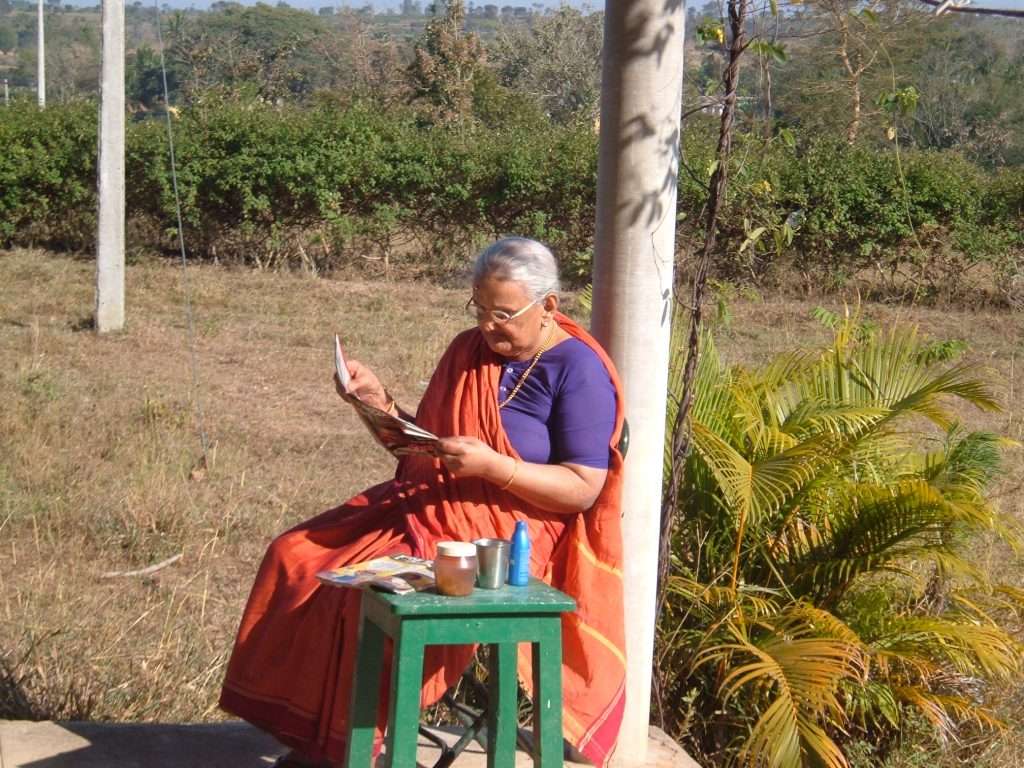
Amma was an ardent reader. As I look back on my childhood, one of my earliest memories of her is that she always had a book in her hand. When our family moved to Vriddhachalam during my high-school years, she was the one who encouraged me to become a member of the local government library. From there, I would bring home books not only for myself but also for her.
She did not merely read books; she treasured them. From weekly magazines such as Kalki and Ananda Vikatan, she carefully collected serialized stories and had them bound into volumes so that we could read them again and again. Unfortunately, all those collections were lost when our house was destroyed in a fire accident in 1971. Yet one collection survived. Even today, I still have her bound collection of articles from Thuglak, in which Cho Ramaswamy wrote his famous series Indu Maha Samudiram (“The Ocean of Hinduism”), which she preserved during the years she lived with me in Hosur (Mathigiri).
When Amma moved to Hosur to stay with me, I naturally continued supplying her with books and weekly magazines. But they were nowhere near sufficient for her appetite for reading. Eventually, I discovered the local government library and became a member. Initially, I was allowed to borrow only three books at a time. Amma would finish all three within four or five days, forcing me to make another trip to the library.
Her obsession with reading often drove me to distraction. One of her favourite habits was to sit in front of the television with a book in her hand. Her serials would be running at full volume, yet her eyes would be fixed on the printed page. One evening, irritated by this strange arrangement, I switched off the hall light while she was reading. I reasoned that with only the dim light spilling in from the dining room, she would be forced to choose between reading and watching television. Satisfied with my strategy, I went to the kitchen to prepare dinner.
Amma did not argue. She quietly finished her dinner, closed the book in front of me, and settled down to watch television like an obedient citizen complying with an unjust law.
Or so I thought.
Later, after I had withdrawn to my room—as was my daily custom, since I could not endure the endless family quarrels unfolding in television serials—I stepped out and discovered her sitting inches away from the television screen, reading her book by the flickering light of the serial itself, carefully avoiding the hall switch I had turned off.
When I caught her and began scolding her, she showed not the slightest sign of repentance.
“Next time,” she declared, “if I see your room light still on after one o’clock in the morning, I will come in, switch it off, and snatch the book from your hand.”
I protested, “At least watch the serial properly if you’re going to sit in front of it!”
She was unmoved.
“How many times can one keep looking at those same faces?” she replied. “Before the serial even starts, I already know what is going to happen. A book is not like that.”
In Tamil, however, her dismissal was far more colourful and impossible to translate adequately:
“அந்த முகங்களையே எத்தனை தரம் பார்க்கிறது? வேஷம் போட்டுக்கிட்டு வர்றாங்க; அவதாரம் பூசிக்கிட்டு வர்றாங்க!”
Roughly speaking, she meant that the actors appeared so heavily made up and so endlessly recycled that one could hardly bear to look at them anymore.
Finally, I obtained another library membership in her name so that I could bring home six books at a time. Even then, I struggled to find enough new books to satisfy her. Often I would advise her, “Why don’t you spend some time doing cross-stitch work or watching your serials? Don’t read as though you are preparing for an examination!”
But Amma never missed an opportunity to turn my own words against me.
Many nights I would remain awake reading until one o’clock in the morning. Whenever she got up to use the bathroom and noticed the light still on in my room, she would march over and scold me:
“Enough! Close the book and go to bed. Are you preparing for an examination? Or are you trying to get a new job?”
She continued this practice even in the ashram whenever she noticed the light in my room after midnight.
Amma was also very selective about what she read. If I brought home a book on the Ramayana or Mahabharata, she would immediately reject it.
“I have already seen enough Ramayanas and Mahabharatas in our family life,” she would say. “Why should I read the original versions again?”
She preferred novels and short stories, especially those written by her favourite authors such as Anuthama, K. V. Jagannathan, Kalki, Akilan, and others. She frequently reminded me to bring books by those writers. Of course, she also devoted time to reading her sloka books and chanting mantras, a discipline she maintained throughout her life.
One incident gave me an opportunity to tease her.
The library books had to be returned every two weeks, so I would usually remind Amma the day before I planned to visit the library. Knowing that the books would soon disappear, she would hurriedly finish any remaining pages.
One morning, as I was about to leave for the library, Amma was in the middle of her daily puja, singing bhajans and chanting mantras. Suddenly she stopped, picked up one of the library books, and began reading the last few pages before I left.
Naturally, I seized the opportunity.
“So,” I said, “reading a storybook is more important than doing your puja and chanting slokas and mantras?”
Never one to admit defeat, she immediately replied:
“Gods can wait. But you cannot. You don’t have any patience.”
During the Covid lockdown, however, her real ordeal began.
Everything was shut down. Television channels kept recycling old serials that she had already watched many times. She had little interest in movies or other programmes; only her regular serials mattered. Social interaction had almost vanished because everyone was confined to their homes and maintaining physical distance.
By then, the library memberships and regular supply of books that had sustained her reading habit for years had suddenly become useless. For a reader like Amma, the lockdown was not merely an inconvenience; it was a genuine deprivation.
Seeing her struggle, I somehow persuaded the local librarian to lend me books even though the library itself was officially closed. After considerable effort, I managed to obtain about twenty books. I brought them home while Amma was taking her afternoon nap and carefully hid them, planning to ration them out gradually.
But Amma quickly discovered my secret stockpile.
The moment she learned that I had more books hidden away, she demanded all of them immediately.
I refused.
“If you finish them all now, what will you do later? The library is closed. I cannot get more.”
That, of course, triggered one of our regular debates.
“Go and look at your room,” she protested. “How many books do you have in your personal library? More than two hundred! Books on your shelves, books on your table, books beside your bed. You spend your whole day surrounded by books and computers. How am I supposed to pass my time? How long can I keep doing cross-stitch and crochet work? They strain my eyes.”
Trying to corner her, I replied:
“Too much reading will also affect your eyes.”
She immediately fired back:
“You read all the time too! Besides, cross-stitch and crochet give pain to my fingers and elbows. Reading never does.”
Both those skills, incidentally, were gifts I inherited from her. I still practise them myself.
Unable to win the argument, I surrendered and handed over the entire collection. As expected, she finished all books within a week and promptly demanded more.
After that, I began searching for books in second-hand bookshops where old paperbacks were sold cheaply after being rescued from scrap collections.
When we eventually moved back to the ashram on September 5, 2021, I continued bringing books from Thally and other local village [Maruppalli] libraries whenever possible. But by then Amma had grown physically weaker. Gradually she lost the strength to spend long hours reading or watching television.
Yet she continued her cross-stitch work. To my amazement, she was still doing it until about two months before her death.
[One can see most of her cross-stitch works in my FB account where I also shared some of my own works]
Amma as a Writer
Amma also kept a diary in which she recorded many of her memories. I had given her the diary myself. After her passing, I tried to read it. But after only a page or two I had to stop. The pain was overwhelming. She had written honestly about the many struggles she endured throughout her life.
Unable to continue, I handed the diary to my sister.
“I cannot read this,” I told her. “You keep it.”
As far as I know, my sister never read it either. She already knew the story of our mother’s struggles.
I still possess some of the letters Amma wrote to me during the 1980s and 1990s. They too are difficult to read. In one letter she wrote:
“Take me with you wherever you go and live.”
Years later, when she was admitted to Nagesh Hospital only a few days before her death, I sat beside her one night. Earlier I had brought her back from a care home in Bangalore, where I had reluctantly placed her because I found it difficult to manage alone in the ashram without assistance.
On the night of December 22, with tears in my eyes, I asked her:
“Amma, what do you want?”
She looked at me with affection and compassion and answered softly:
“What else do I need now? I want only you.”
When I later digitized many of her old letters and records, I typed and preserved those letters as electronic copies. Yet I rarely revisit them. Reading them again disturbs me deeply.
If I have inherited anything from Amma, it is not merely the habit of reading and writing. It is the longing itself.
My love for books did not arise entirely from natural inclination. It is also part of the legacy she passed on to me. As long as I continue to read and write, a part of her will continue to live through that inheritance.
Among my siblings, perhaps none inherited that particular passion. But through me, her legacy of reading, reflection, and love for the written word continues.
Ashram
19 June 2025
Leave a Reply