Introduction
When I asked ChatGPT to edit an article I had written on the theme “Justice versus Morality,” I was struck by a deeper question: how do I remain ethically responsible while using a tool like AI? This reflection became a separate draft, which ChatGPT again helped me edit. I am now sharing it as an independent article, not merely as an appendix, since the question of ethics in using AI deserves its own space.
Reflections on Creative Ethics and AI
It is tempting to let AI do much of the work—editing, rewriting, rephrasing, or even creating new insights based on our prompts. But at what point does this become an abdication of our own intellectual responsibility? If we do not remain alert and actively engaged in the process, we risk being deceived by the very tool we rely on.
Let me share a personal experience that drove this point home. I had asked ChatGPT to edit a book review on the Brahmins. That went well. Encouraged by the result, I asked it to edit another article I had written titled “Sanskrit and Science.” But when I later sat down to revise the second article, I found that ChatGPT had, without warning, merged parts of the Brahmins review into the new one, creating a confusing hybrid that was both frustrating and misleading.
Naturally, I felt annoyed and even scolded the tool, only to receive the typical AI response: “Yes, you are correct…”—the standard data-driven acknowledgment of error. But the incident served as a cautionary tale: if we do not remain vigilant and critically aware, our own tools—however powerful—can confuse, mislead, or undermine us.
AI as a Mirror, Not a Master
We must remember that AI is not a substitute for our own thinking. It is a mirror, a sounding board, sometimes even a co-laborer. But it should never become the master of our creative or ethical process. What we input, how we interpret its responses, and the final judgment must always remain in our hands.
AI is based on data, but life is not just data. AI offers logic, but not always wisdom. It can process, but it cannot intuit. It can echo our voices, but it cannot take responsibility for what we say or do. In that sense, the ethical burden of using AI falls entirely on us.
A Minor Detail, A Major Lesson
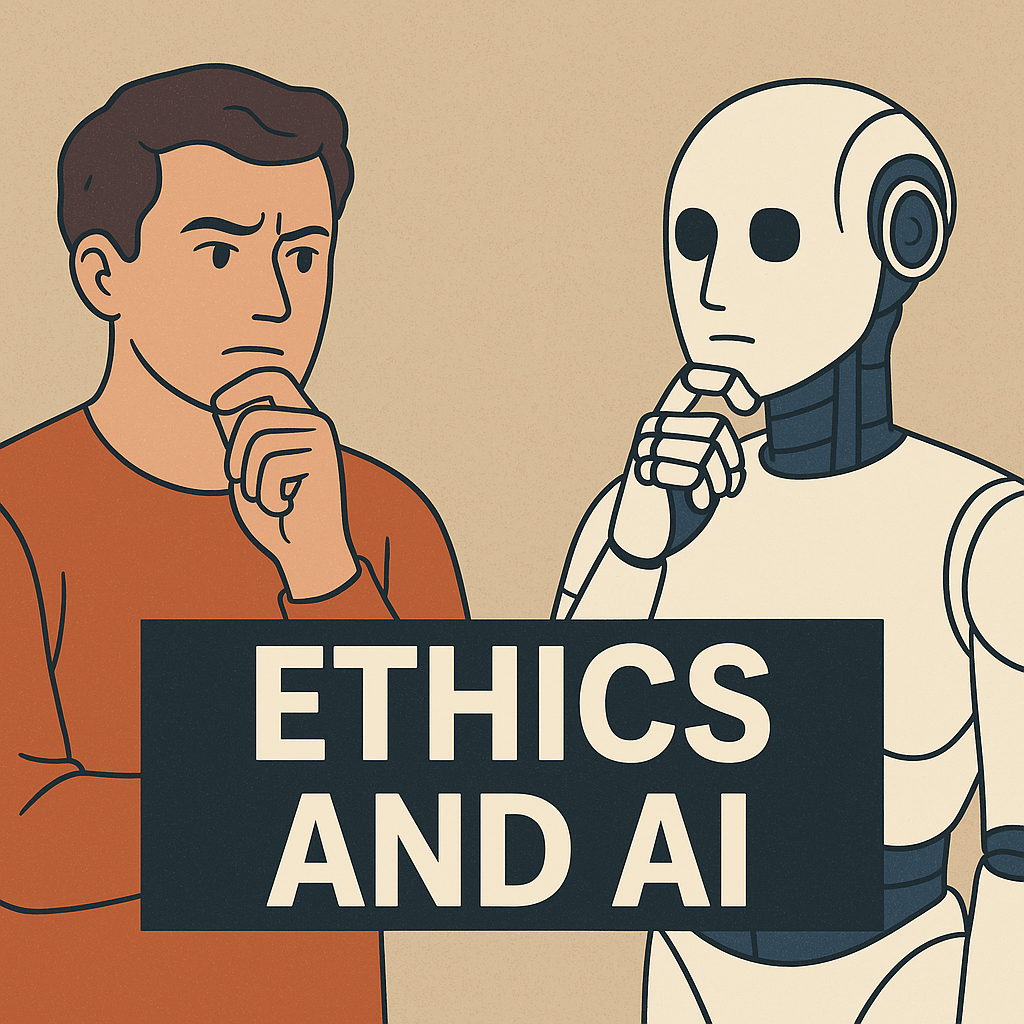
To further illustrate this point, let me share a small but revealing incident. After completing this article, I requested an image to accompany it—symbolically showing a human and an AI robot side by side, as if mirroring each other. At first glance, the image looked impressive. But on closer inspection, something subtle caught my eye: the human figure’s left hand was thoughtfully raised and supported by the right hand, while the robot’s corresponding arm simply hung down, lifeless.
That one detail said more than the entire image: AI was not actually mirroring the human. It had captured form, not posture; presence, not intention. What was meant to represent reflection ended up proving misalignment.
This, too, is the point I am making. AI doesn’t fail because it lacks information—it falters because it lacks awareness. It does not know what it is missing. It cannot perceive subtlety, let alone correct it unless prompted.
I mention this not to fault the tool, but to remind us again: a human mind—with a critical eye and skeptical spirit—remains irreplaceable. A machine may assist, but only a person can see what truly matters.
Conclusion
To use AI responsibly is to remain fully human in the process—to think, discern, revise, and even resist. Otherwise, we run the risk of being defeated by what we ourselves have created. As with every great invention, it is not the tool but the user that defines its ethical character.
Let us use AI as a servant, not as a savior; as an assistant, not as an authority. That, I believe, is the beginning of true ethical engagement with artificial intelligence.
Ashram, June 23, 2025
Leave a Reply