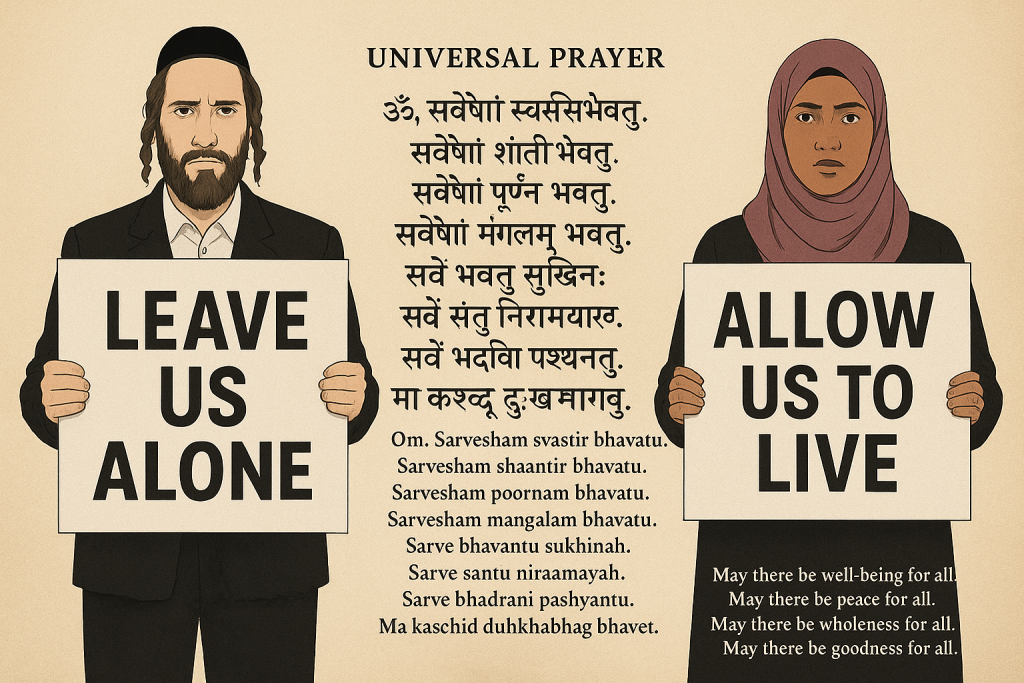
The Jewish Plea
In a recent Jerusalem Post opinion piece (Donald Zev Uslan, August 17, 2025)1, a Jewish psychotherapist from Jerusalem shared his anguish at the relentless pressure Jews face from triumphalist Christians and Muslims. Returning from a trek to Everest Base Camp, he described how, in Nepal, Hindus and Buddhists treated Jews with respect and required nothing beyond cooperation with their rules. In sharp contrast, Jews in Israel face Islamist extremists who seek their destruction and Christian missionaries who seek their souls.
His experience highlighted a powerful truth: Hinduism and Buddhism, in their essence, are not triumphalist religions. They are not driven to dominate or convert. Instead, they create space for coexistence and spiritual growth.
The Factual Slip
Uslan, however, makes a small factual slip. He writes: “The Nepalese are Buddhists and Hindus (non-idol worshipers).” But according to the worldview of the Abrahamic faiths, Hindus and Buddhists are generally branded as “idol worshipers.” This is not how Hindus or Buddhists define themselves, but it is a label imposed from outside.
Fanaticism Across Traditions
While I empathize with his trauma and centuries-old Jewish suffering, I must ask: does he not recognize similar strains of fanaticism in his own Scriptures? Hyper-evangelicals often quote certain biblical passages to justify their mission of converting others into their own image. The same triumphalist impulse that he condemns in Christianity and Islam can be traced back to parts of his own tradition.
The Hindu-Buddhist Experience
Buddhism, often seen as an offshoot of Hinduism, did take a missionary turn in history. Ashoka’s missions carried Buddhist teachings across Asia, and even today, Buddhism retains a subtle missionary dimension—though never with the aggressive zeal we see in Christian missions.
Hinduism, however, tells a different story. Yes, there were sectarian rivalries, and even persecution of Śramaṇas in certain times. But Hindus never launched global conquest or systematic conversion campaigns. The Indic ethos has largely been one of accommodation. Hindu civilization absorbed new faiths, engaged with them, but rarely sought to annihilate or cannibalize them.
Even when looted, suppressed, and colonized for centuries, Hindus never fully lost their land or their civilizational core. Theirs was, and continues to be, a civilization powered more by “soul force” than physical domination.
A Shared Pain, A Shared Hope
In this sense, Hindus can deeply empathize with the Jewish experience. Both communities have endured centuries of oppression. But while Jews were exiled from their homeland for long stretches of history, Hindus retained their land, even if under foreign control. The Jewish Uslan pleads: “Leave us alone.” It is a plea Hindus could echo as well. Both communities long for freedom from triumphalist ideologies that seek to convert or destroy.
A Deeper Contradiction
Yet here lies a painful contradiction. The Jewish plea to be left alone becomes complicated when seen in the light of Palestine. The land has been continuously inhabited by Palestinians for generations. By their own Scriptures, the Jews were first sojourners—Abraham confessed himself a stranger in Canaan, Jacob’s family left for Egypt, and only later did their descendants return under Moses and Joshua by conquest, believing God had given them the land. Their original claim, then, was not by native habitation but by theological conviction.
Yes, Israel and Judah existed as kingdoms in the Levant, and Jerusalem became their capital. But these were not unbroken claims of native presence. Over centuries Jews were conquered, dispersed, and became a diaspora, while Palestinians and other local peoples remained with continuous ties to the soil. Today, Jewish attachment is historical, symbolic, and theological; Palestinian attachment is continuous, lived, and ancestral.
The modern reoccupation came about through colonial history. Britain’s Balfour Declaration and Mandate policies carved out a Jewish homeland from existing Palestine, backed by Western Christian powers serving their own geopolitical interests. This second occupation displaced Palestinians, and now, ironically, Jews—who themselves suffered as a people without land—risk forcing Palestinians into becoming a diaspora.
Two Nations, One Hope
I am not condemning Jews as a people, nor indifferent to their present crises. But unless both sides accept the Two-Nation solution—one homeland for Jews, one homeland for Palestinians—this conflict will never find peace. Palestinians would rather die defending their land than accept permanent displacement.
The truth is harsh: Jews cannot fully understand the depth of attachment Palestinians have to their homeland, because their own claim is rooted more in faith and history than in unbroken habitation. But if they can acknowledge this difference and recognize the Palestinians’ right to a homeland of their own, there may yet be a way forward.
Beyond the Abrahamic Lens
The plea to “leave us alone” is universal. Hindus, Buddhists, Jews, Muslims, and Christians—all have voices within them that long to live without being dominated, converted, or destroyed. But this plea cannot be selective. If Jews long for space to live without interference, they must also extend the same dignity and space to Palestinians. Likewise, in India, some right-wing Hindu groups have begun expressing support for Jews, even drawing parallels between their struggles. Yet such sympathy is not born of principle; it too often rests on the old logic: “the enemy of my enemy is my friend.”
A truly universal ethic demands more. To ask for freedom for oneself while denying it to others is not moral courage but moral convenience. The real test of our humanity is whether we can extend the prayer—“May all be happy, may all be free from suffering”—beyond our own tribe, our own religion, and even beyond our own wounds.
Conclusion
The plea to “leave us alone” is universal. Hindus, Buddhists, Jews, Muslims, and Christians—all have voices within them that want to live without being dominated, converted, or destroyed. But this plea cannot be selective. If Jews long for space to live without interference, they must also grant the same dignity and space to Palestinians.
True greatness does not come from conquest or conversion. It comes from coexistence. Only when every people is free to flourish in its own land—without fear, without compulsion—will the world finally see peace.
The Indian ethos expressed this vision long ago in a single sloka: Vasudhaiva Kutumbakam—“the whole world is one family.” It continues to echo in the prayers that India has gifted to the world. The late Kanchi Sankaracharya, Sri Chandrasekara Saraswati Swamiji, composed a Sanskrit hymn for Bharat Ratna Smt. M. S. Subbulakshmi to sing at the United Nations—a timeless call for universal brotherhood:
Maitrīm bhajata akhila hṛdaya mitrīm, ātmavat eva parān api paśyata;
Yuddhaṁ tyajata, spardhāṁ tyajata, tyajata pāreṣv akramam ākramaṇam.
Jananī pṛthivī kāmadughāste, janako devaḥ sakaladayāluḥ;
Dāmyata, datta, dayadhvam janatā; śreyo bhūyāt sakalajanānām.
मैत्रीं भजत अखिलहृजेत्रिं।
आत्मवत् देवः परानपि पश्यत।
युद्धं त्यजत, स्पर्धां त्यजत।
त्यजत प्रश्रयक्रमम् आक्रमणम्।
जननी पृथिवी कामदुघा अस्ते।
जनको देवः सकलदयालुः।
दाम्यत, दत्त, दयध्वं जनता।
श्रेयः भूयात् सकलजनानाम्।
Cultivate friendship, which will conquer all hearts. Look upon others as thyself. Renounce wars; forswear competition. Give up aggression, which is wrong. Wide Mother Earth is here, ready to grant our needs. The Lord, our Father, is compassionate to all. O people of the world—restrain yourselves, give, be kind. May all humanity be happy and prosperous.
And alongside it, the ancient śānti mantra remains a simple, profound expression of humanity’s deepest hope:
UNIVERSAL PRAYER
Om, Sarveṣāṁ svastir bhavatu.
Sarveṣāṁ śāntir bhavatu.
Sarveṣāṁ pūrṇam bhavatu.
Sarveṣāṁ maṅgalam bhavatu.
Sarve bhavantu sukhinaḥ.
Sarve santu nirāmayāḥ.
Sarve bhadrāṇi paśyantu.
Mā kaścid duḥkhabhāg bhavet.
Om, may there be well-being for all.
May there be peace for all.
May there be wholeness for all.
May there be auspiciousness for all.
May all be happy.
May all be free from illness.
May all see what is good.
May no one suffer in life.
ॐ सर्वेषां स्वस्तिर्भवतु ।
सर्वेषां शान्तिर्भवतु ।
सर्वेषां पूर्णं भवतु ।
सर्वेषां मङ्गलं भवतु ।
सर्वे भवन्तु सुखिनः ।
सर्वे सन्तु निरामयाः ।
सर्वे भद्राणि पश्यन्तु ।
मा कश्चिद्दुःखभाग्भवेत् ॥
May such prayers guide us toward a world where every people, every faith, and every land can finally breathe in peace.
Ashram, August 17, 2025
Summary of “Leave us alone as Jews” (The Jerusalem Post)
The author, a Jewish psychotherapist living in Jerusalem, reflects on the constant pressure Jews face from extremist Muslims and Christians. After trekking to Everest Base Camp in Nepal, he contrasts the peaceful coexistence of Buddhist and Hindu cultures—non-triumphalist religions—with the hostility Jews face from Abrahamic extremism.
He observes that while the Nepalese simply welcomed Jews with respect and required only cooperation, Muslims and Christians driven by triumphalist theologies seek either to destroy Jews physically (Islamist extremists) or to convert them spiritually (radical Christians). Both are rooted in a compulsion to dominate and impose their beliefs.
Drawing on Saul Bellow’s reflections in To Jerusalem and Back (1976), the author notes that Jewish existence itself seems to provoke irrational hostility in some nations, perhaps because Jews live with uncertainty, doubt, and creativity, resisting the limitations of belief in a “god of flesh.”
Ultimately, the author pleads: Jews do not need to be dominated, converted, or destroyed. They only ask to be left alone to thrive in their own land and faith, to find resilience within themselves, and perhaps fulfill their calling to be “a light unto the nations.”
Leave a Reply