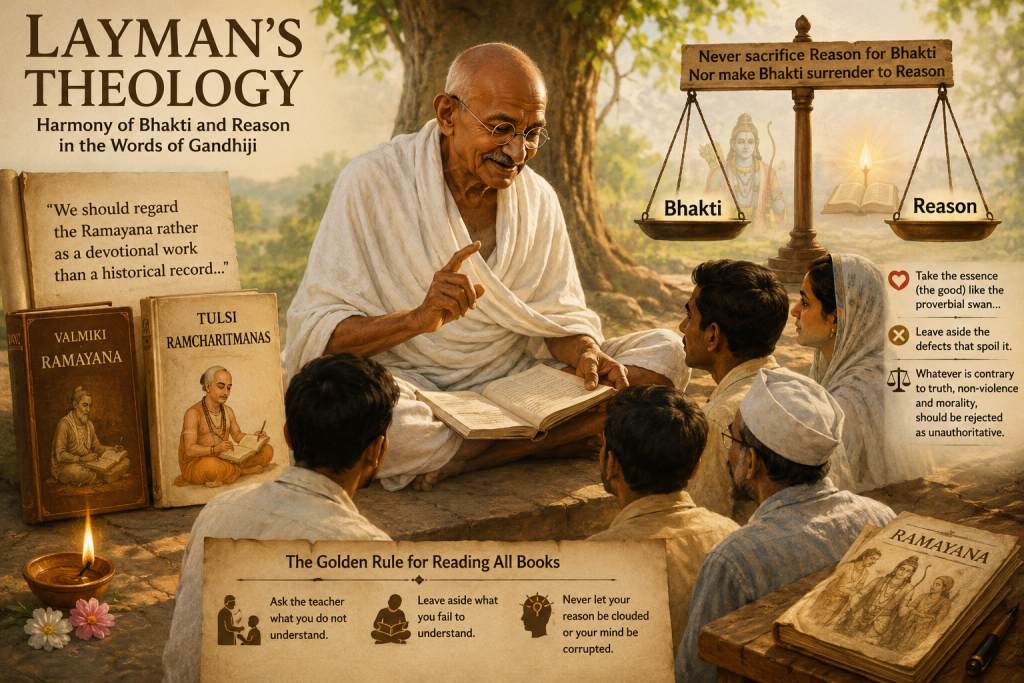
The way Mahatma Gandhiji communicates profound theological truths to ordinary people, speaking as a fellow layman rather than as a professional theologian, is truly remarkable. This distinguishes him from many academically trained theologians. In much theological writing, although the central message may remain clear, readers often have to negotiate numerous technical discussions, specialized methods of exegesis, and unfamiliar terminology before reaching the main point. Some theologians even coin new expressions that remain inaccessible not only to ordinary readers but sometimes even to scholars unfamiliar with their particular school of thought—for example, terms such as cosmotheandric.
Gandhiji, thankfully, avoids such technical language and scholarly apparatus. Without sacrificing depth, he communicates profound theological insights in simple, direct, and accessible language. Yet his greatest strength lies in the fact that he never sacrifices reason for the sake of bhakti, nor does he require bhakti to surrender to reason. Instead, he holds the two together in a harmonious balance. His approach is practical and realistic rather than abstract or merely philosophical.
The following letter beautifully illustrates this distinctive approach. Rather than presenting a theological treatise, Gandhiji offers simple yet profound guidance on how to read the Rāmāyaṇa with both devotion and discernment.
Gandhiji in His Own Words
“…I would certainly pay more respect to Tulsi’s Ramayana as a religious work. Valmiki’s may excel in art… Tulsidas is richer in devotional spirit… neither of the works is historical… we should regard the Ramayana rather as a devotional work than a historical record… while we read its fiction part we should ignore whatever we find contrary to morality… we should, like the proverbial swan, take in the essence in the form of good qualities and leave alone the defects that spoil it. This is the golden rule that should apply to the reading of all books… we should never let our reason be clouded or our mind be corrupted. Whatever appears contrary to truth, non-violence and so on, should be rejected as unauthoritative although it may have been printed in an avowedly scriptural work.”
Reference
M. K. Gandhi, “Letter to Jayanti,” August 11, 1927, in The Collected Works of Mahatma Gandhi, vol. 34 (New Delhi: Publications Division, Government of India), 330–31. Originally written in Gujarati. Reproduced from the manuscript of Mahadev Desai’s Diary, courtesy of Narayan Desai.
Available at: mkgandhi.org.
Ashram, August 5, 2026
Original from CWMG., vol. 34, pp. 330-31
304. LETTER TO JAYANTI
August 11, 1927
CHI. JAYANTI,
…Now about the Ramayana. I would certainly pay more respect
to Tulsi’s Ramayana as a religious work. Valmiki’s may excel in
art, but I have not the slightest doubt that Tulsidas is richer in
devotional spirit.
Moreover, at present Valmiki’s Ramayana is
available in Sanskrit only. I have so far come across no Gujarati
translation which re-creates the interest of the original. You must
know that neither of the works is historical. True, Valmiki has
portrayed a few historical men and women, but these are not
clearly defined. I firmly believe that one cannot infer historical
facts from them. But in the case of Tulsidas the question of histo-
ricity does not arise. We might say that he adapted Valmiki to
suit his own age, but while doing so, having come under the spell
of bhakti, he took such liberties as he wished to and thereby
he has done no harm but only done good to Hindu society. With
the passage of time men and women of divine glory become gods
and goddesses and are ultimately worshipped as such. This will
always happen and that is right.
A man being embodied can
never worship God in any other form. It being so, whatever
Tulsidas writes about Lord Ramachandra are only his own feelings.
Tulsidas has portrayed God as beyond description, as inappre-
hensible by mere sense-organs and as also beyond attributes. If
therefore we cannot swallow the killing of Vali, we should leave
aside that passage or believe that while depicting it Tulsidas
acted only in conformity with the beliefs of his own age and could
not transcend them. As man progresses, his idea of God neces-
sarily becomes subtle and pure, inevitably so. Therefore, we should
regard the Ramayana rather as a devotional work than a historical
record and while we read its fiction part we should ignore what-
ever we find contrary to morality. Tulsidas himself describes his
work Ramacharitamanasa as full of faults. He gives a different reason
for it but that he has regarded it as not without fault should
suffice for us. Moreover, in his well-known verse beginning, “God
created the world full of animate and inanimate objects with goodb
qualities as well as bad”, Tulsidas has taught us the art of
looking at things. Since all human action is partly good and partly (p.330) bad, we should, like the proverbial swan1, take in the essence
in the form of good qualities and leave alone the defects that spoil
it. This is the golden rule that should apply to the reading of all
books. We should humbly ask the teacher what we do not under-
stand and we should leave aside what nevertheless we fail to
understand; we should however never let our reason be clouded
or our mind be corrupted. Whatever appears contrary to truth,
non-violence and so on, should be rejected as unauthoritative
although it may have been printed in an avowedly scriptural
work.
[From Gujarati]
From the manuscript of Mahadev Desai’s Diary. Courtesy: Narayan Desai—CWMG, Vol. 34, pp. 330-31. Mkgandhi.org
Leave a Reply