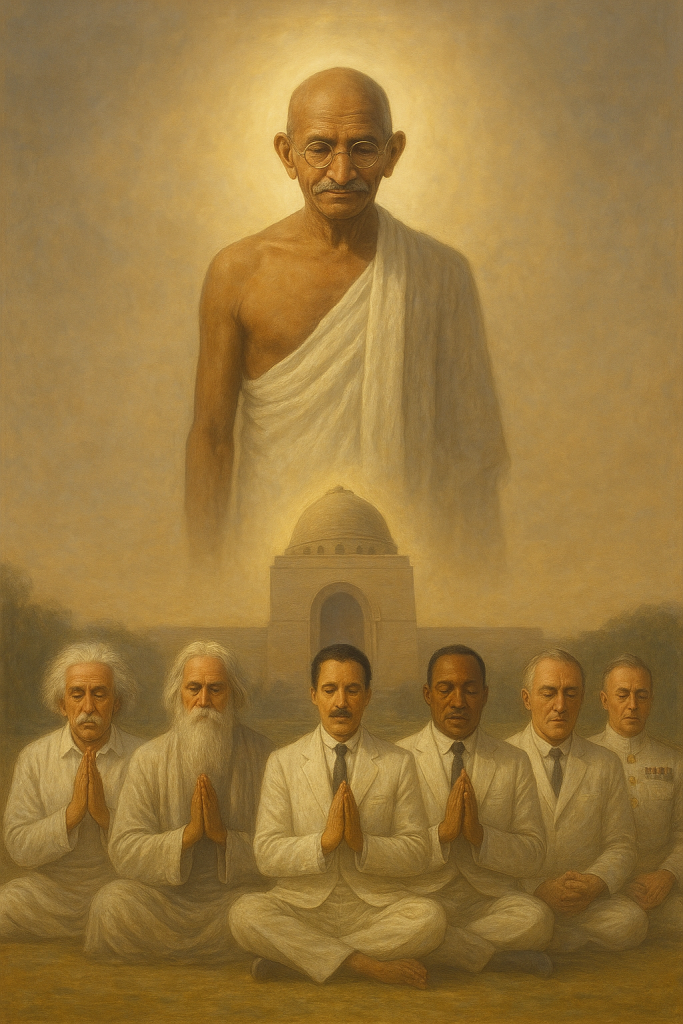
After finishing Satyagraha in South Africa by Mahatma Gandhi, I find myself suspended in awe, unable to turn to anything else except to dwell on him—this singular soul who embodies the highest ideals of morality and spirituality.
Throughout his life, and even today, he was critiqued, condemned, questioned, doubted, rejected, glorified, and worshipped. Yet, in all of human history, no one has walked a path quite like his. That’s why the renowned scientist Albert Einstein said:
“Generations to come will scarce believe that such a one as this ever in flesh and blood walked upon this earth.”¹
At the same time, what Rabindranath Tagore said about Gandhiji remains strikingly relevant: “The world today does not know what to do with Gandhi; he is too simple and too pure for the age.”
For me, reading his writings is not an exercise in knowledge, but a spiritual sadhana. It is not about gathering facts or anecdotes—it is about encountering a presence that transforms the reader. One cannot imitate Mahatmaji, not even a fraction, but engaging with his words reshapes the inner life.
We often mistake obstinacy for strength and blind surrender for humility. Gandhi revealed something far deeper: he was unyielding in his devotion to truth and justice, yet flexible in approach; humble in demeanor, yet unwavering against injustice. This is the paradox and the power of ‘Gandhism’—a life lived in alignment with the soul.
To read Satyagraha in South Africa is to witness his essence fully. Words alone cannot capture it; one must experience it, allowing the mind and heart to absorb his presence.
It is no mere political ritual that the Prime Minister of India begins Independence Day at his Samadhi before hoisting the flag. Many nations have claimed freedom, and many leaders have inspired generations—but none have merged moral courage and spiritual insight as he did.
He went to South Africa as a simple man, Mohan Karamchand Gandhi, seeking a livelihood. He returned to India as Mahatma Gandhi, having spent twenty-one years understanding his calling and shaping a movement that would transform a nation and guide the world. The rest, as they say, is history.
To honor this spirit within ourselves, we must engage with his writings. Satyagraha in South Africa and My Experiments with Truth are more than books—they are invitations to awaken the inner strength that our National Emblem proclaims: Satyameva Jayate—Truth Alone Triumphs.
Ashram, August 15, 2025
Tribute to Mahatma Gandhi: Voices of the World
Albert Einstein (1939, on Gandhi’s 70th birthday)
“Generations to come will scarce believe that such a one as this ever in flesh and blood walked upon this earth.”
Jawaharlal Nehru (1948, after Gandhi’s assassination)
“The light has gone out of our lives and there is darkness everywhere.”
Martin Luther King Jr. (1960s, reflecting on Gandhi’s influence)
“Christ gave us the goals, and Mahatma Gandhi the tactics.”
Franklin D. Roosevelt (circa 1942, contemporary admiration)
“Gandhi is a beacon of moral courage and the power of nonviolence in a world torn by conflict.”
Charlie Chaplin (1931, on Gandhi’s approach to nonviolence)
“Gandhi has taught the world that courage can be gentle and that the simplest man can change history.”
Lord Mountbatten (1947, on India’s independence and Gandhi)
“Without Gandhi’s guidance and sacrifice, the path to freedom would have been far bloodier and more painful.”
Rabindranath Tagore (1921, on Gandhi’s influence)
“The world today does not know what to do with Gandhi; he is too simple and too pure for the age.”
सत्य और साहस का वैश्विक प्रमाण: महात्मा गांधी
सत्याग्रह इन साउथ अफ्रीका पढ़ने के बाद मैं स्तब्ध रह गया, और किसी और विषय की ओर नहीं बढ़ सका—सिवाय उनके, इस अद्वितीय आत्मा के बारे में सोचने के, जो नैतिकता और आध्यात्मिकता के उच्चतम आदर्शों का प्रतीक हैं।
उनके जीवन भर, और आज भी, उन्हें आलोचना, निंदा, प्रश्न, संदेह, अस्वीकार, महिमा और पूजन दोनों का सामना करना पड़ा। फिर भी, मानव इतिहास में कोई भी उनका समान मार्ग नहीं चला। इसी कारण प्रसिद्ध वैज्ञानिक अल्बर्ट आइंस्टीन ने कहा¹:
“आने वाली पीढ़ियाँ शायद विश्वास भी न करें कि ऐसा कोई कभी इस पृथ्वी पर जिंदा था।”
साथ ही, रवींद्रनाथ टैगोर का कथन आज भी प्रासंगिक है:
“आज की दुनिया नहीं जानती कि गांधी के साथ क्या करे; वह इस युग के लिए बहुत सरल और बहुत शुद्ध हैं।”
मेरे लिए, उनके लेखन का अध्ययन केवल ज्ञान अर्जन नहीं, बल्कि एक आध्यात्मिक साधना है। यह तथ्य या किस्से इकट्ठा करने के बारे में नहीं है—यह एक ऐसी उपस्थिति का सामना करने के बारे में है जो पाठक को बदल देती है। महात्मा जी की नकल करना असंभव है, लेकिन उनके शब्दों के साथ जुड़ना हमारे आंतरिक जीवन को पुनः आकार देता है।
हम अक्सर जिद को शक्ति और अंधाधुंध समर्पण को विनम्रता समझते हैं। गांधी ने कुछ और गहरा दिखाया: वह सत्य और न्याय के प्रति अडिग थे, लेकिन दृष्टिकोण में लचीले; व्यवहार में विनम्र, पर अन्याय के खिलाफ अडिग। यही ‘गांधीवाद’ का विरोधाभास और शक्ति है—एक जीवन जो आत्मा के अनुरूप जिया गया।
सत्याग्रह इन साउथ अफ्रीका पढ़ना उनके सार को पूर्ण रूप से देखने के समान है। केवल शब्द इसे व्यक्त नहीं कर सकते; इसे अनुभव करना चाहिए, ताकि मन और हृदय उनकी उपस्थिति को आत्मसात कर सकें।
यह कोई मात्र राजनीतिक रस्म नहीं है कि भारत के प्रधानमंत्री स्वतंत्रता दिवस पर ध्वजारोहण से पहले उनके समाधि पर जाते हैं। कई राष्ट्रों ने स्वतंत्रता प्राप्त की, कई नेताओं ने पीढ़ियों को प्रेरित किया—पर किसी ने नैतिक साहस और आध्यात्मिक अंतर्दृष्टि को उनके समान नहीं मिलाया।
वे साउथ अफ्रीका गए एक साधारण व्यक्ति के रूप में, मोहन करमचंद गांधी, जीविका की तलाश में। वे भारत लौटे महात्मा गांधी के रूप में, 21 वर्षों के अनुभव और एक आंदोलन की नींव डालने के बाद, जिसने एक राष्ट्र को बदल दिया और दुनिया को मार्गदर्शन दिया। शेष, जैसा कहा जाता है, इतिहास है।
इस आत्मा का सम्मान करने के लिए हमें उनके लेखन से जुड़ना चाहिए। सत्याग्रह इन साउथ अफ्रीका और माय एक्सपेरिमेंट्स विद ट्रुथ केवल पुस्तकें नहीं हैं—ये आंतरिक शक्ति को जागृत करने का निमंत्रण हैं, जिसे हमारा राष्ट्रीय प्रतीक कहता है: सत्यमेव जयते—सत्य की ही जीत होती है।
Ashram, August 15, 2025
पादटिप्पणी:
- विश्व ने गांधी को ऐसे देखा:
- अल्बर्ट आइंस्टीन (1939, गांधी के 70वें जन्मदिन पर):
“आने वाली पीढ़ियाँ शायद विश्वास भी न करें कि ऐसा कोई कभी इस पृथ्वी पर जिंदा था।” - जवाहरलाल नेहरू (1948, गांधी की हत्या के बाद):
“हमारे जीवन से प्रकाश चला गया और हर जगह अंधकार है।” - मार्टिन लूथर किंग जूनियर (1960 के दशक, गांधी के प्रभाव पर):
“मसीह ने हमें लक्ष्य दिए, और महात्मा गांधी ने रणनीति।” - फ्रैंकलिन डी. रूज़वेल्ट (लगभग 1942, समकालीन प्रशंसा):
“गांधी नैतिक साहस और अहिंसा की शक्ति का प्रकाशस्तंभ हैं, एक संघर्ष से जर्जर दुनिया में।” - चार्ली चैपलिन (1931, गांधी के अहिंसा दृष्टिकोण पर):
“गांधी ने दुनिया को सिखाया कि साहस को कोमल बनाया जा सकता है और सबसे साधारण व्यक्ति इतिहास बदल सकता है।” - लॉर्ड माउंटबेटन (1947, भारत की स्वतंत्रता पर):
“गांधी के मार्गदर्शन और बलिदान के बिना स्वतंत्रता की राह कहीं अधिक रक्तपातपूर्ण और दर्दनाक होती।” - रवींद्रनाथ टैगोर (1921, गांधी के प्रभाव पर):
“आज की दुनिया नहीं जानती कि गांधी के साथ क्या करे; वह इस युग के लिए बहुत सरल और बहुत शुद्ध हैं।”
- अल्बर्ट आइंस्टीन (1939, गांधी के 70वें जन्मदिन पर):
Leave a Reply