Life and Death: A Funny Thing Happened on the Way to Enlightenment
Introduction:
Most of us face two big questions in life: how should we live, and how should we die? King Aśoka’s brother, Vītaśoka, ended up struggling with both in just one week. This is an old story from India that feels like a mix of a moral tale, a practical joke, and a spiritual lesson—with a surprise ending. It’s about how fear of death, a royal prank, and a bit of Buddhist publicity all came together to form what we can call the first-ever “Seven-Day Mindfulness Challenge.”
The Setup:
Vītaśoka was the brother of King Aśoka—the same king who changed from a cruel ruler into a strong follower of the Buddha. But Vītaśoka wasn’t impressed. He looked at the peaceful life of Buddhist monks—their robes, their food, their calm routines—and said, “Really? That’s called renunciation?”
Then he saw the Jain monks, who were much stricter. No robes, no bowls filled with rice and ghee, no relaxed talks over tea. Only tough fasting, sleeping on thorns, and long speeches on karma. “Now that’s real discipline,” thought Vītaśoka.
So he decided that the Jain way was the true spiritual path and went to join their hard lifestyle of toothpicks and pebbles.
Aśoka’s Plan:
King Aśoka didn’t find this funny at all. But instead of sending soldiers or starting a religious argument, he made a dramatic (and slightly scary) plan.
He called Vītaśoka back and said, “Brother, you have been sentenced to death.”
Vītaśoka was shocked. “But why?” he asked.
“No reason,” said the king, probably sipping masala chai with a little smile. “Just go along with it.”
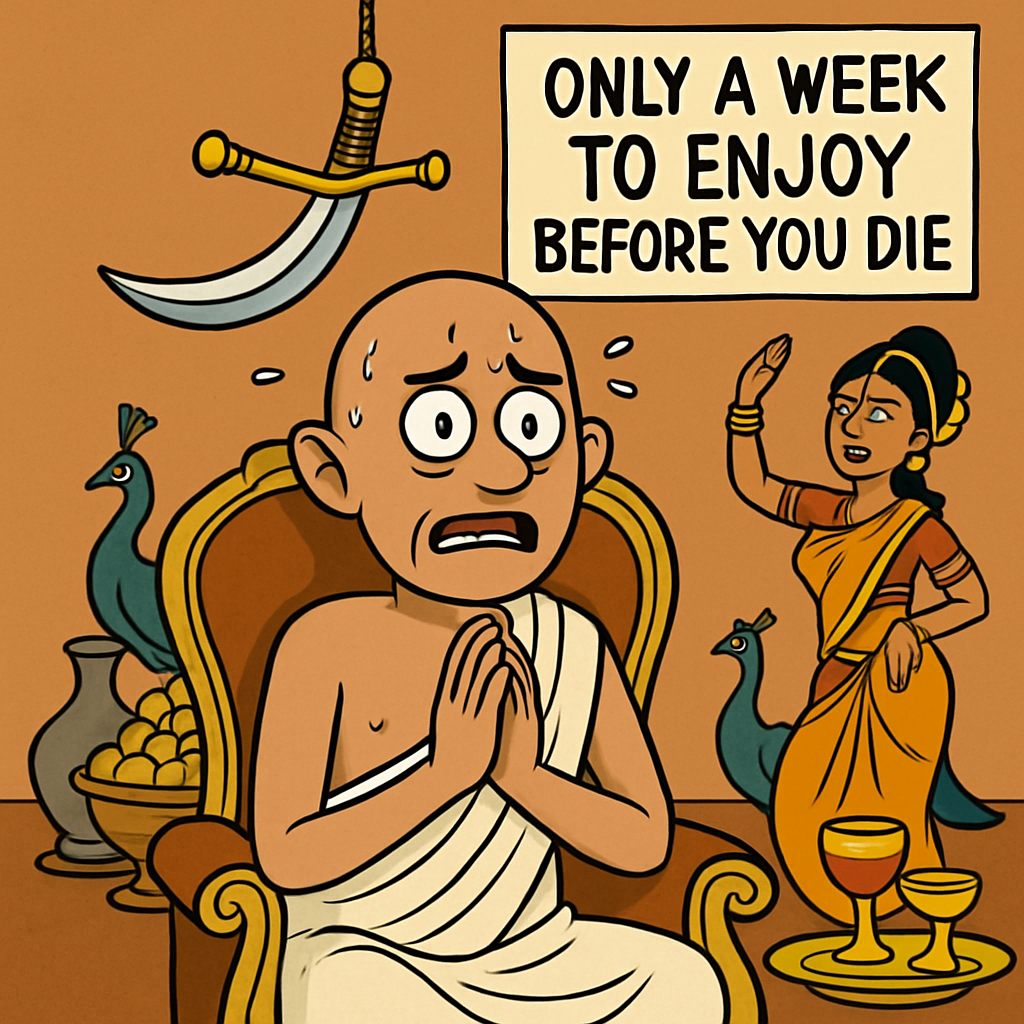
But then Aśoka added, “Before your death, I will give you a gift—seven days to rule the kingdom. Enjoy everything as much as you can.”
The Seven-Day Mindfulness Retreat (Royal Edition):
You’d think that with just seven days left and the whole empire in his hands, Vītaśoka would have enjoyed it. Wine, music, dancers, maybe a peacock parade and a golden chariot.
But no.
Every meal felt tasteless. Every sound of music reminded him of death. Every joy felt empty because he knew it would all end soon.
He couldn’t sleep, couldn’t laugh, and didn’t even take a single painting or sculpture to remember it by.
The Reveal:
On the seventh day, Aśoka came and said, “Surprise! You’re not going to die.”
Vītaśoka stood there, shocked.
“See?” said the king. “You had everything, but the thought of dying made you miserable. That’s how Buddhist monks live—not because they’re scared, but because they’re aware. They don’t need to torture their bodies to understand life is short. It’s the mind that needs detachment, not just the body.”
Aśoka might have smiled and said, “And here’s a little book for you—The Middle Path for Dummies. Enjoy.”
Conclusion: Death, but Make It Funny
And that’s how Vītaśoka realised that being simple doesn’t mean being extreme, and living in comfort doesn’t mean forgetting the truth. You don’t have to suffer to be spiritual. You just need to live knowing that life is short—and still take care of your everyday duties.
As for Aśoka, maybe he created the first-ever spiritual prank—with a message only kings could afford: Live each day as if you might die, but don’t forget to enjoy your samosas.
Moral of the story?
Life is short. Death is sure. And sometimes enlightenment comes as a joke from your elder brother.
Ashram, August 6, 2025
This hilarious article is based on the original excerpts in: Appendix VIII: Why did Buddhism and Jainism Develop Differently in India in Johannes Bronkhorst, How The Brahmins WON: From Alexader to the Guptas, New Delhi, Manohar Publishers, 2025, p. 476
Stories confirm that Jaina monastics endured, voluntarily, more hardships than their Buddhist colleagues. Consider the following passage from an article by Phyllis Granoff, “Being in the minority: Medieval Jain reactions to other religious groups.” Jainism and Prakrit in Ancient and Medieval India. Essays for Prof. Jagdish Chandra Jain. Ed. N. N. Bhattacharyya. New Delhi: Manohar, pp. 241-266, 1994: 259):
It is a common theme of Jain stories that Jains may be wrongly duped into becoming Buddhists, particularly because they are attracted to the lush life in a Buddhist monastery compared to the severity of life as a Jain monk. Thus in a biography of the Jain monk Ārya Khapaṭācārya we hear of the master’s nephew, Bhuvana, who becomes a Buddhist and magically causes wonderful food to appear in the begging bowls of the Buddhist monks. The Jains lose many of their faithful, who are enticed by the promise of such rich delights.39
Buddhists countered these Jain stories with their own stories in which they justified the Buddhist monastic practices and criticized the strict regimen of the Jain ascetic. One very telling story is the Vītaśokāvadāna that occurs in the Divyāvadāna. Vītaśoka, the brother of the famous king Aśoka, is persuaded by the harsh asceticism of the Jain monks that they must be the true ascetics and not the Buddhist monks who live a life of relative ease and comfort. Aśoka devises a stratagem to make him realize his mistake; he has him sentenced to death and then allows him the pleasures of being king for seven days before the sentence is to be carried out. Vītaśoka does not take pleasure in his week as king, for he becomes obsessed with his death sentence. King Aśoka finally tells him that all has been a ruse, to show him that although the Buddhist monks may live a life of comfort, they find no pleasure in that life for they are ever occupied with the thought that death pursues all mortals.— Appendix VIII: Why did Buddhism and Jainism Develop Differently in India in Johannes Bronkhorst, How The Brahmins WON: From Alexader to the Guptas, New Delhi, Manohar Publishers, 2025, p. 476
39 Reference to (ed. The Clever Adulteress & Other Stories: A Treasury of Jain Literature. Oakville – New York – London: Mosaic Press,1990: 153-156.
Leave a Reply