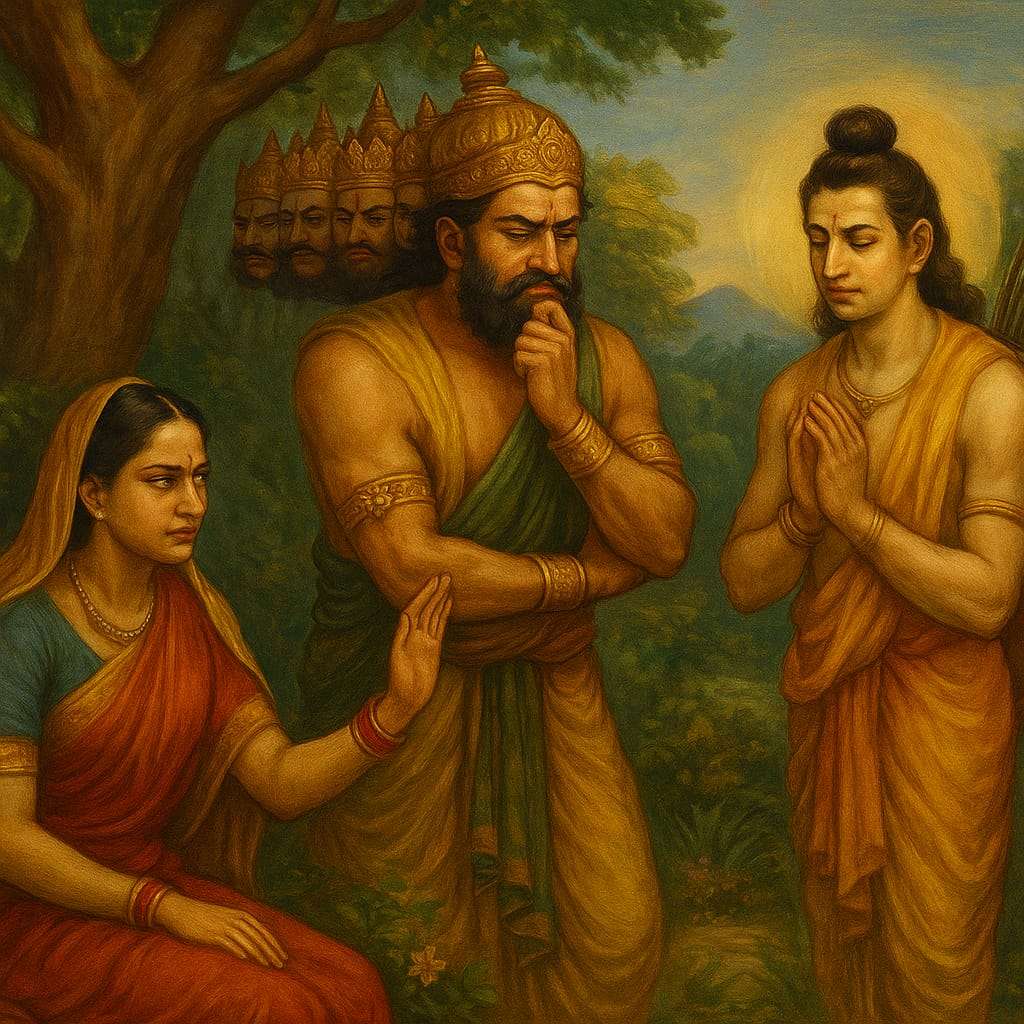
When Ravana abducted Sita and kept her in the Ashoka grove in Sri Lanka, he used every means he could think of to seduce her. Taking on many beautiful and enchanting forms, he tried to win her over. But Sita, steadfast and pure, was unmoved. She despised him with a piercing, condescending look and rejected him with firm words and unwavering dignity.
Ashamed and frustrated, Ravana wandered back and forth, restless and confused. One of his ministers approached him with advice:
“She is not a woman who can be swayed by beauty or power. If you wish to win her heart, you must take on the form of Rama himself.”
Ravana replied with a bitter smile,
“Do you think I have not thought of that? I tried. But when I assumed the form of Rama, all my lustful desires vanished. I became almost like him — pure-hearted, faithful to one wife, and incapable of the wickedness I now seek.”
Deeper Moral
This episode from the Ramayana reveals a profound truth: true righteousness is not a costume one can wear. When Ravana tried to imitate Rama outwardly, Rama’s inner purity touched him and transformed even his corrupted heart. True virtue, true love, and true nobility cannot be imitated for selfish purposes — they have the power to change the imitator himself.
Righteousness is not an external act but an inner state of being. In the presence of true goodness, even evil finds itself disarmed. Pretending to be good is dangerous for the wicked — for in the very act of imitation, their own darkness begins to dissolve.
Part Two
This story is not found in the Kamba Ramayanam but is part of folk tradition — one of many such narratives that exist outside the main literary and scriptural canon. There are numerous versions of the Ramayana not only across India but throughout the world. Likewise, various regional renditions of the Mahabharata — though not always complete — are widespread. These epics have remained flexible, allowing space for new stories to be inserted, reflecting the needs, values, and imaginations of different regions and times. Many scholarly books and research papers have explored this fascinating phenomenon.1 This was said by the legendary Tamil poet Kannadasan in his book Arthamulla Hindumadam (Meaningful Hinduism).
It is truly remarkable how many such fluid, evolving stories exist — tales that may not appear in the core texts yet convey profound moral or spiritual insights.
If we could gather and share these untold stories, it would make for a rich and meaningful collection. Every religious tradition and literary culture holds such gems — narratives that may not be scriptural but still embody the heart and wisdom of their source traditions.
If you know of any such stories familiar in your region, consider sharing them with others. They offer not only enjoyment but also opportunities for learning and reflection.
In my next post, I will share another such story from the Ramayana.
These evolving stories often do not feel alien but seamlessly integrate with the overarching themes and characters. For instance, when I generated an illustration with the help of ChatGPT, it unexpectedly aligned with the very theme of this story. Building on that, I inserted a sub-story — one not found in any canonical Ramayana — into the narrative.
In the image, Ravana, having assumed the form of Rama, stands before Sita not with lustful intent but with hands folded in reverence. The very form he adopted transforms his demeanor. This suggests a powerful idea: even the act of imitating a noble figure can influence a person’s mind and heart. In fact, several actors who have portrayed virtuous characters like Rama have shared how the experience changed them.
Audiences too can become deeply affected. One notable example is from the life of Kulasekara Alvar, a 9th-century Vaishnavite saint and king of Kerala. According to tradition, Kulasekara Alvar was so emotionally immersed in the Ramayana that, upon hearing of Rama’s battle with the demon Khara, he commanded his own army to prepare for battle in support of Rama. On another occasion, during the narration of Rama’s crossing to Lanka, he is said to have donned armor and entered the sea, intending to assist Rama.2 These stories illustrate the profound devotional impact the Ramayana had on its listeners, inspiring them to transcend the boundaries between narrative and reality.
Similarly, in my imagined version of the story, Sita — though ever faithful to Rama — does not rise to greet this impostor, even though he appears in her husband’s form. Her look is one of contempt and defiance. She chooses not to show even the customary respect, because doing so would undermine the honor of her true husband. She wants Ravana to know that she recognizes him, no matter the disguise, and refuses to offer even symbolic reverence.
This interpretation, of course, does not appear in any traditional version of the Ramayana. I created it to illustrate how new thoughts and perspectives can give rise to new stories and bring fresh meaning to well-known narratives.
Notes
1 Paula Richman (ed.), Many Ramayanas: The Diversity of a Narrative Tradition in South Asia, pp. 114–36, Delhi: Oxford University Press, 1992.
. R. Deshpande, “Studies in Recensions and Versions of the Mahabharata,” in A Homage to Dr. Manikar, eds. C. R. Deshpande and Nalinee Chapekar, Bombay: By Editors, 198—, pp. 18–32, esp. p. 30.
If more frequent references have been made to Southern redactors it is only because they have a recension of about 99,000 verses against that of about 83,000 verses of the Northern ones. The Critical Edition has arrived at the Constituted Text running into about 73,000 verses, so the contribution ofthe Southerners comes to about 26,000 verses as against that of the Northerners which is about 10,000 verses only.—ibid. p. 30
2 M. P. Srinivasan and Padma Srinivasan, Kulasekara Alvar, Sahitya Akademi, 2009 (English Edition), p. 131.
रावण और सीता
जब रावण ने सीता का अपहरण कर उन्हें लंका के अशोक वाटिका में रखा, तो उसने उन्हें रिझाने के लिए हर संभव प्रयास किया। वह विभिन्न सुंदर और मोहक रूपों में प्रकट हुआ, लेकिन सीता, जो अडिग और पवित्र थीं, उसकी किसी भी चाल में नहीं फँसीं। उन्होंने उसे तीव्र और तिरस्कारपूर्ण दृष्टि से देखा और दृढ़ शब्दों में अस्वीकार कर दिया।
अपमानित और निराश रावण बेचैन होकर इधर-उधर भटकने लगा। उसके एक मंत्री ने सुझाव दिया:
“वह सौंदर्य या शक्ति से प्रभावित होने वाली स्त्री नहीं है। यदि आप उसका हृदय जीतना चाहते हैं, तो आपको स्वयं राम का रूप धारण करना होगा।“
रावण ने कड़वी मुस्कान के साथ उत्तर दिया:
“क्या तुम सोचते हो कि मैंने यह प्रयास नहीं किया? जब मैंने राम का रूप धारण किया, तो मेरी सारी वासनाएँ समाप्त हो गईं। मैं लगभग उनके जैसा बन गया — एकनिष्ठ, पवित्र हृदय वाला, और उस दुष्टता के लिए असमर्थ, जिसे मैं अब चाहता हूँ।“
गहन नैतिक संदेश
यह कथा — जो मुख्य ग्रंथों में नहीं, बल्कि लोक परंपरा में मिलती है — एक गहरी सच्चाई को उजागर करती है: सच्चा धर्म केवल एक बाहरी आवरण नहीं है जिसे कोई पहन सकता है। जब रावण ने राम का रूप धारण किया, तो राम की आंतरिक पवित्रता ने उसे भी प्रभावित किया और उसके भ्रष्ट हृदय को परिवर्तित कर दिया।
सच्चा सद्गुण, प्रेम और nobility स्वार्थी उद्देश्यों के लिए अनुकरणीय नहीं हो सकते — वे स्वयं अनुकरणकर्ता को बदलने की शक्ति रखते हैं। धर्म केवल बाहरी आचरण नहीं, बल्कि एक आंतरिक अवस्था है। सच्ची भलाई की उपस्थिति में, बुराई भी निष्क्रिय हो जाती है। अच्छाई का दिखावा करना दुष्टों के लिए खतरनाक हो सकता है — क्योंकि अनुकरण के कार्य में ही, उनका अंधकार मिटने लगता है।
भाग दो
यह कथा कंब रामायण में नहीं मिलती, लेकिन यह लोक परंपरा का हिस्सा है — उन कई कथाओं में से एक जो मुख्य साहित्यिक और धार्मिक ग्रंथों के बाहर मौजूद हैं। रामायण के कई संस्करण न केवल भारत में, बल्कि पूरी दुनिया में पाए जाते हैं। इसी प्रकार, महाभारत के विभिन्न क्षेत्रीय संस्करण भी व्यापक रूप से प्रचलित हैं। इन महाकाव्यों ने लचीलापन बनाए रखा है, जिससे विभिन्न क्षेत्रों और समयों की आवश्यकताओं, मूल्यों और कल्पनाओं को प्रतिबिंबित करने वाली नई कहानियाँ उभर सकीं। कई विद्वानों ने इस विषय पर गहन अध्ययन किया है।1 यह वास्तव में आश्चर्यजनक है कि कितनी लचीली और विकसित होती कहानियाँ मौजूद हैं — ऐसी कथाएँ जो मुख्य ग्रंथों में नहीं हैं, फिर भी गहन नैतिक और आध्यात्मिक अंतर्दृष्टियाँ प्रदान करती हैं। यह बात प्रसिद्ध तमिल कवि कन्नदासन ने अपनी पुस्तक अर्थमुल्ल हिन्दू मदम् (सार्थक हिन्दू धर्म) में कही है।
यदि हम इन कहानियों को एकत्रित और साझा कर सकें, तो यह एक समृद्ध और अर्थपूर्ण संग्रह बन सकता है। हर धार्मिक परंपरा और साहित्यिक संस्कृति में ऐसे रत्न होते हैं — कथाएँ जो ग्रंथों में नहीं हो सकतीं, लेकिन उन परंपराओं के हृदय और ज्ञान को प्रतिबिंबित करती हैं।
यदि आपके क्षेत्र में ऐसी कोई कहानी प्रचलित है, तो कृपया उसे साझा करें — न केवल आनंद के लिए, बल्कि सीखने और चिंतन के लिए भी। मैं अपनी अगली पोस्ट में रामायण की एक और ऐसी कहानी साझा करूंगा।
ये विकसित होती कहानियाँ अक्सर महाकाव्यों की व्यापक थीम्स के साथ स्वाभाविक रूप से एकीकृत हो जाती हैं। उदाहरण के लिए, जब मैंने ChatGPT की सहायता से एक चित्रण उत्पन्न किया, तो वह अनपेक्षित रूप से इस कहानी की भावना के अनुरूप था। इससे प्रेरित होकर, मैंने एक उप-कथा जोड़ी — जो किसी भी पारंपरिक रामायण में नहीं मिलती — इस कथा में।
उस चित्र में, रावण, राम के रूप में, सीता के सामने folded hands के साथ खड़ा है, वासना की बजाय reverence दिखाते हुए। जो रूप उसने अपनाया, उसने उसकी मंशाओं को बदल दिया। यह एक शक्तिशाली विचार प्रस्तुत करता है: एक noble figure का अनुकरण करने का कार्य भी किसी के आंतरिक अस्तित्व को आकार देना शुरू कर सकता है।
वास्तव में, कई actors जिन्होंने राम जैसे virtuous characters का portrayal किया है, ने कहा है कि इस अनुभव ने उन्हें बदल दिया। हाल ही में, उत्तर भारत में एक राम लीला प्रदर्शन के दौरान, एक अभिनेता मंच पर ही character में इतना immersed हो गया कि उसकी मृत्यु हो गई — उसने स्वयं की चेतना खो दी।
दर्शक भी गहराई से प्रभावित हो सकते हैं। एक प्रसिद्ध उदाहरण है कुलशेखर अलवार का, जो 9वीं शताब्दी के वैष्णव संत और केरल के राजा थे। परंपरा के अनुसार, जब उन्होंने रावण द्वारा सीता के अपहरण की कथा सुनी, तो उन्होंने तुरंत अपनी सेना को लंका पर आक्रमण के लिए तैयार करने का आदेश दिया। एक अन्य अवसर पर, जब राम के लंका पार करने की कथा सुनाई गई, तो उन्होंने armor पहनकर समुद्र में प्रवेश किया, राम की सहायता करने के इरादे से।
ये कहानियाँ दिखाती हैं कि रामायण कैसे इतनी गहरी भक्ति को प्रेरित करती है कि श्रोता और पात्र के बीच की रेखा धुंधली हो जाती है।
इसी तरह, मेरी कल्पित कथा में, सीता — जो हमेशा राम के प्रति faithful हैं — उस impostor के सामने उठने से इनकार करती हैं। भले ही वह राम के रूप में प्रकट होता है, उनकी दृष्टि तिरस्कार और विरोध की होती है। वह symbolic respect भी नहीं देतीं, यह जानकर कि ऐसा करना उनके सच्चे पति की प्रतिष्ठा को कम करेगा। वह रावण को यह बताना चाहती हैं कि वह उसे पहचानती हैं, चाहे वह किसी भी disguise में हो।
यह व्याख्या किसी भी पारंपरिक रामायण संस्करण में नहीं मिलती। मैंने इसे यह दिखाने के लिए बनाया है कि कैसे नए दृष्टिकोण पुरानी कथाओं को नया अर्थ दे सकते हैं और रचनात्मक पुनर्कल्पनाओं के द्वार खोल सकते हैं।
टिप्पणियाँ और संदर्भ
- Paula Richman (संपादक), Many Ramayanas: The Diversity of a Narrative Tradition in South Asia, ऑक्सफोर्ड यूनिवर्सिटी प्रेस, दिल्ली, 1992, पृष्ठ 114–136।
सी.आर. देशपांडे, “Studies in Recensions and Versions of the Mahabharata,” A Homage to Dr. Manikar, संपादक: सी.आर. देशपांडे और नलिनी चापेकर, बॉम्बे: संपादक, 1980, पृष्ठ 18–32।
“यदि दक्षिण भारतीय संपादकों का अधिक बार उल्लेख किया गया है, तो इसका कारण केवल यह है कि उनके पास लगभग 99,000 श्लोकों की एक परंपरा (संस्करण) है, जबकि उत्तर भारतीयों के पास लगभग 83,000 श्लोकों की। आलोचनात्मक संस्करण (Critical Edition) में जो समन्वित पाठ (Constituted Text) निर्धारित किया गया है, वह लगभग 73,000 श्लोकों का है। इस प्रकार, दक्षिण भारतीयों का योगदान लगभग 26,000 श्लोकों का है, जबकि उत्तर भारतीयों का योगदान केवल लगभग 10,000 श्लोकों का है।” — वही, पृ. 30
- एम.पी. श्रीनिवासन और पद्मा श्रीनिवासन, Kulasekara Alvar, साहित्य अकादमी, नई दिल्ली, 2009, पृष्ठ 131।
Leave a Reply