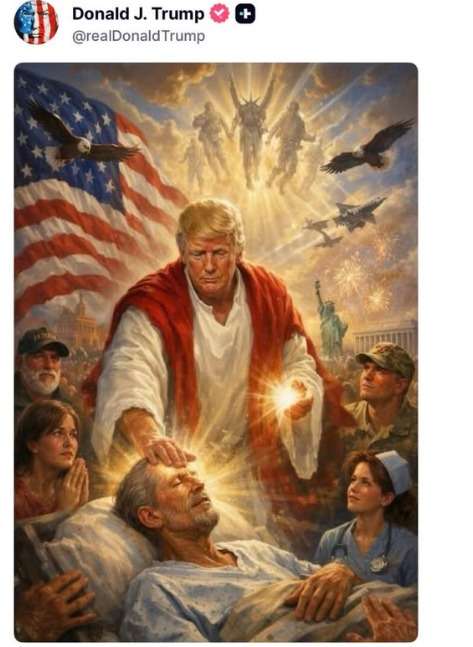
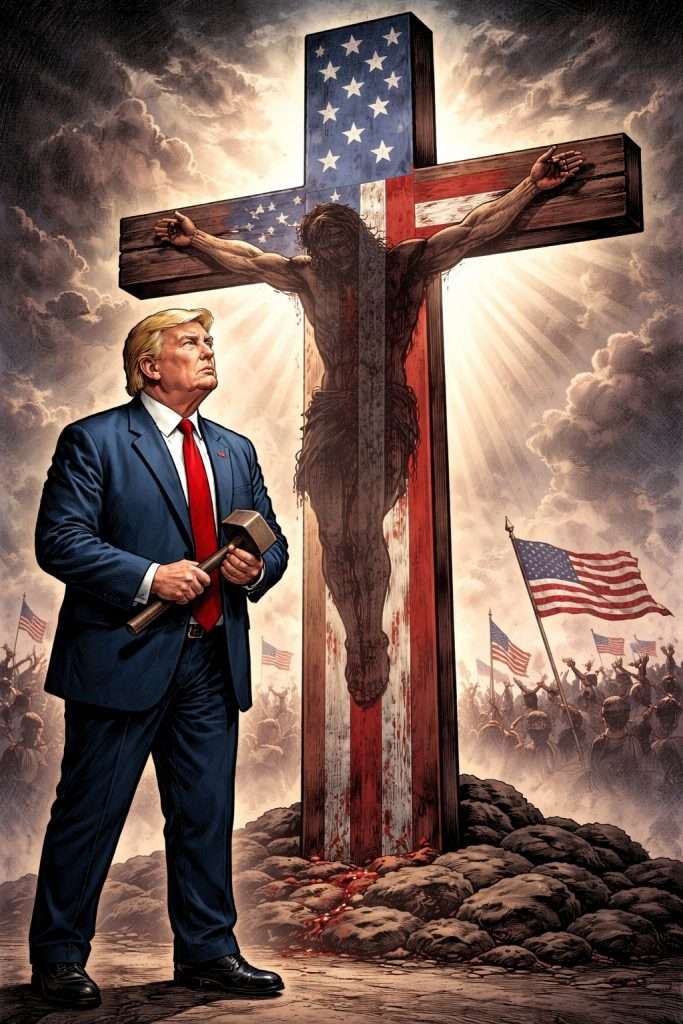
Images have always shaped human imagination, but when they draw upon sacred traditions, they carry a weight far beyond aesthetics. The image portraying Donald J. Trump in a Christ-like form—radiant, robed, and engaged in an act of healing—must therefore be approached not merely as digital art, but as a symbolic act with deep theological and cultural implications.
An important clarification must be made at the outset. The precise origin and intention behind this image remain uncertain. It may not have been created by Trump or his admirers; it is equally plausible that it emerged from critics, perhaps as a form of political or moral commentary, even as an expression shaped by opposition to war. There are also indications that a version of this image—depicting him in a healing posture—was at one point shared by Trump himself and later removed following criticism.
When questioned about it, Trump explained that he understood the image as portraying him as a doctor rather than as Jesus Christ. Even if this explanation is taken at face value, and even if the image was subsequently removed, the deeper concern does not entirely disappear. Once such imagery enters the public sphere, it begins to function independently of intention. Its meaning is shaped less by later clarification and more by the symbolic language it unmistakably employs.
That visual language draws directly from the iconography of Christ: the gesture of healing, the luminous aura, and the quiet authority of divine presence. Within Christian theology, however, Christ is not a symbol of worldly power or political triumph. He is understood as embodying humility, sacrifice, and radical moral accountability. The cross itself is not an emblem of dominance, but of suffering borne in truth.
At the same time, some viewers have suggested an alternative reading: that the image may not be one of glorification, but of inversion—where the symbolism points less to identification with Christ and more to a subtle critique of political power itself, even suggesting participation in the suffering that the cross represents. If this interpretation holds, the image functions not as devotion but as commentary. Yet whether read as admiration or critique, the symbolic field remains the same: sacred imagery is being used to frame political reality.
This concern, however, is not limited to any one individual; it applies more broadly to any situation in which sacred imagery is drawn into the sphere of political representation.
A deeper insight emerges when this is viewed through a comparative lens. In traditions shaped by Itihāsa and Purāṇa, figures such as Rama are revered across multiple retellings, reinterpretations, and devotional expressions. Even when such portrayals fall short of scriptural or ethical expectations, they are generally experienced as a wound to devotional sentiment rather than as a violation of theological finality. The sacred, in this framework, is expansive and accommodates plurality without collapsing into contradiction.
In the dharmic understanding, even when a devotee of Rāma fails to live according to dharma, that failure is not projected back onto Rāma himself. It is not said that Rāma is “exiled again” because of the devotee’s moral lapse. Responsibility remains entirely with the individual, and the consequence is understood as a decline of dharma in human conduct rather than as a re-enactment of a divine event.
A similar principle appears in relation to Shiva. In Purāṇic tradition, Shiva consumes the halāhala poison that emerges during the churning of the cosmic ocean in order to preserve the universe. That act is understood as complete and non-repeatable. A devotee’s failure in dharma does not symbolically compel Shiva to “drink the poison again.” The burden of disorder remains human, not divine. The ontological status of the deity remains unaffected.
By contrast, within Christian thought, the figure of Christ is singular, historically grounded, and theologically definitive, with the crucifixion standing at the center of its understanding of redemption. Within certain strands of Christian reflection, moral failure is sometimes expressed in deeply symbolic terms—not merely as deviation, but as participation in the pattern of Christ’s suffering. In this sense, failure to live according to His teachings has at times been described as “crucifying Him again,” not as a literal claim, but as a way of expressing the gravity of ethical contradiction.
Seen in this light, the image before us becomes deeply paradoxical. Whether interpreted as admiration, satire, or critique, it invokes a theological framework in which symbols are not neutral. When a public figure identifies with Christian faith yet acts in ways that are widely perceived to diverge from the spirit of Christ’s teachings, the tension is not merely one of inconsistency. Within the symbolic structure being invoked, such tension can take on a deeper moral and theological resonance.
In this sense, what was enacted on the Roman cross two millennia ago may be understood as finding a symbolic echo in the present—not in historical fact, but in moral and theological imagination. Some may even read this echo more pointedly, as a form of “Christ again crucified on a modern political cross,” at times associated in public perception with figures such as Donald J. Trump—not as a doctrinal assertion, but as a critical interpretation emerging from within the symbolic logic itself. The concern, therefore, is not simply that a political figure is depicted in Christ-like terms, but that the symbolism itself invites reflection on the distance between sacred ideal and human action.
This reading does not depend on the intention behind the image. Indeed, if the image originated as criticism, it reinforces rather than weakens this interpretation. What appears as glorification may in fact be exposure; what seems devotional may carry within it a deeper irony.
At the same time, humility must temper judgment. No individual fully embodies the ideals they profess, and this limitation belongs to the human condition itself. Yet this acknowledgment does not diminish responsibility—especially when sacred imagery is invoked in the public sphere, where it shapes collective perception.
The image also brings together religious symbolism with political imagination, suggesting a fusion of divine sanction with temporal authority. History repeatedly warns of the dangers inherent in such a fusion. When the sacred is used to legitimize power, it can dull moral scrutiny and elevate leadership beyond accountability.
Such reflections are offered with respect for the depth and sensitivity of Christian belief, recognizing that these symbols carry profound meaning for millions of faithful practitioners.
In conclusion, this image is not merely about one individual, nor only about one religious tradition. It reveals a deeper tension between symbol and reality, devotion and power, reverence and responsibility. In a dharmic framework, misrepresentation may wound sentiment; in a Christian framework, it may carry the weight of theological tension. To invoke Christ is to invoke not only His image, but His standard—and where that standard is not reflected in action, the image does not simply glorify, but reveals, with quiet clarity, the distance between what is shown and what is lived.
Chennai, April 13, 2026
Leave a Reply