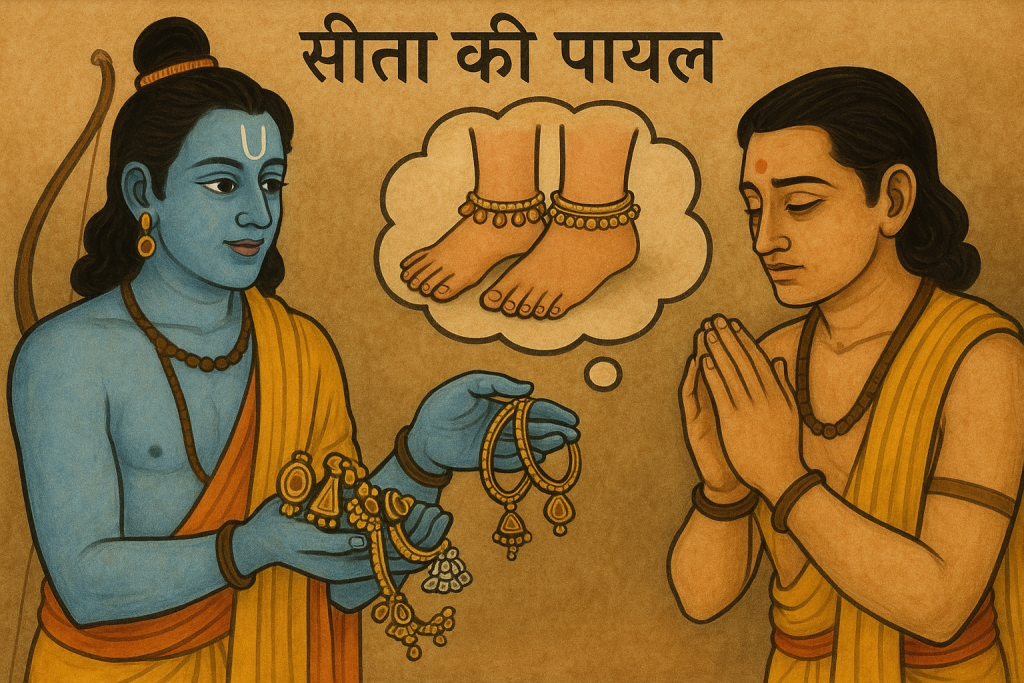
When Rama was searching for Sita after she was abducted by Ravana, he was accompanied by his brother Lakshmana. Along the way, they came across some of Sita’s ornaments scattered on the ground. As Rama picked up each item—her head ornament, earrings, nose ring, necklace—he anxiously showed them to Lakshmana and asked, “Aren’t these Sita’s?” Each time, Lakshmana replied, “I don’t know.”
But when Rama picked up her payal (anklet) and asked the same question, Lakshmana immediately answered, “Yes, indeed. This is hers.”
The moral of the story is that, during their years of exile, Lakshmana accompanied Rama and Sita as a guardian, always treating Sita with the utmost reverence. He had never once looked at her face or any other part of her body—only at her feet, as a mark of respect. Hence, he could recognize only her anklet.
It’s important to note that this story does not appear in Kambaramayanam or other major versions of the Ramayana—it is a folk tale. It was shared by the popular Tamil orator Srimati Bharati Baskar during her talk at the Kamban Kazhagam event in London.
What made her retelling especially powerful was how she linked it to the central theme of her talk: “Kamban Yennum Manudan”—Kamban, a True Human.
She also drew attention to another moving episode: when Lakshmana rushed to Rama after hearing him cry out for help while chasing the golden deer that Sita had desired. Before leaving, Lakshmana had refused to abandon Sita, warning her that the cry was likely a trick by the rakshasas. However, Sita harshly accused him of having ulterior motives and forced him to go. Later, after being abducted by Ravana, she deeply regretted her words, lamenting, “How could I speak that way to my son, Lakshmana?”
What Srimati Bharati Baskar emphasized is especially noteworthy. When Rama rebuked Lakshmana for leaving Sita alone—despite his explicit instructions—Lakshmana could have easily defended himself by recounting exactly what had happened. He could have told Rama, truthfully and without exaggeration, that it was Sita who compelled him to leave. But he didn’t. Not at that time, nor at any point in the future, did Lakshmana ever reveal what Sita had said to him.
This, Baskar noted, is where Kamban’s portrayal of Lakshmana differs significantly from other versions like Valmiki’s. In such situations, most people would feel justified in speaking the truth—even if it caused pain or further conflict. But Lakshmana chose silence, accepting Rama’s rebuke to preserve the sanctity of Rama and Sita’s relationship.
Through this, Kamban presents Lakshmana not just as a loyal brother, but as a deeply human character—one whose restraint, humility, and devotion serve as a model for us all.
Such stories of noble character and moral depth are found not only in Indian scriptures but in sacred literature around the world.
Ashram, May 1, 2025
सीता की पायल
जब राम, रावण द्वारा सीता के अपहरण के बाद उनकी खोज में लगे थे, तो उनके साथ उनके भाई लक्ष्मण भी थे। रास्ते में उन्हें ज़मीन पर सीता के कुछ गहने बिखरे हुए मिले। जैसे ही राम ने एक-एक कर उन गहनों को उठाया—उनका सिर का आभूषण, कान की बालियाँ, नथ, हार—उन्होंने व्याकुलता से लक्ष्मण को दिखाते हुए पूछा, “क्या ये सीता के नहीं हैं?” हर बार, लक्ष्मण ने जवाब दिया, “मुझे नहीं पता।”
लेकिन जब राम ने उनकी पायल उठाई और वही प्रश्न किया, तो लक्ष्मण ने तुरंत कहा, “हाँ, यह उनकी ही है।”
इस कथा का सार यह है कि वनवास के वर्षों में लक्ष्मण, राम और सीता के साथ एक रक्षक के रूप में रहे और उन्होंने सीता को हमेशा अत्यंत श्रद्धा से देखा। उन्होंने कभी उनके चेहरे या शरीर के किसी अन्य अंग की ओर दृष्टि नहीं डाली—सिर्फ उनके चरणों की ओर, सम्मान के चिन्हस्वरूप। इसलिए वे केवल उनकी पायल को पहचान सके।
यह ध्यान देना महत्वपूर्ण है कि यह कथा कंबरामायणम या रामायण के अन्य प्रमुख संस्करणों में नहीं मिलती—यह एक लोककथा है। इसे लोकप्रिय तमिल वक्ता श्रीमती भारती भास्कर ने लंदन में आयोजित कंबन कज़गम कार्यक्रम में अपने भाषण के दौरान साझा किया।
उनकी प्रस्तुति को विशेष रूप से प्रभावशाली बनाने वाली बात यह थी कि उन्होंने इसे अपने भाषण के मुख्य विषय “कंबन एन्नुम मनिदन”—“कंबन, एक सच्चा मनुष्य”—से जोड़ा।
उन्होंने एक और मार्मिक प्रसंग की ओर भी ध्यान आकर्षित किया: जब राम मृग का पीछा करते समय सहायता के लिए चिल्लाए और लक्ष्मण दौड़कर उनके पास पहुँचे। उस समय लक्ष्मण ने सीता को अकेला छोड़ने से इनकार कर दिया था और उन्हें चेतावनी दी थी कि यह राक्षसों की कोई चाल हो सकती है। लेकिन सीता ने कठोर शब्दों में उन पर अपमानजनक आरोप लगाए और उन्हें जबरन भेज दिया। बाद में, रावण द्वारा अपहरण के बाद, सीता ने गहरे पछतावे से कहा, “मैं अपने पुत्र लक्ष्मण से इस तरह कैसे बोल सकती थी?”
श्रीमती भास्कर ने जिस बात को विशेष रूप से रेखांकित किया, वह अत्यंत महत्वपूर्ण है। जब राम ने लक्ष्मण को डांटा कि उन्होंने सीता को अकेला क्यों छोड़ा, तो लक्ष्मण आसानी से अपने बचाव में सच बोल सकते थे। वे यह स्पष्ट रूप से कह सकते थे कि सीता ने ही उन्हें जाने के लिए विवश किया था। लेकिन उन्होंने ऐसा कभी नहीं किया—न उस समय, न ही भविष्य में कभी।
यहाँ पर कंबन की लक्ष्मण की प्रस्तुति अन्य संस्करणों, जैसे वाल्मीकि रामायण, से काफी भिन्न है। आमतौर पर लोग ऐसी परिस्थिति में सच बोलने को उचित समझते हैं—even अगर उससे दुःख या टकराव बढ़ जाए। लेकिन लक्ष्मण ने मौन को चुना—राम और सीता के रिश्ते की पवित्रता बनाए रखने के लिए।
इस प्रकार, कंबन लक्ष्मण को केवल एक निष्ठावान भाई के रूप में नहीं, बल्कि एक गहन रूप से मानवतावादी चरित्र के रूप में प्रस्तुत करते हैं—जिसकी संयम, विनम्रता और भक्ति हम सभी के लिए एक प्रेरणा है।
ऐसी महान चरित्रों की कहानियाँ और नैतिक गहराई न केवल भारतीय धर्मग्रंथों में, बल्कि विश्व के पवित्र साहित्य में भी मिलती हैं।
आश्रम, 1 मई 2025
Leave a Reply