Introduction
The idea of the “art of living” has become a popular expression in modern spiritual discourse, often associated with organized programs, institutional teachings, and structured methods of self-transformation. Yet within the broader Hindu civilizational context, the question of how one learns to live has never been confined to formalized settings alone.
Traditional Hindu thought has long emphasized the guru as an essential guide in the pursuit of spiritual knowledge, expressed in the well-known phrase acharyavan veda—“one who has a teacher knows.”¹ At the same time, this guru-disciple tradition has historically functioned within a much wider ecosystem of family, society, ritual life, and lived experience.
The modern expansion of guru-centered institutions raises new questions about how this ancient principle adapts to contemporary social realities.
From Guru Parampara to Modern Institutions
Guru traditions in India are extremely ancient and have historically served as the backbone of spiritual transmission. Figures such as Śaṅkara are traditionally credited with organizing monastic centers (mathas), which contributed to the institutional continuity of philosophical traditions.² Over time, these structures became models for later forms of organized spiritual communities.
In the modern period, however, guru traditions expanded beyond local and regional frameworks into large institutional and even global movements. Figures such as Sri Narayana Guru, Swaminarayan, Ramana Maharshi, and later movements such as the Chinmaya Mission illustrate this continuity as well as transformation. Alongside them, internationally visible figures such as Sathya Sai Baba, Mata Amritanandamayi, and Maharishi Mahesh Yogi further extended guru-centered spirituality into global contexts.
While these developments helped popularize meditation, yoga, and Indian spiritual concepts worldwide, they also introduced new questions about institutional scale, authority, and accessibility.
Institutionalization and Its Consequences
As guru movements expanded, they increasingly developed administrative structures, educational programs, and large-scale organizations. In some cases, this led to concerns about institutional complexity, financial management, and hierarchical authority.
Chaturvedi Badrinath observes that while guru traditions can preserve spiritual insight, they may also develop authoritarian tendencies when unquestioned authority becomes central.³ At the same time, he acknowledges that classical Indian philosophical traditions generally retained a role for reason and inquiry alongside scriptural authority.
Thus, the tension is not between spirituality and criticism, but between tradition as lived wisdom and tradition as institutional authority.
A Village Conversation: Learning in Everyday Life
These questions become clearer when viewed through lived experience.
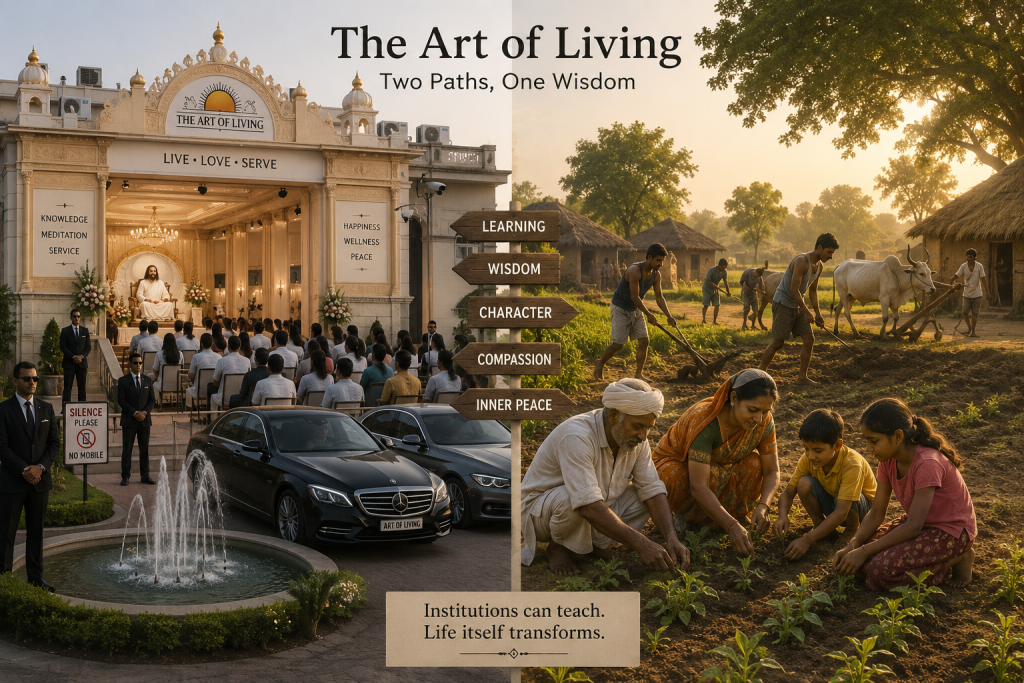
In a village in South India, a local headman, Sri Umapathy, once visited a well-known spiritual institution in a nearby city at the invitation of a friend. After returning, he spoke about being encouraged to send village youth to learn the “art of living” and manage modern stress and pressure.
When asked whether village youth—engaged in daily labor and responsibilities—would realistically attend such programs, he replied candidly:
“No. I went only because my friend insisted and paid for everything.”
When asked whether he could share these teachings with his own community, he said:
“No one would come to listen.”
And when asked about his own family, he laughed:
“They will say I have time to wander everywhere, but they do not have that luxury.”
The conversation revealed not rejection, but a structural question: how teachings designed in organized environments translate into everyday life-worlds.
Public Critiques and Reflections
Similar concerns have appeared in public discourse.
Dr. Dilip Joshi, responding to media portrayals of modern guru culture, questioned the commercialization of spiritual messaging and the gap between popular representation and lived understanding.⁴ His concern reflects a broader skepticism among sections of educated society regarding celebrity-driven spirituality.
Dr. U. S. Iyer similarly expressed unease about the institutional expansion of certain spiritual organizations, noting that administrative structures and financial accumulation sometimes overshadow the experiential or contemplative dimension of teaching.⁵
These voices do not reject spiritual traditions but raise questions about scale, mediation, and authenticity.
Globalization of Guru Traditions
The globalization of guru movements has added another dimension. Western interest in Indian spirituality has created a demand for structured programs, retreats, and institutional teachings. As Chaturvedi Badrinath notes, this has sometimes led to a commodification of spirituality, where demand itself shapes institutional supply.
At the same time, this global spread reflects genuine cross-cultural engagement and the universal appeal of meditative and contemplative practices.
The phenomenon is therefore mixed: expansion and simplification, transmission and commercialization, accessibility and distortion.
Learning Beyond Institutions
Despite the prominence of organized systems, much of traditional Indian understanding continues to locate learning within lived experience—family, social relations, responsibility, and everyday moral negotiation.
From this perspective, spiritual learning is not confined to institutional settings. It is embedded in the ongoing process of life itself.
This does not diminish the role of gurus or institutions but situates them within a broader ecology of learning.
Conclusion
Guru-centered spirituality in modern India represents a complex continuity of an ancient tradition adapting to new conditions.
On one hand, it preserves and disseminates practices of meditation, devotion, and ethical living across cultural boundaries. On the other hand, it raises questions about institutionalization, accessibility, authority, and commercialization.
The village conversation with Umapathy illustrates one dimension of this complexity: the gap between structured spiritual instruction and everyday life-worlds. Public critiques by figures such as Joshi and Iyer highlight another: concerns about institutional scale and credibility.
Ultimately, the question is not whether spiritual learning should be institutional or informal, but how both dimensions can remain in productive balance.
In the broader Hindu civilizational context, the guru tradition has never been merely an institution. It has been a way of transmitting meaning across generations, embedded within life itself. The challenge of the present is to preserve this depth while navigating the structures of modern organization.
Ashram, May 24, 2026
Footnotes
- Acharyavan veda is associated with the Upanishadic tradition emphasizing the necessity of a teacher in spiritual knowledge.
- Encyclopaedia of Religion and Ethics, 2:907.
- Chaturvedi Badrinath, Dharma, India and the World Order (1993), 47.
- Dr. Dilip Joshi, letter in India Today, Nov. 26, 2001, 8.
- Dr. U. S. Iyer, letter in India Today, Nov. 26, 2001, 8.
Leave a Reply