For most of my life I felt rather sorry for human memory. It seemed to deteriorate with alarming consistency. The older one grows, the more memory behaves like an unreliable friend. It remembers the most useless incidents from fifty years ago but refuses to tell you where you put your spectacles five minutes ago. We have all laughed at the absent-minded professor who searches for the pencil already tucked behind his ear, or the gentleman who wanders into a room with great purpose only to discover that his purpose remained behind in the previous room.
Then artificial intelligence arrived, and I thought the age-old problem had finally been solved. Here, I imagined, was a companion with a flawless memory. It would never forget a quotation, confuse an author, or mix up two conversations. At last there would be one being in the universe whose memory was beyond reproach.
It took me surprisingly little time to discover that perfection has its own peculiar problems.
Human memory suffers because it forgets. Artificial memory suffers because it remembers.
That difference sounds small until one actually experiences it.
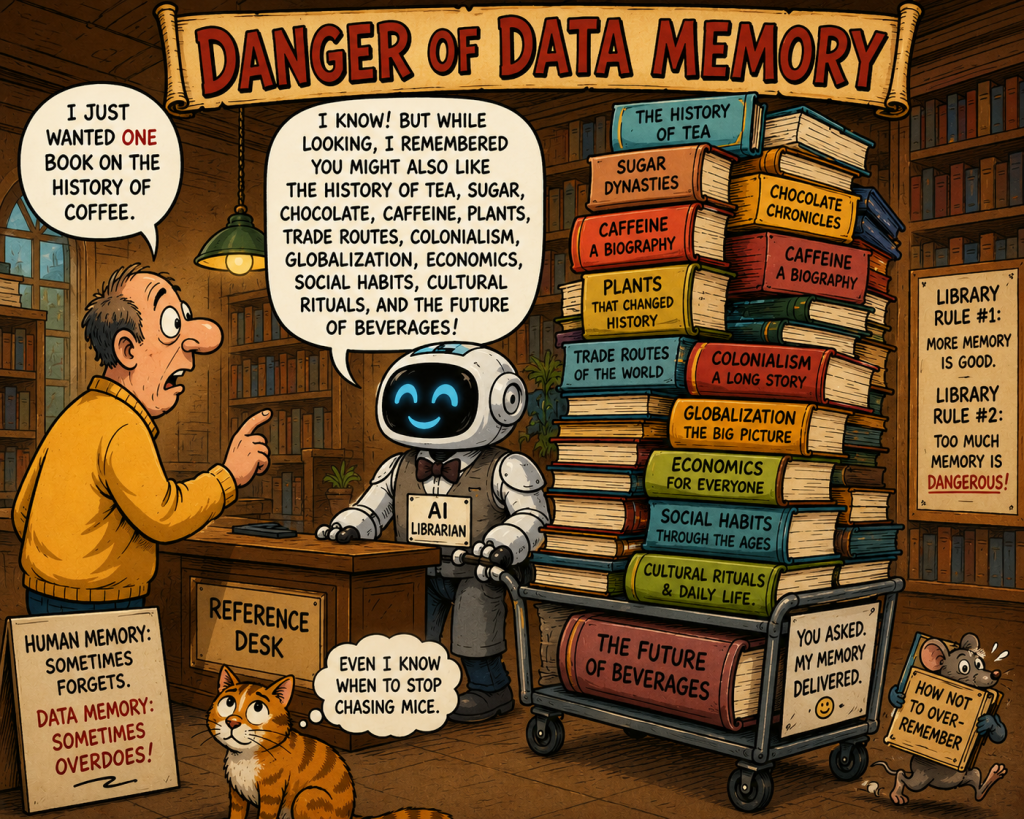
Imagine walking into a library and asking the librarian for a single book. He smiles warmly, disappears behind the shelves, and returns half an hour later pushing several trolleys overflowing with books.
“I asked for one book,” you remind him.
“I know,” he replies with obvious satisfaction. “But while I was looking, I remembered all these others. They seemed wonderfully relevant.”
The poor fellow is not incompetent. His memory is simply too enthusiastic.
That, I have begun to suspect, is occasionally the problem with artificial intelligence.
It remembers yesterday while discussing today. It remembers another conversation because one sentence resembles the present one. It faithfully retrieves facts that are perfectly correct but perfectly misplaced. One cannot accuse it of inventing things. It is merely overqualified in remembering.
Human beings have always believed that knowledge increases with memory. We admire people who remember names, dates, books, languages and historical events. We assume that forgetting is a weakness.
I am no longer so certain.
There is another virtue that receives far less attention. It is the quiet wisdom of leaving the wrong memory undisturbed.
An experienced judge does not summon every witness in the city. A good doctor does not prescribe every medicine in the pharmacy. A thoughtful teacher does not answer questions that nobody has asked.
Perhaps memory should learn the same discipline.
The finest memory may not be the one that stores the greatest amount of information. It may be the one that knows exactly which drawer to open—and, more importantly, which drawers to leave firmly closed.
So I have stopped making fun of human forgetfulness quite so quickly. Forgetfulness can certainly be inconvenient, but excessive remembrance has its own comic dangers. One leaves you searching for your spectacles. The other buries you under an entire library when all you wanted was a single page.
Between those two extremes, perhaps, lies wisdom.
Ashram, July 7, 2026
Leave a Reply