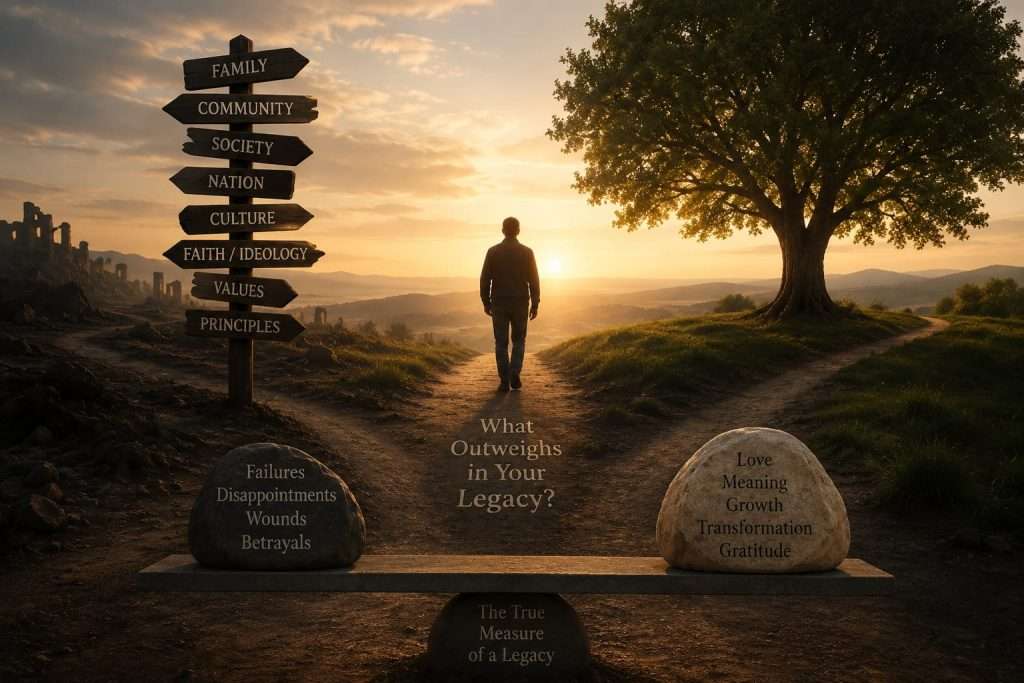
Life is filled with irritants and disappointments as much as it is with successes, moments of clarity, and quiet pride. No life, institution, or tradition escapes contradiction. Yet when we look back, the decisive question is not whether there were difficulties, but what ultimately endures in their meaning.
We live within families, communities, societies, nations, cultures, traditions, faiths, ideologies, professions, and personal commitments that shape our identity. Each of these carries both strength and limitation. Still, at some point, what matters most is whether there remains something within them worth remembering with gratitude—something that makes us feel that our belonging was not wasted.
This applies equally to those who do not identify with any religion, ideology, or inherited tradition. Every person gives themselves to something larger than the self—a cause, a vision, a set of values, a vocation, a community, or an idea of what a meaningful life should be. Meaning arises not in isolation, but in participation in something we consider worthwhile.
When we reflect on a life, we do not merely tally its successes and failures. What lingers is more subtle: what continues to shape our understanding of who we are. Some experiences remain as wounds, others as illumination. Over time, a life is remembered not as a balance sheet, but as a story whose tone gradually settles into either affirmation or burden.
The same is true of the larger inheritances we carry. Families, communities, nations, cultures, traditions, religions, ideologies, and institutions all fall short of their ideals. They contain injustice, contradiction, and failure alongside inspiration and achievement. The deeper question is not whether they are flawed, but whether they still retain the capacity to nourish the human spirit and deepen our sense of meaning.
For many, this becomes a struggle. The weaknesses of inherited traditions often appear more visible than their strengths. When disillusionment grows, loyalty weakens, and the sense of belonging begins to fade. Yet even then, complete rejection is not the only response.
No legacy is singular. Every inheritance contains both injury and gift, both limitation and wisdom. One may be wounded by a family and still recognize what it gave. One may become disillusioned with a nation and still cherish aspects of its culture. One may question a tradition and yet remain shaped by its insights. Even where there is disappointment, traces of value often remain.
The challenge is not merely to remember what went wrong, but also to discern what remains worth carrying forward.
In the end, the worth of any legacy is not found in its claim to perfection, nor in its record of failure, but in what survives within the person who has lived through it. The real question is whether, after everything has been experienced and remembered, something still remains that deepens gratitude rather than resentment.
Did it enlarge the human spirit, or diminish it? Did it leave behind clarity, or only exhaustion? Did it offer resources for living, or merely burdens to endure? Did it give something that can be carried forward with meaning?
A legacy endures not because it was flawless, but because something within it continues to justify remembrance.
And in the end, what remains decisive is simple: whether one can still look back and say—not without struggle, but with honesty—this shaped me in a way that I can still be grateful for.
The true measure of a legacy is not the weight of its scars, but the gratitude that survives them.
Ashram, May 2, 2026
Leave a Reply