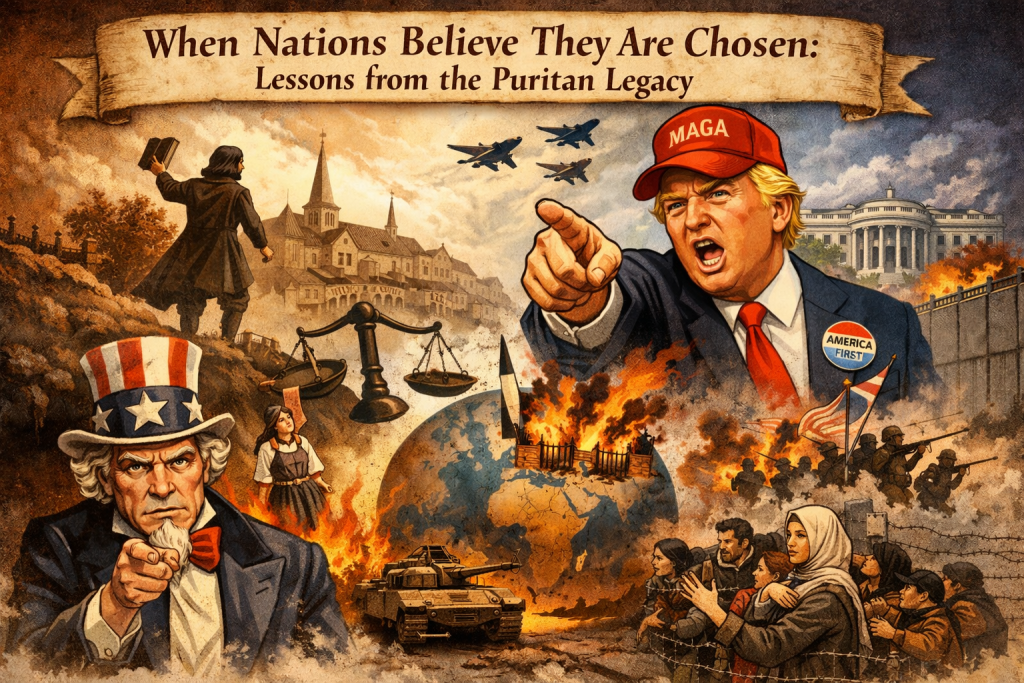
Without understanding the past, we cannot understand the present. That is true for every nation. But it becomes especially urgent when a nation begins to act with moral certainty — when its leaders speak as if history has entrusted them with a sacred role.
The story of the Puritans is not merely a chapter in American history. It is a warning written in the language of faith, power, and conviction.
The video opens at Proctor’s Ledge, where nineteen people were hanged in 1692. Their crime was not violence, nor treason, but deviation — deviation from a rigid moral and theological order (0:00–4:12). The Puritans believed they were building a godly society. They believed they were bound by covenant with God. They believed they were chosen.
That belief gave them extraordinary courage.
In England, they sought to “purify” the Church beyond Elizabeth’s settlement (4:12–16:50). When reform failed, some crossed the Atlantic. John Winthrop envisioned Massachusetts as a “city upon a hill” (21:10–26:25), a model community watched by the world. It would succeed through covenant faithfulness or fail through divine judgment.
This sense of chosenness was not empty rhetoric. It built institutions. Harvard was founded in 1636 (1:00:07). Democratic practices such as town meetings and written covenants took root (1:00:10). Literacy rates rose. Work was dignified. Education was sacred. A society emerged that combined discipline, learning, and communal responsibility.
But the same conviction that built schools also built gallows.
When dissenters like Roger Williams and Anne Hutchinson challenged theological authority, they were banished (30:57–38:58). When fear gripped Salem, spectral evidence was accepted as legal proof (38:58–46:50). Nineteen were executed. Giles Corey was pressed to death. The society that aimed to reflect divine order revealed something darker: certainty without humility.
The video later reflects on this dual legacy — democratic institutions alongside witch trials, education alongside intolerance (1:00:07–1:18:02). The most haunting insight appears near the conclusion:
“Understanding how good people convince themselves to do evil things.” (1:11:52)
The Puritans were not monsters. They were disciplined, devout, intellectually serious people who believed they were building God’s kingdom. Their tragedy was not hypocrisy. It was confidence — absolute confidence that they were right.
And here lies the contemporary relevance.
The metaphor of the “city on a hill” did not disappear with Puritanism. Centuries later, it resurfaced in political speech. The belief that America has a special mission — that it stands apart, watched by the world — echoes Winthrop’s sermon (1:05:12). The theology faded; the exceptionalism endured.
When nations believe they are chosen, several things happen:
- Moral language becomes political language.
- National interest becomes moral necessity.
- Opponents become enemies of righteousness.
This does not apply only to America. It applies to any state where religious doctrine or ideological certainty guides domestic and foreign policy. Whether the banner is theological, nationalist, or revolutionary, the pattern is the same. Conviction merges with authority. Dissent becomes disloyalty. Policy becomes sacred duty.
The danger is not religion itself. The danger is conviction without humility.
The Puritans believed they were accountable to God. Yet they failed to question their own judgments. They crossed an ocean in pursuit of freedom, but denied freedom to those who disagreed. They built a covenant community and called it holy. They hanged nineteen people to preserve it.
The lesson is not that faith corrupts. It is that power sanctified by certainty resists self-critique.
In our own time, political rhetoric often carries moral absolutism. Leaders speak of destiny, of divine favor, of national greatness ordained by history. When such language shapes foreign policy, wars can be framed as moral crusades. When it shapes domestic policy, dissent can be painted as betrayal.
The Salem tragedy shows how easily a society can move from moral aspiration to moral coercion. It reminds us that:
- Most people conform.
- Most people trust authority.
- Most people participate because standing alone is costly.
The Puritan legacy is therefore double-edged (1:00:07–1:18:02). It gave America educational institutions, democratic habits, and a strong work ethic. It also left a pattern of moral intensity that can harden into self-righteousness.
When the video closes at Proctor’s Ledge, the memorial stones bear only names and dates (0:00–4:12). They do not explain. They do not justify. They simply remember.
That silence is instructive.
Every nation must ask:
What are we building?
Who are we serving?
And when we are certain we are right, how do we know we are not about to do something terrible in the name of righteousness?
History does not single out one country for judgment. It offers a mirror to all.
When nations believe they are chosen, they may achieve greatness. They may build universities, laws, and thriving communities. But if humility does not accompany conviction, the hill that shines can also cast a long shadow.
The Puritans built a city on a hill. The world watched. It still watches.
The question is whether we have learned from what they built — and from what they destroyed.
Ashram, February 13, 2026
Leave a Reply